


The fastest way to improve channel program performance is to recruit fewer, higher-fit partners and guarantee each one a short path to first value. That means building an Ideal Partner Profile before you source a single prospect, then designing a 45-day activation plan around it. Your next move is simple: draft the IPP checklist and one activation play, then test both on a small pilot cohort before you scale outreach.
TL;DR:
- Score prospects against five Ideal Partner Profile criteria, including customer overlap and delivery capacity, and require at least four passes before scheduling outreach.
- Prioritize curated networks and account mapping over open forms: PartnerStack found curated network partners are 14 times more likely to generate revenue.
- Plan around the typical 45 to 50 days to first sale, with a direct call on day 20 if a partner shows no engagement.
- Match onboarding and incentives to partner economics: affiliates need quick payouts, agencies value co marketing, and resellers need margins that cover delivery costs.
- Crossbeam reports an average 11.7% win rate lift on partner involved deals, rising to 58.6% among teams with heavy partner tool adoption.
Table of Contents
- What channel partner recruitment really means and why it matters
- Building an ideal partner profile and using it as your recruitment filter
- Where to find partners who already match your profile
- Designing outreach and campaigns that turn prospects into signed partners
- Vetting partners fast without letting weak fits onto the roster
- The 45-day activation playbook that gets partners to first revenue
- Metrics that tell you whether recruitment is actually working
- [How our 90-day channel sales strategy operationalizes this playbook](#how-our-90-day-channel-sales-strategyhttpsblogchadburmeistercomblogchannel-sales-strategy-operationalizes-this-playbook)
- Incentives and compensation shapes that support activation
- Legal and contractual considerations in channel partner recruitment
- Tools and technologies to streamline partner recruitment and management
- Common challenges in channel partner recruitment and how to overcome them
- Three priority actions worth your time this quarter
- Where to go next if you want this built for you
- FAQ
- Sources
What channel partner recruitment really means and why it matters
Channel partner recruitment is the process of identifying, qualifying, and signing third-party businesses (resellers, agencies, affiliates, technology integrators) that sell or extend your product into markets you cannot reach alone. Done well, it is closer to hiring than marketing: you are screening for fit, not chasing sign-up counts.
The return on getting this right is measurable. Involving partners in deals lifts win rates by an average of 11.7%, and companies with heavy sales-seat adoption in partner tools see win-rate lifts as high as 58.6% on partner-involved deals, according to Crossbeam’s ecosystem data. Recruitment quality drives that lift. A partner with no customer overlap or no real capability to sell your product will not move those numbers no matter how many you sign.
This is also where most programs confuse two separate problems:
- Recruitment is getting the right partner to sign the agreement.
- Activation is getting that partner to their first sale.
A program can recruit aggressively and still stall if it never solves activation. We treat the two as connected stages of one system, not as separate initiatives competing for budget.
Building an ideal partner profile and using it as your recruitment filter
Forrester frames the Ideal Partner Profile as a job description for partners: a specific, written standard you measure every prospect against, rather than an open invitation anyone can accept. Programs that use one are more selective and see fewer dead-weight partners on the roster, according to Forrester’s channel sales guidance.
A usable IPP covers five attributes:
- Customer overlap: does the partner already serve the accounts you want to reach?
- GTM fit: do their sales motion and buyer journey match how your product gets bought?
- Technical or service capability: can they actually implement, integrate, or service what you sell?
- Margin model: does your commission or markup structure make sense inside their existing business?
- Vertical and geography fit: do they operate where you need coverage, in the industries you serve?
Turn each attribute into a yes-or-no check with a minimum threshold, not a vague impression. “Has at least 20 active clients in our target vertical” is checkable; “seems like a good fit” is not. Score each prospect across the five dimensions and set a floor, for example four out of five checks passed, before anyone moves to outreach.
A mid-market software company targeting healthcare IT distributors, for instance, might require existing HIPAA-compliant implementation experience and at least one existing vendor relationship in the same category. Prospects that fail either check get filtered out before a single call is scheduled.
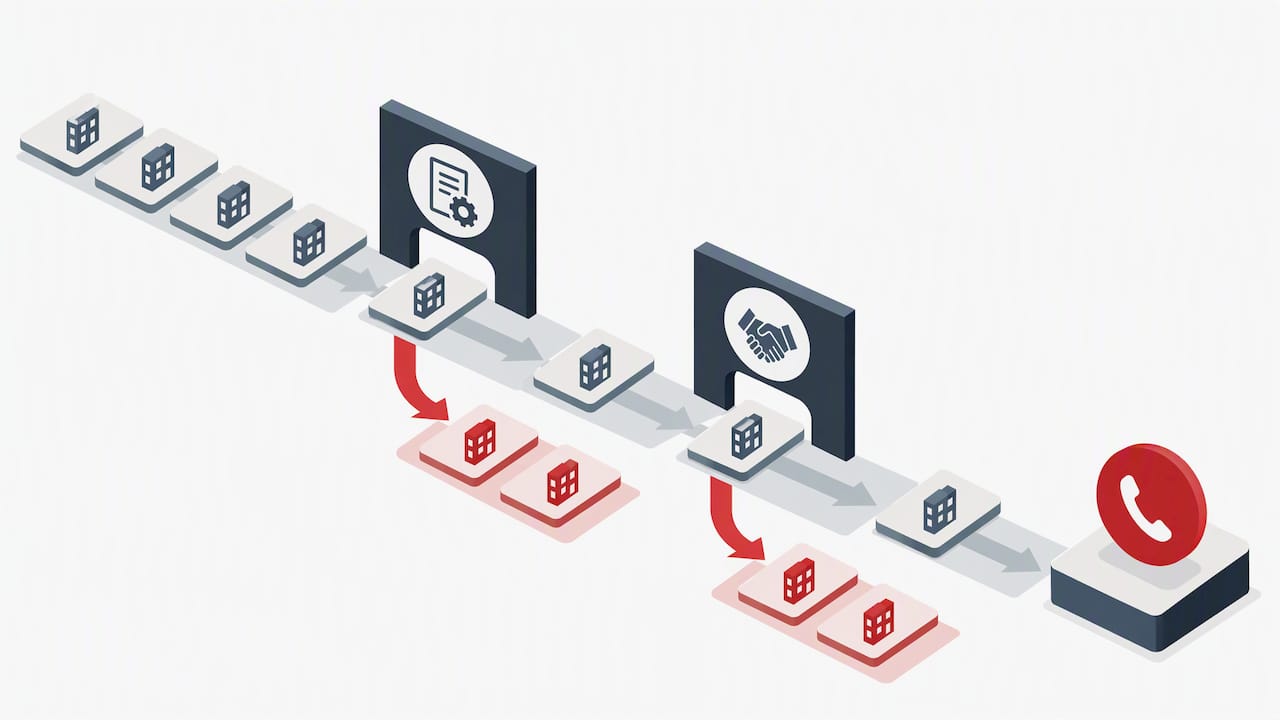
Pro Tip: Write your IPP as a one-page scorecard your whole team can use consistently, not as a paragraph of criteria open to interpretation.
Where to find partners who already match your profile
Once the IPP exists, sourcing becomes a search problem, not a numbers problem. The highest-yield sources are rarely open web forms.
- Curated partner networks and marketplaces that pre-qualify businesses by category and activity level.
- Account-mapping platforms that reveal which potential partners already share customers with you.
- Vendor ecosystems adjacent to your product, where complementary tools often share buyers.
- Vertical trade events and conferences where your target partner type already gathers.
- Industry forums and communities where your ideal partner type is active and visible.
Network data backs the shift away from open recruitment. PartnerStack research found that partners sourced through curated networks are 14 times more likely to generate revenue than partners who join through a generic sign-up form, and many engaged partners activate within ten days of joining, according to PartnerStack’s 2026 research. Account-mapping and active discovery outperform passive forms because they start with partners who already have relevant customer overlap, which is the first filter in your IPP anyway.
Build a prioritized outreach list using triggers that signal readiness: a partner just added a complementary product line, posted about a gap in their service offering, or recently lost a competitive deal to a company you could help them beat. Rank prospects by how many IPP checks they clear, then work the list top-down instead of blasting everyone at once.
Designing outreach and campaigns that turn prospects into signed partners
Messaging that leads with your product’s features rarely moves a prospective partner. Messaging that leads with their economics does. Open with what they earn, how fast they earn it, and how little lift it takes to start, because that is the question every partner is actually asking.
A repeatable cadence looks like this:
- Initial email: subject line built around partner economics (“Add $X in revenue without adding headcount”), with a specific commission structure or margin model in the first two lines.
- LinkedIn touch: a short, personal note referencing something specific about their business, sent two to three days after the email, not a templated connection request.
- Pilot invitation: a direct offer to join a small, time-boxed pilot cohort rather than a full program commitment, which lowers the barrier for a partner still evaluating fit.
- Follow-up with proof: a brief case example or expected first-value timeline, sent about a week later if there has been no response.
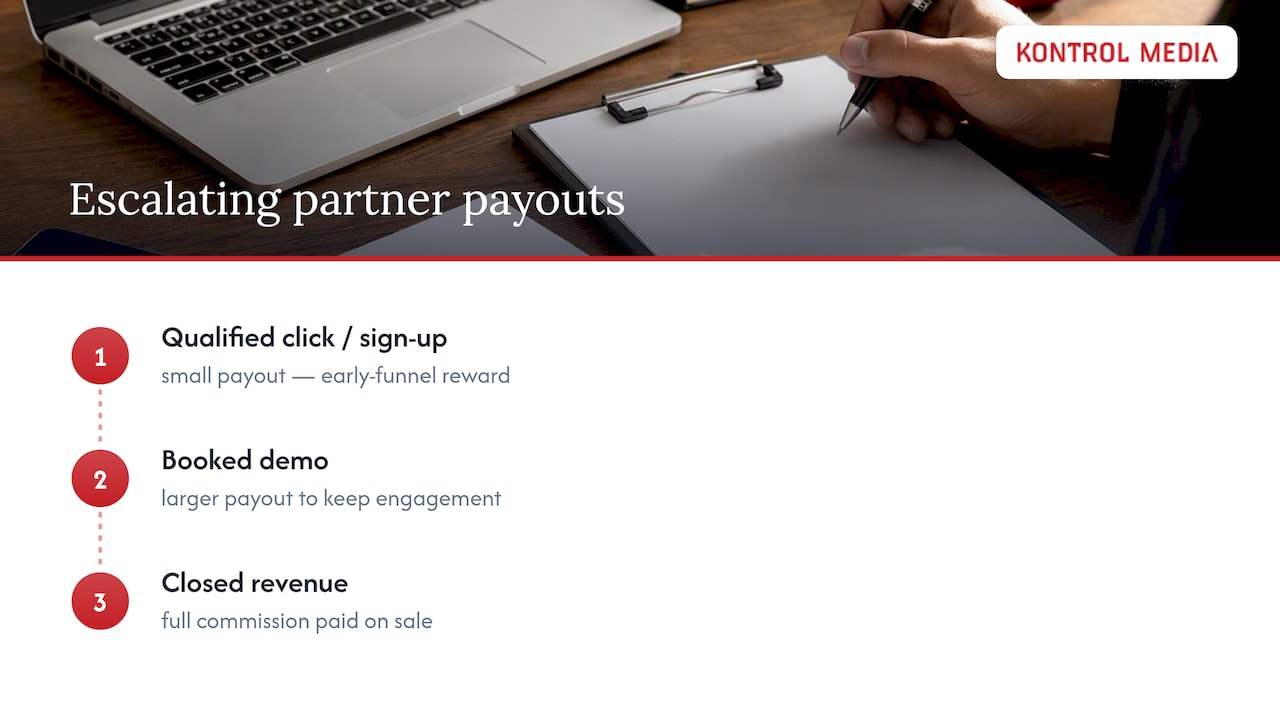
Early-funnel incentives accelerate everything downstream. Paying partners for early-stage actions such as a qualified click, a completed sign-up, or a booked demo, rather than waiting until the first closed sale, shortens the emotional distance between joining and earning. Programs that pay for these early signals see stronger long-term engagement and retention than programs that rely on commission alone, according to PartnerStack’s activation research. Commission rate matters less than most teams assume. Clarity and a visible path to revenue matter more.
Vetting partners fast without letting weak fits onto the roster
Speed and rigor are not opposites here. A four-stage flow keeps both intact.
- Fit check: run the prospect against your IPP scorecard before any conversation happens.
- Pilot commitment: ask for a specific, time-boxed commitment (a set number of introductions or a defined campaign) rather than a vague agreement to “partner up.”
- Capability verification: confirm technical or service capacity with a short reference call or a sample deliverable.
- Contract terms: finalize scope, commission structure, and exclusivity terms only after the first three stages pass.
Watch for concrete red flags: no case studies or reference clients in your category, integration or service gaps that would slow delivery, or an existing relationship with a direct competitor that creates conflict. Any one of these should pause the process, not just raise a question.
Where possible, build the IPP scorecard and the pilot-commitment tracking directly into your CRM or partner portal so scoring happens automatically as prospects move through the pipeline, rather than living in a spreadsheet someone forgets to update.
The 45-day activation playbook that gets partners to first revenue
Recruiting the right partner is only half the job. The average partner takes 45 to 50 days to close their first sale, and programs that compress that window with early incentives see materially better long-term retention, according to PartnerStack’s partner activation research. A structured 45-day plan turns that window into a managed process instead of a waiting game.
- Days 0 to 7: contract signed, portal access granted, welcome call completed, and the partner’s first marketing or referral asset delivered.
- Days 8 to 15: first outreach or campaign launched on the partner’s side, with your team checking in on early engagement signals like link clicks or demo requests.
- Days 16 to 30: first qualified lead or introduction logged; early-funnel incentive paid if your program includes one.
- Days 31 to 45: first sale closed or, if it has not happened yet, a direct diagnostic call to identify what is blocking the final step.
Onboarding assets should differ by partner type. An affiliate needs fast, frictionless payout mechanics and ready-made creative. An agency needs lead-generation support or co-marketing material. A reseller needs deeper technical enablement and sales collateral built for their own sales team. Treating all three the same is one of the most common reasons activation stalls, according to PartnerStack’s findings on partner segmentation.
Statistic Callout: Average time to first partner sale runs 45 to 50 days, which makes it the single most useful benchmark for staging your own activation plan.
Pro Tip: If a partner has not logged any engagement by day 20, call them directly instead of waiting for the automated check-in email to work.
When early signals lag, change the incentive timing before you change the partner. Paying for a click or a booked demo instead of waiting for a closed deal often unlocks movement that a reminder email never will.
Metrics that tell you whether recruitment is actually working
A handful of KPIs separate a healthy recruitment motion from one that is quietly accumulating inactive names.
- Activation rate: the share of recruited partners who reach a defined first milestone, ideally within the 45 to 50 day window.
- Time-to-first-sale: how long it takes a signed partner to close their first deal.
- Partner-generated pipeline: the dollar value of opportunities partners bring into your funnel.
- Engaged partner ratio: the share of your roster that is actively selling versus sitting dormant.
- Win-rate lift: the difference in close rate on deals that involve a partner versus deals that do not.
That last metric is where the business case gets concrete. Deals involving partners close at an average win-rate lift of 11.7%, with heavy adopters of partner tooling seeing lifts up to 58.6%, according to Crossbeam’s ecosystem research.
Statistic Callout: Partners sourced through curated networks are 14 times more likely to generate revenue than those from open sign-up forms, which is a strong argument for instrumenting source quality alongside activation rate.
Instrument these metrics across your CRM, your partner portal, and an account-mapping tool if you use one, so recruitment quality and activation speed show up on the same dashboard instead of living in three disconnected systems.
How our 90-day channel sales strategy operationalizes this playbook
We built our channel partner work around the same lifecycle this article walks through, compressed into a 90-day engagement with four KPIs tracked from day one: activation rate, time-to-first-sale, partner-generated pipeline, and win-rate lift.
- We start with a small, deliberately limited pilot cohort rather than a broad recruitment push, so the IPP and activation plan get tested and corrected before scaling.
- We handle outreach, vetting, and onboarding execution directly, which means internal teams are not stretched across campaign management on top of their existing workload.
- We apply the same approach across different channel types, including our real estate agent partnership work and broader media partnership programs.
Full detail on the structure, including how the four KPIs get tracked week by week, is laid out in our 90-day channel partner strategy.
Incentives and compensation shapes that support activation
Commission rate is the detail most programs obsess over and the one that moves activation least. What moves activation is when a partner gets paid relative to the work they just did.
A tiered structure that pays a small amount for a qualified click or sign-up, a larger amount at a booked demo, and the full commission at closed revenue keeps partners engaged through the slow middle stretch where many programs lose people. This early-funnel approach is specifically tied to stronger long-term retention and engagement, according to PartnerStack’s activation findings.
Compensation shape should also match partner type. Affiliates respond best to fast, frequent, low-friction payouts since their business model depends on volume and speed. Agencies often value co-marketing funds or lead-sharing arrangements as much as straight commission, since their revenue comes from client relationships rather than product resale. Resellers and technology integrators typically need margin structures that make sense against their own cost of delivery, which means your margin model has to leave room for their implementation or service costs, not just your own.
Avoid a single flat commission rate applied uniformly across every partner type. It simplifies administration but ignores the actual economics each partner type operates under, which is exactly the kind of mismatch that stalls activation before it starts.
Legal and contractual considerations in channel partner recruitment
A signed agreement should lock in the specifics that prevent disputes later, not just formalize the relationship in general terms. At minimum, a channel partner contract should define scope of authority (what the partner can represent or sell on your behalf), territory or vertical exclusivity if any is granted, commission structure and payment timing, confidentiality and data handling obligations, and termination conditions on both sides.
Exclusivity deserves particular care. Granting a partner exclusive rights to a territory or vertical can accelerate their commitment, but it also limits your flexibility to recruit additional partners if that one underperforms. Many programs use time-limited exclusivity tied to performance minimums, so the arrangement expires or adjusts if the partner does not hit agreed milestones.
Data handling terms matter more as partner programs increasingly involve shared customer information through account-mapping tools. Specify what customer data a partner can access, how it can be used, and what happens to it if the relationship ends.
None of this replaces legal counsel review specific to your industry and jurisdiction. Contract terms that work for a software reseller agreement will not necessarily hold up for a real estate or financial services partnership, where additional licensing or disclosure rules may apply. Treat the structure above as a starting checklist, not a finished agreement.
Tools and technologies to streamline partner recruitment and management
A partner relationship management platform or partner portal is the backbone most programs build around, handling onboarding workflows, asset distribution, and commission tracking in one place. Account-mapping tools add a different layer entirely: they surface which prospects already share customers with you, which turns cold outreach into warm introductions.
CRM integration matters as much as the standalone tools. Partner activity needs to flow into the same system your sales team already works in, so a partner-sourced lead gets tracked with the same visibility as a direct one. Without that integration, partner pipeline tends to disappear into a separate spreadsheet nobody reconciles against actual revenue.
For teams building these workflows for the first time, Salesforce’s Trailhead module on channel partner recruitment walks through practical checklists for recruiting, onboarding, and adoption planning that pair well with the lifecycle described here.
The point of any tool stack is to make the IPP scoring, activation tracking, and KPI dashboard described earlier run automatically instead of manually. A program tracking activation rate and time-to-first-sale in a spreadsheet updated monthly is always working from stale information compared to one with live visibility into partner engagement.
Common challenges in channel partner recruitment and how to overcome them
The most common failure mode is chasing partner count instead of partner fit, a pattern Forrester’s channel research identifies as the single biggest reason recruitment initiatives underperform. The fix is the IPP itself: a documented standard that makes “no” an acceptable answer to a prospect who does not clear the bar, according to Forrester’s channel sales guidance.
A second common problem is one-size-fits-all onboarding applied across affiliates, agencies, and resellers who operate on fundamentally different business models. Segmenting onboarding assets and incentive timing by partner type, as covered earlier, solves most of this.
A third challenge shows up internally rather than externally: sales and partner teams working from misaligned incentives, where sales reps see partner-sourced deals as a threat to their own commission rather than an accelerant. Addressing this requires clear deal-registration rules and leadership that treats partner-sourced pipeline as additive, not competitive.
Finally, many programs underinvest in discovery and assume partners will self-identify through an open application form. Active outreach and account-mapping consistently outperform passive recruitment, which is why the sourcing tactics covered earlier matter as much as the vetting process that follows them.
Three priority actions worth your time this quarter
If I had to compress this entire playbook into what actually moves a program forward, it comes down to three moves: build the IPP before you source anyone, run a small pilot cohort before scaling outreach, and instrument activation metrics from day one instead of retrofitting them after the roster grows.
The mistake I see most often is chasing partner count as a vanity metric, which produces a roster full of names and almost no revenue. A close second is applying identical onboarding to partners with completely different business models, which quietly kills activation before it starts. And internally, sales and partner teams pulling in different directions, one chasing quota and the other chasing sign-ups, undermines both.
Align those two teams around the same activation number, and recruitment stops being a counting exercise and starts being a revenue lever.
— Mark Kapczynski
Where to go next if you want this built for you
We built our channel partner work specifically for leaders who have read a playbook like this one and want it executed, not theorized. Our approach centers on the same IPP-first, activation-focused structure covered above, run as a hands-on engagement rather than a framework you implement alone.
- We run a small, deliberately limited pilot cohort first, so your IPP and activation plan get validated before you commit to scale.
- We track the same four KPIs covered in this article (activation rate, time-to-first-sale, partner-generated pipeline, and win-rate lift) from the first week of the engagement.
- We apply this structure across channel types, from real estate agent partnerships to broader media and retail partnership programs.
If a 90-day, measurable channel partner build fits where your program is right now, our channel partner strategy page walks through the structure in full, and our services overview covers how an engagement starts.
FAQ
What is the salary of a channel partner?
Channel partners are not salaried employees; they are independent businesses compensated through commission, margin on resale, or referral fees tied to the revenue they generate. Compensation structure varies widely by partner type and industry, so there is no single salary figure that applies across programs.
How much does a channel partner cost?
There is no fixed cost to recruit a channel partner; the real cost comes from the commission, margin share, or incentive payments built into your compensation model. Programs that pay for early-funnel actions such as clicks or demos, rather than waiting for closed revenue, spend modestly upfront in exchange for faster activation, according to PartnerStack’s activation research.
What are the three types of channel partners?
The three most common categories are resellers, who buy and resell your product directly; affiliates, who refer customers in exchange for a commission on resulting sales; and agencies or system integrators, who implement, service, or build around your product for their own clients. Each type needs a different onboarding and incentive approach to activate successfully.
How do channel partners get paid?
Channel partners are typically paid through a commission on closed revenue, a margin built into a resale price, or a flat referral fee per qualified lead or sale. Programs increasingly pay smaller amounts for earlier-funnel actions like sign-ups or booked demos as well, since this structure is tied to stronger long-term partner engagement, according to PartnerStack’s findings.
What should I check before choosing a channel partner recruitment approach?
Look for an approach that filters for fit before volume, using a documented Ideal Partner Profile rather than open sign-up forms, since curated and account-mapped sourcing produces partners far more likely to generate revenue, according to PartnerStack’s research. Also confirm the approach includes a defined activation timeline, since the first 45 to 50 days determine whether a signed partner ever becomes a selling one.
Sources
- PartnerStack is scaling revenue precision in 2026
- New data: involving partners in deals increases win rate for nearly every ecosystem size and type
- The Ideal Partner Profile — A Channel Sales Leader’s North Star