


Account-based marketing is a B2B approach that targets and coordinates personalized marketing and sales activities around specific high-value accounts rather than broad lead pools. It fits best when account economics justify the focused effort: high annual contract value, a multi-person buying committee, and a sales cycle stretching past 90 days. Done well, it produces tighter sales and marketing alignment and a clearer return on the accounts that matter most.
TL;DR:
- ABM is most effective for high-value accounts with deals over $50,000 and sales cycles longer than 90 days, focusing efforts on targeted organizations.
- Successful programs build personalized messaging for a small, well-defined account list, using deep stakeholder mapping and coordinated multi-channel tactics.
- Measuring ABM success relies on account engagement, pipeline movement, and early indicators rather than traditional lead-based metrics like form fills.
- Launching a 90-day pilot with 5 to 10 accounts, clear objectives, and cross-functional alignment helps prove ABM’s value before scaling.
- Scaling from pilot to full program requires careful tier review, documented processes, and technology that supports, not replaces, account research and orchestration.
Table of Contents
- What Account-Based Marketing Actually Means
- Why ABM Works: The Business Case
- Types of ABM: Matching Approach to Account Economics
- How to Build an ABM Program: A 90-Day Pilot Blueprint
- ABM Tactics and Channels That Move Accounts
- Measuring ABM: Proving Value at the Account Level
- Common ABM Pitfalls and How to Avoid Them
- How We Operationalize ABM at Kontrol Media
- Budgeting and Resourcing an ABM Program
- What Successful ABM Campaigns Tend to Look Like
- Scaling ABM Without Losing What Made It Work
- Our Take: Start Small, Prove It, Then Scale
- Where Kontrol Media Fits If You Want Help Running This
- FAQ
- Sources
What Account-Based Marketing Actually Means
Traditional demand generation casts a wide net and scores individual leads as they trickle in. Account-based marketing flips that logic: we pick the accounts first, then build everything (messaging, content, outreach) around the organizations most likely to become valuable customers. The American Marketing Association describes ABM as a strategic shift from chasing individual leads to concentrating effort on targeted, high-value accounts, often ones with at least $50,000 in annual contract value and sales cycles that run longer than 90 days.
That shift changes what gets built. Instead of a single campaign aimed at thousands of anonymous visitors, an ABM program is built around a handful of named companies and the humans who work there.
The core components tend to stay consistent across programs:
- An ideal customer profile (ICP) that defines firmographic and behavioral traits worth pursuing
- A finite, named list of target accounts instead of an open-ended lead funnel
- A buying-committee map that identifies the champions, influencers, and blockers inside each account
- Personalized value propositions built for each stakeholder’s role, not a generic pitch
ABM also stretches across the full customer lifecycle. It is not only a tool for landing new logos. The same account-centric thinking applies to growing existing accounts through cross-sell and upsell, and to retaining accounts by watching for churn signals before a renewal conversation ever starts.
Why ABM Works: The Business Case
The appeal of ABM comes down to concentration. Spreading a budget across thousands of unqualified leads produces a lot of noise and not much signal. Pointing the same budget at fifty accounts that already match your ICP tends to produce fewer, better conversations.
Mature ABM programs tend to report stronger ROI than less targeted approaches, according to the American Marketing Association, particularly when programs focus on accounts with meaningful contract value and longer buying cycles. That tracks with how the discipline forces marketing and sales to work from the same account list instead of arguing over lead quality.
The practical benefits show up in a few consistent places:
- Marketing and sales operate from a shared account list, which cuts down on the usual friction over what counts as a qualified opportunity
- Targeted accounts tend to convert at a higher rate and close larger deals than unpargeted outbound efforts
- Resource allocation gets easier to justify because spend maps directly to named accounts and their expected value
We have written before about what it takes to align sales and marketing teams around shared revenue goals, and ABM is one of the clearest frameworks for making that alignment concrete rather than aspirational.
Types of ABM: Matching Approach to Account Economics
Not every account deserves the same level of personalization, and trying to hand-craft a program for a thousand accounts will burn out a team fast. ABM practitioners generally sort programs into three tiers based on how much hands-on effort each account warrants.
- One-to-one ABM builds fully custom campaigns, content, and outreach for a small number of named strategic accounts, often fewer than ten, where deal size justifies the investment
- One-to-few ABM groups accounts with similar characteristics into small clusters and builds semi-customized plays for each cluster, balancing personalization with scale
- One-to-many ABM applies lighter personalization across a larger list, often using technology to automate segmentation and messaging at volume
A software company closing seven-figure enterprise deals might run one-to-one programs for its top twenty accounts. A company selling mid-market software with a lower average deal size might run one-to-few plays across industry verticals, while reserving one-to-many tactics for a long tail of smaller prospects that still fit the ICP.
How to Build an ABM Program: A 90-Day Pilot Blueprint
Launching ABM does not require a full platform overhaul on day one. A focused pilot proves the model before you scale the budget behind it.
- Set objectives and account tiers. Decide whether the pilot targets new-logo acquisition, expansion within existing accounts, or retention, since each motion calls for different metrics and messaging, a distinction Forrester draws out clearly when it separates land, grow, and retain programs.
- Build the ICP and select target accounts. Use firmographics, technographics, and intent signals to narrow a list of 5 to 10 accounts for the pilot, a scope Forrester recommends for demonstrating early impact without overextending the team.
- Map the buying committee. Identify who influences the purchase decision inside each account and what each person cares about. ITSMA emphasizes that success depends on deep stakeholder profiling and differentiated value propositions for the entire committee, not just the loudest contact.
- Align sales, marketing, and customer success. Set shared KPIs and a simple governance rhythm before launch, not after the first awkward handoff.
- Choose channels and launch the pilot. Pick two or three channels you can execute well, set 90-day milestones, and track engagement weekly.
Pro Tip: Keep the pilot account list small enough that every person on the team can name each account from memory. If nobody can, the list is too big.
Treat the first 90 days as a proof point, not a finished program. The goal is clear evidence that the approach works before asking for a bigger budget.
ABM Tactics and Channels That Move Accounts
The tactics themselves are not exotic. What makes them “ABM” is that they are aimed at named accounts instead of anonymous traffic.
- Personalize the website experience for known accounts, showing relevant case studies or industry language when a target account’s employees visit
- Layer targeted advertising on top of that personalization so the same accounts see consistent messaging across channels
- Equip sales with personalized outreach sequences and direct mail that reference the account’s specific situation rather than a generic pitch
- Run small, invite-only events or tailored webinars for a cluster of target accounts instead of a one-size-fits-all webinar
- Map content to each buying-committee role, so a technical evaluator and a budget owner see different material at different stages
None of this works without orchestration behind it. Personalization at this level depends on marketing, sales, and whatever technology stack connects them agreeing on who gets which message and when. Sales reps preparing for account conversations also benefit from structured pre-call intelligence. OffBook’s guidance on prospect research for sales teams offers a useful framework for building that research habit before every meeting, which pairs naturally with the buying-committee maps an ABM program already requires.
Measuring ABM: Proving Value at the Account Level
Lead-based metrics do not translate well to ABM. Counting form fills tells you almost nothing about whether a $200,000 target account is moving toward a deal. Gartner advises that ABM measurement needs its own metrics, built around buying-group behaviors and account-level baselines rather than the demand-generation funnel most teams already track.
Forrester organizes that measurement into six reporting dimensions that together tell a coherent story about program value.
| Reporting dimension | What it tracks |
|---|---|
| Account segments | How target accounts are grouped and prioritized |
| Account insights | What the team learns about each account over time |
| Account attraction | How well accounts respond to initial outreach |
| Account behavior | Engagement patterns across channels and stakeholders |
| Account conversion | Movement from target to opportunity to closed deal |
| Account impact | Revenue and pipeline value generated |
During a pilot, waiting for closed revenue to prove the model takes too long. Forrester recommends watching early indicators instead: engagement lift among target accounts, meeting velocity with key stakeholders, and pipeline progression through defined stages. Those signals show whether the program is working long before the first contract closes.
Getting the dashboard right matters as much as picking the metrics. We cover the mechanics of this in more detail in our piece on measuring marketing and advertising ROI, and our guide to closed-loop attribution in 90 to 120 days walks through building a short-term proof point without waiting for a full sales cycle to close.
Common ABM Pitfalls and How to Avoid Them
Most ABM programs stumble in predictable ways, and each failure has a fairly direct fix.
- Treating ABM as a marketing-only tactic rather than a cross-functional strategy, which AMA training on ABM activation identifies as the most common failure mode: the fix is shared governance and KPIs that marketing, sales, and customer success all own together
- Weak stakeholder mapping, where teams target a single contact instead of the full buying committee: the fix is systematic profiling of every stakeholder’s role and concerns
- Leaning on tools instead of insight, buying an ABM platform and assuming it replaces account research: the fix is pairing any platform with seller input and ongoing account intelligence
- Measuring the wrong things, applying lead-funnel metrics to an account-based program: the fix is choosing account and cohort KPIs from the start, not after the pilot stalls
Pro Tip: Schedule a recurring weekly sync between sellers and marketers on active accounts. It costs thirty minutes and catches most of these problems before they become a pattern.
How We Operationalize ABM at Kontrol Media
We build ABM programs the way we build most growth work: strategy and execution together, not strategy handed off to someone else to run. That means we help define account tiers, map buying committees, and then sit inside the campaign orchestration ourselves rather than disappearing after a slide deck.
- We align sales and marketing on shared account KPIs before a single campaign launches
- We design account-driven email, advertising, and partnership plays suited to the account’s channel, including retail and commerce media contexts where relevant
- We stay hands-on through measurement, not just planning, so the pilot produces evidence rather than assumptions
Budgeting and Resourcing an ABM Program
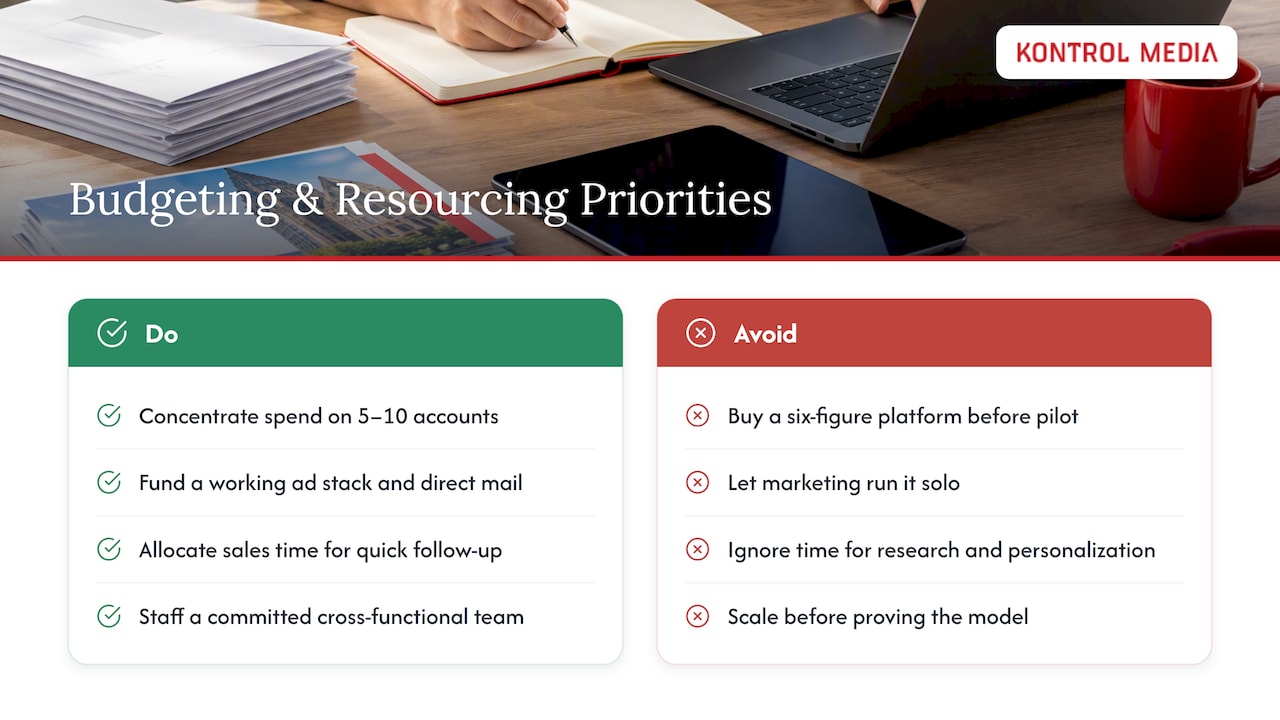
ABM concentrates spend instead of spreading it thin, which changes how a budget conversation should go. A pilot targeting five to ten accounts does not need a six-figure platform commitment before it has proven anything. It needs enough budget to personalize a handful of channels well: a working ad stack, a direct mail touch or two, and the sales time to follow up quickly.
Resourcing matters more than raw budget. A pilot with a modest spend but a committed cross-functional team (someone from marketing, someone from sales, someone who owns the account relationship) tends to outperform a larger budget run by marketing alone. Plan for the time cost of research and personalization, not just media spend; buying-committee mapping and account-specific content take real hours before a single ad runs.
As a program scales past the pilot stage, budget should shift toward the tiers that proved out, moving more into one-to-one treatment for the accounts that showed the clearest engagement lift and keeping one-to-many spend lean until there is a reason to expand it. Tools and platforms are worth paying for once the process they support already works; buying a platform before the team has run a manual pilot usually means automating a process nobody has validated yet.
Expect the first budget cycle to go toward proving the model, not scaling it. The second cycle, informed by real account conversion data, is where resourcing decisions get easier to defend.
What Successful ABM Campaigns Tend to Look Like
The programs that hold up share a few traits rather than a single formula. They start narrow: a short list of named accounts rather than a broad target list dressed up as “account-based.” They stay coordinated: the same message shows up whether a stakeholder sees an ad, gets an email, or takes a sales call. And they treat the first results as a pilot, not a verdict, adjusting the account list and messaging once real engagement data comes in.
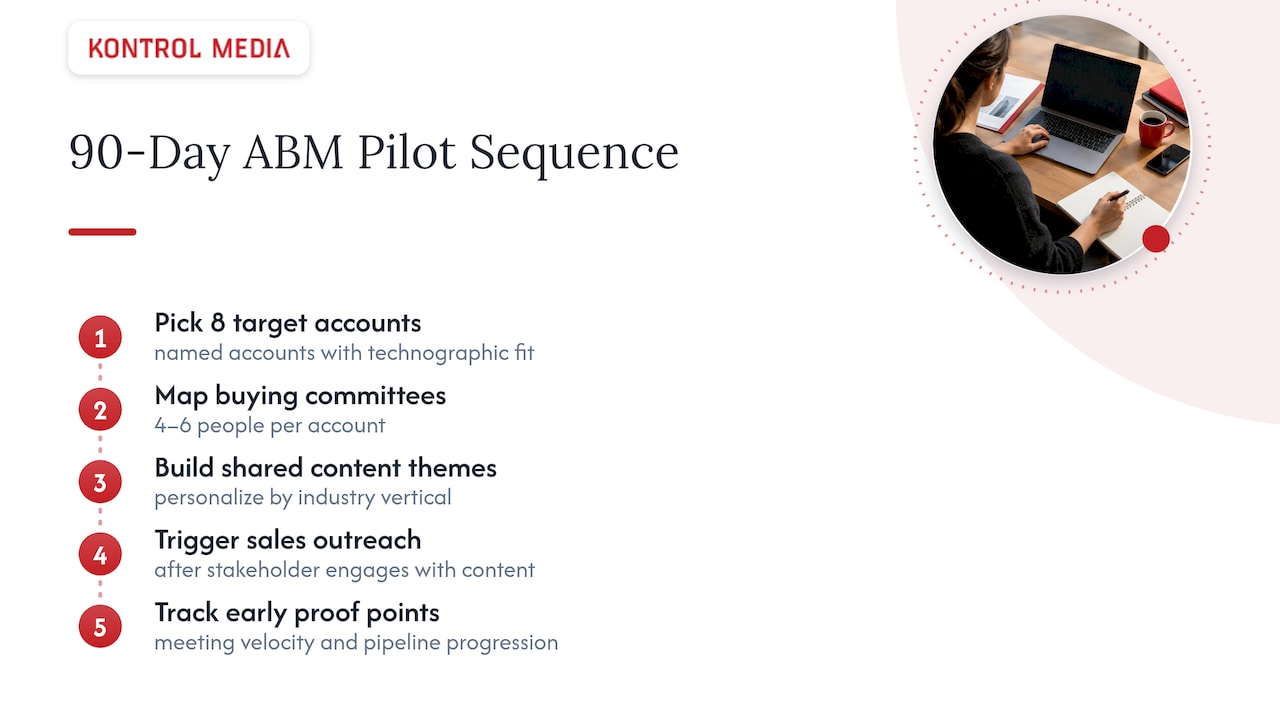
A useful way to picture this: say a mid-market software company picks eight target accounts, each with an existing technographic fit and a buying committee of four to six people. The team builds a one-to-few play: shared content themes across the eight accounts, personalized by industry vertical, paired with direct outreach from sales once a stakeholder engages with a piece of content. Within the first 90 days, the team tracks meeting velocity and pipeline progression rather than waiting for closed revenue, consistent with Forrester’s guidance on short-term ABM progress. That sequence (narrow list, coordinated channels, early proof points) is less a case study than a pattern that shows up across the programs that actually scale.
Channel partnerships often strengthen this pattern. A brand reaching homebuyers through a real estate agent network, for instance, is applying the same account logic to a different kind of “account”: a network of agents instead of a list of companies, each with its own influence and value to the brand’s pipeline.
Scaling ABM Without Losing What Made It Work
The jump from a successful pilot to a full program is where most of the real difficulty shows up. Personalizing content for eight accounts is manageable with a small team. Personalizing it for 200 accounts without diluting the quality that made the pilot work is a different problem entirely.
The common failure is trying to scale one-to-one personalization across a list that should have moved to one-to-few or one-to-many treatment instead. Review account tiers regularly and move accounts between tiers as their engagement and value signals change, rather than assuming the original tier assignment holds forever.
Governance tends to break down at scale too. A weekly sync works fine for ten accounts; it falls apart for two hundred unless there is a documented playbook that survives turnover on either the sales or marketing side. AMA’s guidance on ABM activation points to documented account intelligence and defined follow-up expectations between sellers and marketers as what keeps momentum alive once a program grows beyond what any one person can track in their head.
Technology helps here, but Gartner’s research on ABM platforms is clear that platform selection is secondary to the underlying process: segmentation, orchestration, activation, and measurement have to work before a tool makes any of it faster. Scaling budget and headcount without first scaling the process just scales the dysfunction.
Our Take: Start Small, Prove It, Then Scale
If you are weighing whether to try ABM, run the 90-day pilot before committing to a platform or a full rebuild of your funnel. Five to ten accounts, clear milestones, and tight alignment between sales and marketing will tell you more in three months than any amount of planning will tell you in advance.
— Mark Kapczynski
Where Kontrol Media Fits If You Want Help Running This
Building an ABM pilot well takes the same combination we bring to most growth work: a clear strategy paired with the hands-on execution to actually run it, rather than a framework that sits in a slide deck.
We work across the pieces many ABM programs need:
- Business and marketing strategy to set account tiers, ICP criteria, and governance before launch
- Sales alignment and process design so marketing and sales share the same account list and KPIs from day one
- Campaign execution support across the channels a pilot requires, including partnership-driven plays where retail or commerce media fits the account mix
- Measurement support to track proof points that justify scaling the program
If an ABM pilot is on your roadmap for this cycle, our services overview lays out how we structure strategy and execution together, or you can reach out directly through our contact page to talk through what a 90-day pilot would look like for your accounts.
FAQ
What is the difference between ABM and traditional lead generation?
Traditional lead generation scores individual contacts as they come in through broad campaigns, while account-based marketing starts with a named list of target companies and builds personalized campaigns around each one. ABM coordinates marketing and sales around the account rather than the individual lead.
How many accounts should a first ABM pilot include?
A first pilot typically works best with 5 to 10 target accounts, a scope small enough to personalize well and demonstrate early impact within 90 days. Scaling beyond that range usually happens after the pilot proves the approach works.
What size deals make sense for ABM?
ABM tends to make the most sense for accounts with at least $50,000 in annual contract value and sales cycles that run longer than 90 days, since the personalization effort only pays off when the account’s value justifies it. Smaller, faster-closing deals are usually better served by broader demand-generation programs.
What metrics prove ABM is working?
Account-level engagement lift, meeting velocity with key stakeholders, and pipeline progression are the short-term indicators Forrester recommends watching before closed revenue is available. Longer term, Forrester’s six reporting dimensions (segments, insights, attraction, behavior, conversion, and impact) organize the fuller measurement picture.
Does Kontrol Media help companies build ABM programs?
Yes, we work on the strategy and hands-on execution that ABM programs need, including sales and marketing alignment, campaign orchestration, and measurement, which you can review on our services page.
Sources
- What is account-based marketing? — American Marketing Association
- Apply six reporting dimensions to show more account-based marketing value — Forrester blog
- Measure ABM success with buying group metrics — Gartner
- Measuring short-term ABM progress — Forrester
- ABM fundamentals — ITSMA