

The most effective gaming media partnerships are multi-month, platform-native deals built around creators, livestreams, in-game activations, and owned events, not one-off sponsorship buys. Prioritize creator partnerships, livestream integrations, in-game activations, and branded events in that order, and hold every deal to a measurable framework. Done right, this approach builds engagement that compounds and shows up in the conversion funnel, not just impression counts.
TL;DR:
- Multi-month, platform-native partnerships that include creator collaborations, in-game activations, and owned events outperform one-off sponsorships in building engagement and trust.
- Effective creator tiers include micro, mid, macro, and mega, each serving different roles such as credibility, reach, or scale, with cross-platform strategies enhancing overall impact.
- Partnerships should be structured as pilots of 3 to 6 months with clear success metrics, using a mix of deliverables and broad usage rights to maximize long-term value.
- Success metrics must measure brand awareness, activation engagement, and direct sales, with measurement frameworks defined before campaign launch to ensure accurate evaluation.
- Long-term, relationship-driven approaches are crucial, as audiences quickly detect inauthentic sponsorships and reward brands that foster sustained community engagement.
Table of Contents
- Gaming Media Partnerships: Formats That Actually Move Audiences
- How Do You Evaluate Gaming Partners Before Signing?
- What’s the Right Deal Structure and Timeline?
- Which Metrics Actually Prove a Gaming Partnership Worked?
- Why Do So Many Gaming Partnerships Fail?
- How Kontrol Media Approaches Gaming Media Partnerships
- The Editorial Take: Stop Buying Sponsorships, Start Building Media
- Ready to Build a Gaming Media Partnership Program
- Sources
- FAQ
Gaming Media Partnerships: Formats That Actually Move Audiences
Every gaming partnership decision starts with matching the format to the job it needs to do. Some formats build reach, some build trust, and very few do both at once.
Creator partnerships work in tiers, and treating them as a pyramid rather than a single buy changes outcomes. Micro-creators (typically under 50,000 followers) deliver credibility and niche relevance at low cost. Mid-tier creators bring reach with retained authenticity. Macro and mega creators supply scale but demand tighter creative control to avoid feeling like an ad read. A multi-tier influencer strategy across Twitch, YouTube, and TikTok consistently outperforms single-channel buys because each platform plays a distinct role: Twitch proves the product in real time, YouTube builds long-tail discovery, and TikTok drives viral spread.
Livestream integrations, meanwhile, work best when they’re built into the stream mechanics rather than bolted on. Chat-triggered drops, branded overlays, and command-based rewards give viewers a reason to stay engaged rather than mute the sponsor segment.
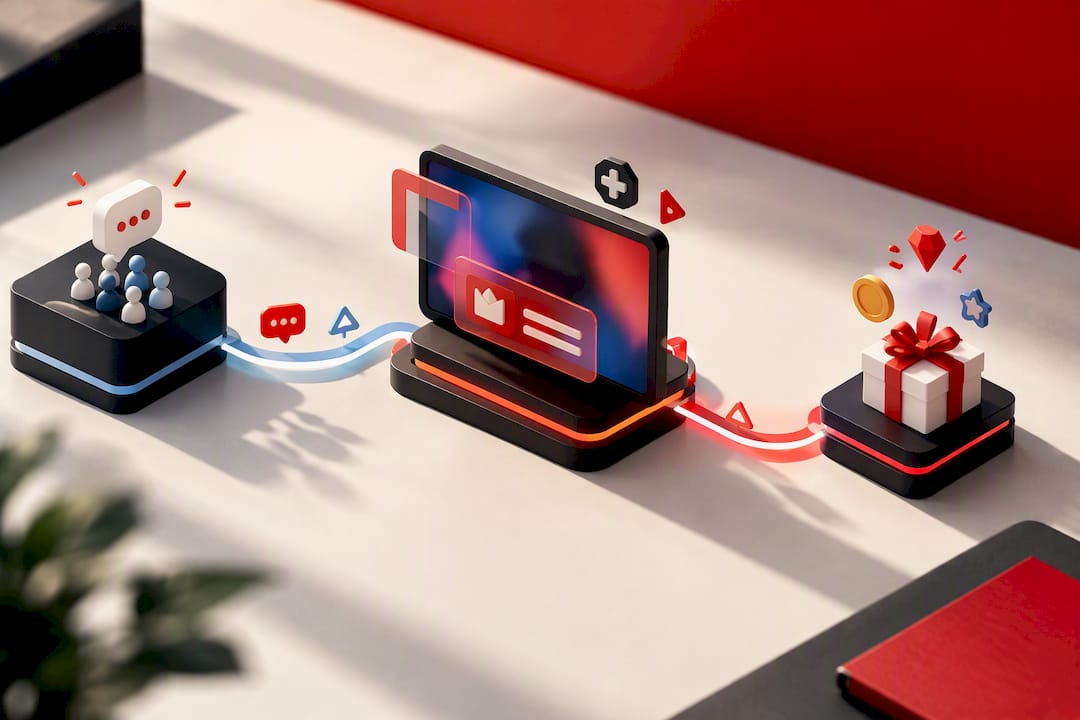
In-game activations, from branded skins to custom map spaces, succeed when they feel native to gameplay. Heinz’s creator-led scavenger mechanic inside a popular title turned a branded object into a community participation moment rather than a static billboard, generating earned media well beyond the paid placement.
Branded events and tournaments round out the toolkit, particularly when paired with branded content series that get repurposed across owned channels. The formats that consistently punch above their weight share a few traits:
- Creator partnerships with tiered spending across micro, mid, and macro accounts
- Livestream mechanics that reward chat participation, not just viewing
- In-game placements that fit the game’s visual and narrative logic
- Branded events that generate content assets usable for months afterward
How Do You Evaluate Gaming Partners Before Signing?
Vetting a gaming partner takes more discipline than most brand teams apply to traditional media buys, largely because credibility in gaming communities is harder to fake and easier to lose. A reproducible checklist keeps evaluation consistent across campaigns and across the different agencies or creators a brand might work with.
- Confirm audience fit. Match the creator’s demographic data, the specific game titles they play, and their platform behavior against your actual buyer profile, not just follower count.
- Check creator credibility. Look at engagement rate relative to audience size, review past disclosure history, and watch a few unsponsored streams to judge authenticity before the pitch call.
- Lock commercial terms and rights. Define deliverables precisely, negotiate repurposing rights for your owned channels, and decide whether exclusivity within the category is worth the premium.
- Verify operational readiness. Confirm production timelines, brand approval workflows, and prize or giveaway logistics well before the campaign date.
- Build in disclosure compliance. FTC disclosure requirements apply across Twitch, YouTube, and short-form platforms, and skipping this step creates legal exposure that outlasts the campaign.
Pro Tip: Ask a prospective creator partner for their audience retention curve on a recent stream, not just their subscriber count. A creator with 40,000 followers who holds viewers for 90 minutes usually outperforms one with 200,000 followers and a five-minute average watch time.
Audience research matters here as much as it does in any other channel. Brands that align content to actual audience needs rather than assumed ones consistently see stronger engagement, and gaming communities punish misalignment faster than almost any other audience segment.
What’s the Right Deal Structure and Timeline?
Structure gaming partnerships as pilots that earn the right to scale, not as single-flight buys. A 3 to 6 month pilot with a clear hypothesis and named metrics gives both sides enough runway to learn what works before committing bigger budgets. Digiday’s reporting on long-form creator deals backs this up directly: brands that treat creators as ongoing partners rather than vendors see stronger community trust and better organic amplification.
A workable deal structure typically includes:
- A defined pilot phase (3 to 6 months) with agreed success metrics set before launch
- Deliverables spanning livestream segments, short-form clips, and at least one long-form piece
- A cross-platform repurposing plan so a single shoot day generates months of owned content
- Usage rights that extend beyond the campaign window, ideally in perpetuity for owned channels
Commercial models generally fall into three camps: flat fee for guaranteed deliverables, affiliate or performance-based pay tied to conversions, and hybrid structures blending a smaller guarantee with upside tied to results. Hybrid deals tend to align incentives best, since they reward creators for genuine promotion rather than just showing up. Budget ranges vary enormously by creator tier and platform, so brands should scope cost against the specific tier mix identified during partner evaluation rather than a flat industry number.
Usage rights deserve their own line item in every contract. Long-tail assets from a single campaign, clips, thumbnails, highlight reels, keep generating value for a year or more if the rights are broad enough. Narrow rights language is one of the most common ways brands leave value on the table after the campaign ends.
Which Metrics Actually Prove a Gaming Partnership Worked?
Impressions alone tell you almost nothing about whether a gaming partnership worked. A three-part measurement rubric, return on objectives (ROO), return on activation (ROA), and return on investment (ROI), forces brands to define success before the deal launches instead of backfilling a narrative afterward.
ROO measures whether the partnership hit the strategic goal you set, brand awareness in a new demographic, category association, or entry into a specific gaming community. ROA measures how well the activation performed on its own terms: concurrent viewers, chat velocity, clip creation, and shares. ROI measures the financial return, tying the campaign to actual revenue through affiliate codes, landing-page conversions, and incremental sales lift.
Track metrics across the funnel:
- Brand metrics: brand lift surveys, total watch time, sentiment in chat and comments
- Activation metrics: peak concurrent viewers, chat message volume, clips and reposts generated
- Performance metrics: affiliate code redemptions, landing-page conversion rate, incremental sales versus a control period
Esports and gaming ad spend keeps climbing because the audience access is real. Deloitte projected esports revenue would top $1.38 billion in 2022, with advertising, co-streaming rights, and sponsorship as the primary revenue streams, which tells you the money brands are chasing is concentrated in exactly these formats. Set your measurement plan and attribution method before the campaign launches, not after, and read our guide on measuring the ROI of marketing and advertising campaigns for a broader framework that applies well beyond gaming.
Why Do So Many Gaming Partnerships Fail?
Most failed gaming partnerships share the same root cause: they were built as a single sponsorship moment instead of a sustained relationship, and the audience noticed. One-off activations rarely generate the trust that turns a viewer into a customer, because gaming communities are unusually sensitive to brands that show up once, run an ad-like segment, and disappear.
- Treat presence as a relationship, not a transaction. Sustained partnerships, even modest ones, outperform single-flight buys because the audience sees continuity as sincerity.
- Protect creative control where it counts, and release it elsewhere. Over-directing a creator’s script kills the authenticity that made them worth hiring in the first place.
- Design for the platform’s native language. A Twitch integration built like a TV spot will underperform one built around chat commands and overlays.
- Match your metrics to your objective before launch. A brand-lift goal measured only by clicks, or a performance goal measured only by sentiment, guarantees a mismatched verdict at the end.
Pro Tip: If a creator pushes back on your script, treat it as a signal, not a problem. Lenovo Legion’s Twitch program worked partly because the brand let streamers integrate the product into real gameplay rather than reading a scripted line, which shifted audience perception more than a traditional ad ever could.
How Kontrol Media Approaches Gaming Media Partnerships
Kontrol Media runs gaming partnerships through a discovery, pilot, scale, and measurement workflow, the same operational sequence used across our retail and commerce media network engagements. Discovery maps audience and title fit. Pilot tests one or two formats against a clear hypothesis. Scale expands the winning format once ROO, ROA, and ROI data confirm it. Measurement runs continuously, not just at the end.
Our work reflects the range of media, real estate, and gaming-adjacent projects this workflow supports.
A pilot without a named hypothesis is just spending. The brands that win in gaming treat the first campaign as a test of a specific belief about their audience, then scale only what the data confirms.
A sample deliverable checklist for a pilot phase: a title-fit audience brief, a two-tier creator mix, one livestream integration, three pieces of repurposable short-form content, and a measurement plan mapped to ROO, ROA, and ROI before launch. Explore how this thinking applies specifically to gaming audiences in our piece on games and advertising as a smarter strategy for brands.
The Editorial Take: Stop Buying Sponsorships, Start Building Media
The conventional advice on gaming sponsorships is still stuck in a sports-marketing mindset: buy the logo placement, run the campaign, measure impressions, move on. That model fails in gaming because the audience doesn’t tolerate passive advertising the way a stadium crowd does. Chat calls out inauthenticity in real time, and clips of a bad integration travel faster than the campaign itself.
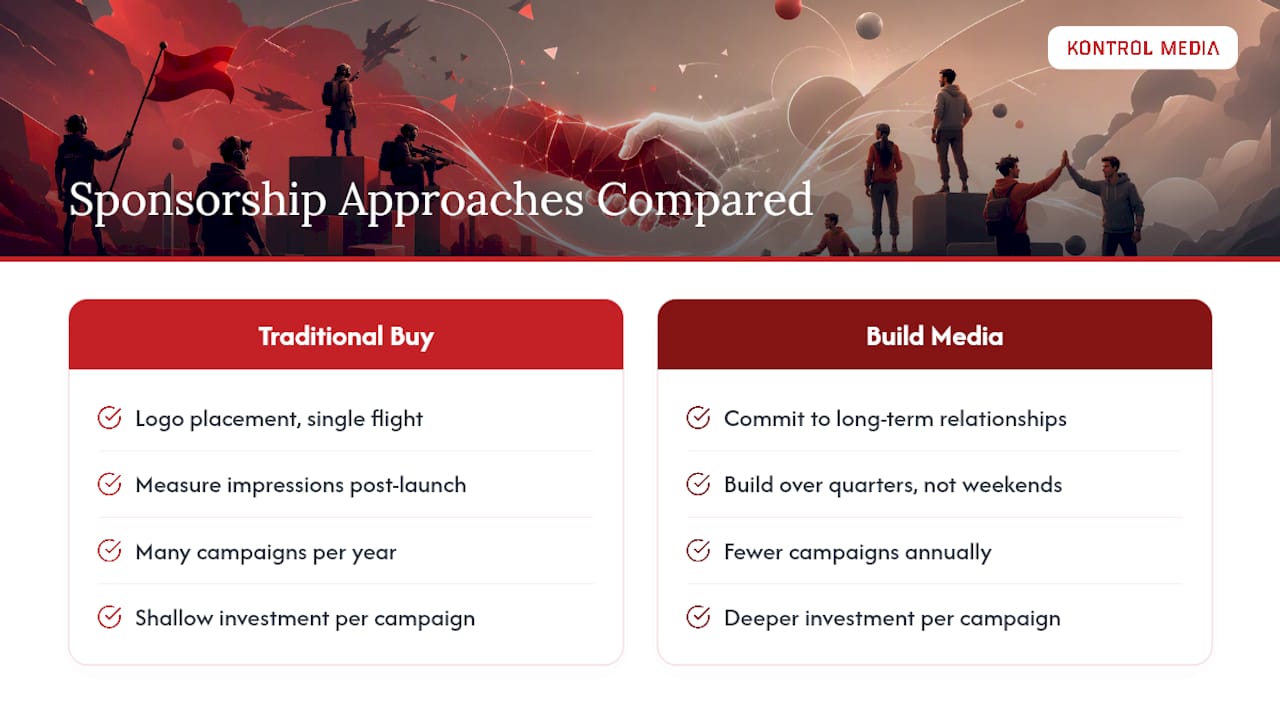
What the research actually supports is narrower and more demanding than most brands want to hear: commit to a relationship, not a flight date. The brands winning in this space, non-endemic ones especially, treat gaming as a media channel worth building over quarters, not a stunt worth renting for a weekend. That means fewer campaigns per year, deeper investment in each one, and a willingness to let creators keep creative control even when it feels uncomfortable to a brand safety team.
The single biggest mistake I’d flag for marketers reading this: setting the measurement framework after the campaign launches instead of before. ROO, ROA, and ROI decisions made in week one determine whether week twelve produces a case study or an excuse.
— Mark Kapczynski
Ready to Build a Gaming Media Partnership Program
Most brands trying to break into gaming end up choosing between two weak options: hiring a specialized gaming agency that knows the culture but not the broader marketing strategy, or leaning on a generalist agency that understands measurement but treats gaming like a media buy instead of a community. This consultancy closes that gap by pairing hands-on execution with strategic rigor applied to retail and commerce media network builds.
Our Business Strategy, Marketing, and Sales services apply directly to gaming partnership programs: audience evaluation, creator vetting, deal structuring, and the ROO/ROA/ROI measurement discipline outlined above. Brands get an operational partner who treats a gaming deal as a long-term media asset, not a one-time placement, and who can plug partnership performance into the broader marketing funnel. If you’re planning your next gaming campaign and want a team that has run outsourced go-to-market and media operations for brands like Enthusiast Gaming, get in touch with Kontrol Media to scope a pilot program.
Sources
- Investing in esports | Deloitte Insights
- The era of the in-depth creator partnership has arrived | Digiday
- Why most gaming partnerships fail to deliver – and how to fix them – Campaign Middle East
- Influencer Marketing for Gaming Brands – partnrUP
FAQ
Who Are the Biggest Gaming Sponsors?
Non-endemic brands across beverages, automotive, and financial services have become some of the largest gaming sponsors, drawn by esports revenue that Deloitte projected would exceed $1.38 billion in 2022 through advertising, sponsorship, and media rights. Endemic brands like gaming hardware and peripheral makers remain heavy spenders as well, but the fastest growth is coming from categories with no prior gaming presence.
Is 52% of Gamers Female?
Gender breakdowns of gaming audiences vary widely by title, platform, and region, so a single figure like this isn’t reliable without knowing the specific study and game category behind it. Brands should pull audience demographic data for the specific title and platform they’re targeting rather than relying on an industrywide average.
What Is the 20/20/20 Rule for Gaming?
This isn’t an established gaming media or partnership standard, and no consistent definition of a specific numeric “rule” appears in gaming marketing or measurement frameworks. If you’ve seen this referenced elsewhere, treat it cautiously and lean on the ROO/ROA/ROI framework instead for a measurement approach with real backing.
Where Can I Find Gaming Partners?
Gaming partners typically come through three channels: creator management agencies, platform-native discovery tools on Twitch and YouTube, and specialized consultancies that vet audience fit before making an introduction. Kontrol Media handles this vetting directly as part of its business strategy and execution services, applying the same audience-fit and credibility checklist outlined earlier in this guide.
How Long Should a Gaming Media Partnership Run?
Most effective partnerships start with a 3 to 6 month pilot built around a specific hypothesis, then scale into longer engagements once the data confirms the format works. Treating the first phase as a test rather than a full commitment reduces risk while still giving the partnership enough time to build genuine audience trust.