


A brand media network strategy is a measurement-first plan that links retailer-owned media to a single business objective and a gated product readiness check. It leans on first-party data and closed-loop sales outcomes instead of impressions alone. Start by picking one objective, defining an incrementality test, and confirming your product inventory and content are actually ready to run.
TL;DR:
- Effective retail media strategies require a clear business objective and a product readiness check before launch to avoid wasted spend.
- Campaign success depends on selecting ad formats aligned with the shopping intent, including onsite sponsored products and off-site audience extensions.
- Proven incremental sales impact must rely on standardized, multi-layer measurement approaches, avoiding attribution solely based on sales proximity.
- Scaling only occurs after repeated proof of incremental lift and operational capacity, with effectiveness tied to category fit and inventory readiness.
- Organizational alignment, including measurement ownership and gating product content, is crucial to avoid misaligned KPIs and program stalls.
Table of Contents
- What Is a Brand Media Network Strategy, and How Does It Differ From Other Channels?
- Why Should Brands Invest in Retail Media Networks?
- What Ad Formats and Placements Belong in the Strategy?
- How Do You Build a Practical Media Network Strategy Framework?
- How Do You Prove Retail Media Actually Drove Sales?
- What Does a Build, Test, and Scale Roadmap Look Like?
- Why Does Integration and Governance Determine Whether Retail Media Scales?
- An Editorial Take: Three Blunt Rules for Launching an RMN Program
- How Kontrol Media Helps Brands Execute This Strategy
- Sources
What Is a Brand Media Network Strategy, and How Does It Differ From Other Channels?
A brand media network, often called a retail media network or commerce media network, is retailer-owned advertising inventory tied directly to that retailer’s transaction data. That linkage is the whole point. It lets you attribute a sale at the SKU level and, increasingly, watch what happens in a physical store after someone sees your ad, an advantage traditional display and social channels can’t fully match.
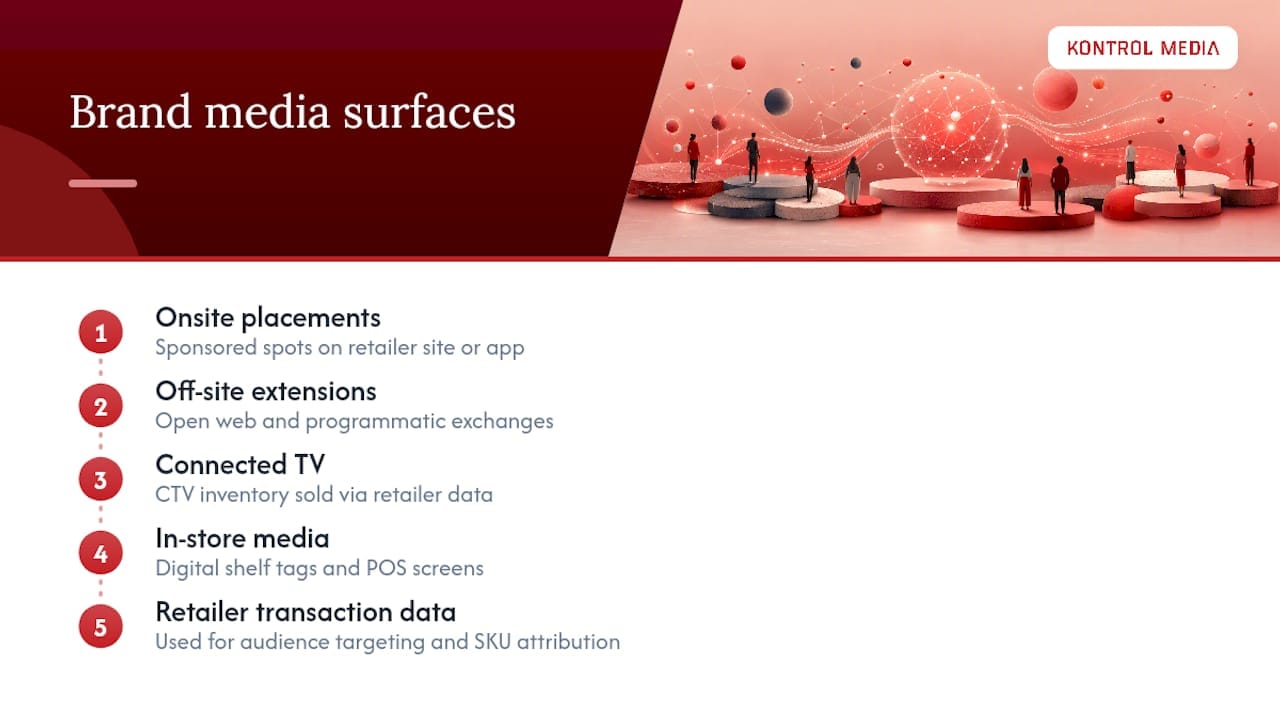
The channel spans four surfaces: onsite sponsored placements on the retailer’s own site or app, off-site extensions into the open web and programmatic exchanges, connected TV inventory sold through the retailer’s data, and in-store media like digital shelf tags or point-of-sale screens. What separates this from a generic media buy is audience quality. You’re not renting a lookalike model. You’re buying access to people who have already bought in that category, from that retailer, recently.
Why Should Brands Invest in Retail Media Networks?
The upside is real: high-intent reach, SKU-level sales visibility, and a revenue stream retailers are eager to hand you a seat at. For retailers, retail media is often a higher-margin business than the merchandise itself, which is exactly why so many have built one in the past three years.
But the limits are just as real. Comparability across networks is a mess right now. Brands frequently run active campaigns on six to eight networks despite dozens being technically available, largely because reporting standards and definitions still vary widely from one retailer to the next. Your ROI ceiling is also capped by product readiness. If your inventory is out of stock, your detail pages are thin, or your images fail the retailer’s spec, no amount of bid strategy fixes that.
What Ad Formats and Placements Belong in the Strategy?
Building a brand media network strategy means treating format selection as a commerce decision, not just a media one. Each placement type demands different creative assets, different lead times, and different readiness checks before you spend a dollar.
- Onsite sponsored products and search put your listing in front of someone actively typing a category term. This is usually the highest-converting, most defensible spend.
- Onsite display and category placements build awareness within a shopping session, useful for new launches without existing search demand.
- Off-site audience extension applies the retailer’s purchase data to programmatic buys across the open web, extending reach beyond the retailer’s own traffic.
- Connected TV through retailer data lets you target based on actual purchase history rather than broad demographic guesses.
- In-store media, including shelf screens and audio, closes the loop at the moment of decision, though measurement here is still maturing.
None of it works without commerce readiness underneath: accurate titles, compliant images, complete detail pages, and inventory that won’t stock out mid-campaign.
How Do You Build a Practical Media Network Strategy Framework?
A repeatable framework beats a one-off campaign brief every time, mainly because retail media budgets get scrutinized quarterly and you need a defensible answer for why money moved where it did. Here’s the sequence that holds up under that scrutiny:
- Fix one business objective first. Awareness, new customer acquisition, conversion, or retention each require a different KPI, and the IAB’s own guidance is explicit that mapping KPIs to a single objective is where planning should start, not where it ends up by accident.
- Define each retailer’s role by category fit, not scale. A network’s usefulness depends on whether shoppers actually buy your category there, not on its total audience count.
- Run product readiness as a hard gate. If your SKUs aren’t stocked, imaged, and content-complete on that retailer’s platform, don’t launch there yet.
- Split budget into three pools: baseline, test, and opportunity. Baseline protects proven performers, test funds your incrementality experiments, and opportunity stays flexible for what the data tells you next quarter.
- Reallocate based on marginal ROI, not sentiment. Move dollars toward retailers producing incremental lift, not the ones with the loudest account rep.
Pro Tip: Treat your test budget as untouchable for at least one full measurement cycle. Pulling it early to chase a short-term dip is the single fastest way to poison your incrementality data.
How Do You Prove Retail Media Actually Drove Sales?
This is where most brand media network strategies quietly fail, not at launch, but at the reporting stage when someone asks “would those sales have happened anyway?” The IAB and MRC’s joint measurement guidelines push the industry toward standardized, incrementality-based reporting for exactly this reason, and toward closed-loop verification across onsite, offsite, and in-store contexts.

Practically, you’re managing three separate measurement layers: raw exposure logs, retailer-attributed commerce data, and incremental or counterfactual proof. Confusing the second layer for the third is the most common mistake in the category, since attributed sales tell you what happened near an ad, not what wouldn’t have happened without it.
Three experiment designs dominate the space right now, and each fits a different data access scenario:
- Geo or matched-market tests, which compare similar regions with and without exposure.
- Platform audience holdouts, which withhold ads from a random subset of the retailer’s own audience.
- Platform-native lift or ghost-ads, which serve a placeholder ad to a control group inside the platform itself.
The measurement stack that works: incrementality functions as your causal ground truth, marketing mix modeling gives you the portfolio-level view, and last-click attribution stays useful only for tactical optimization inside a channel, never for budget justification across channels.
Set expectations early: incremental ROAS almost always lands lower than last-click ROAS, sometimes substantially, because last-click credits sales that would have happened anyway. Budget conversations should start from that lower, truer number.
What Does a Build, Test, and Scale Roadmap Look Like?
A phased rollout keeps you from overcommitting budget before you’ve proven the channel works for your specific product mix.
- Map the ecosystem and audit data readiness. Inventory which retailers matter for your category, and check whether your product data, images, and content actually meet each one’s spec.
- Pilot with a real measurement plan attached. Pick a limited SKU set, choose an experiment design suited to your data access, and run it long enough to reach statistical fit.
- Optimize creative, bids, and inventory ties. Once you have signal, tighten the operational connections between your commerce systems and the ad platform.
- Scale only when incremental proof is consistent and your operations can handle the volume. A single strong test quarter isn’t proof; repeatable lift across cycles is.
Why Does Integration and Governance Determine Whether Retail Media Scales?
Retail media rewards brands that treat it as commerce infrastructure, not a bolt-on ad channel. Disconnected retail media programs consistently produce misaligned KPIs because the media team, the ecommerce team, and the supply chain team are optimizing toward different numbers. That’s an organizational problem before it’s a media problem.
Getting this right means:
- Assigning one owner for measurement definitions across every retailer, so “conversion” means the same thing on every dashboard.
- Setting inventory and content readiness gates that block a SKU from launching until it passes, not after the campaign underperforms.
- Building or hiring for three specific roles: a measurement owner, a commercial operations lead, and someone dedicated to advertiser or partnership acquisition if you’re on the network-operator side.
Generative AI is lowering the cost of running these experiments, which is making incrementality testing accessible to brands that couldn’t previously afford a dedicated data science team. But legacy tech stacks and inventory mismatches remain the more common reason programs stall, not a lack of AI tooling.
Pro Tip: Before you sign a single media contract, have your commercial ops lead confirm every SKU you plan to promote has clean, complete detail pages on that specific retailer’s platform. Skipping this step is the most expensive shortcut in the category.
An Editorial Take: Three Blunt Rules for Launching an RMN Program
Measure before you scale, full stop. Every brand manager wants to expand fast; the ones who protect their test budget through a full cycle are the ones with defensible numbers next quarter. Treat inventory and content readiness as a gate, not a footnote, since no bid strategy fixes an incomplete product page. And pick networks by category fit and marginal return, not by total reach. The largest audience means nothing if your category barely sells there.
— Mark Kapczynski
How Kontrol Media Helps Brands Execute This Strategy
Some agencies stop at strategy decks, but partners can help run the audit, design the pilot, set up the measurement program, and handle the advertiser or retail partnership operations that make a network scale. Where most agencies stop at strategy decks, Kontrol Media runs the audit, designs the pilot, sets up the measurement program, and handles the advertiser or retail partnership operations that make a network scale.
A typical first engagement starts with an audit of your current retail media footprint and data readiness, followed by a pilot scoped around one objective and one incrementality test design. From there, you get a clear read on whether to scale, reallocate, or fix inventory gaps before spending more. If you’re building or operating a network from the retailer or platform side rather than the brand side, Kontrol Media’s retail media network setup and operations work covers the build versus buy decision and the ongoing execution that follows. Brands earlier in the process might start with the non-retailer strategy guide to map where they fit first.
Reach out through Kontrol Media’s contact page to scope your audit and pilot.
Sources
- IAB Retail Media Buyer’s Guide (July 2023)
- IAB/MRC Retail Media Measurement Guidelines (January 2024)
- FAQ on incrementality: How to prove your ads actually work (eMarketer, 2026)
- Retail Media Network strategies: Unlocking high-margin revenue with generative AI (Capgemini, 2024)