


The realtor channel earns its keep when your product depends on trust, community standing, or a long consideration window, categories where an agent’s local credibility moves buyers faster than another display impression. Many millennials report they are more likely to hire an agent with an active social presence, and that same trust transfer works for the brands riding alongside them. Run a measurable pilot with multi touch tracking before committing real budget, and let the data, not the pitch, decide whether to scale.
TL;DR:
- Building relationships through local sponsorships and influencer programs generates long-term trust that influences buyer decisions months after initial contact.
- Measuring ROI requires full-funnel tracking, including impressions, engagement, qualified leads, pipeline value, and closed revenue, not just immediate conversions.
- Running small, short-term pilots in a single micro-market with 3 to 5 agents provides faster insights and lower risks before scaling to larger campaigns.
- Post-pilot scaling demands operational infrastructure like reusable creative templates, clear expectations, incentive structures, and integrated CRM workflows.
- Success hinges on proper tracking setup from the start, focusing on long-term value and referral business rather than just immediate sales.
Table of Contents
- What Is Realtor Channel ROI and How Do Agents Actually Reach Buyers?
- How Do You Measure Realtor Channel ROI With Real Numbers?
- How Do You Structure a Pilot to Prove Realtor Channel ROI?
- What Happens After the Pilot Proves Out?
- When We Recommend the Realtor Channel to Clients
- Let Kontrol Media Build and Measure Your Realtor Pilot
- Sources
What Is Realtor Channel ROI and How Do Agents Actually Reach Buyers?
Realtor channel ROI measures the return a brand or retailer generates by partnering with real estate agents and brokerages to reach home buyers and homeowners, rather than buying that same audience through programmatic display or paid social. The mechanics look different from a typical media buy because the inventory isn’t a slot. It’s a relationship.
Agents activate that relationship in several concrete formats:
- Sponsored posts on an agent’s personal or brokerage social channels
- Co-marketing tie-ins with a local office (open house sponsorships, closing gift programs)
- Sponsored community events, from first time buyer seminars to neighborhood block parties
- In-agent ad placements inside listing platforms, CRM newsletters, or client welcome packets
- Co-branded listing content, including neighborhood guides and buyer resource pages
- Broker-run retail or commerce media placements embedded in transaction workflows
What makes this inventory valuable is access. Inman’s reporting on local sponsorships frames community activations as relationship building that compounds over time, unlike a banner impression that decays the moment the page closes. An agent who sponsors a first time buyer workshop isn’t just distributing your logo. They’re vouching for you to a room of people who already trust their judgment on the biggest purchase of their lives.
That access changes what marketers should expect from the funnel. A realtor-driven touchpoint rarely converts on contact. It plants a preference that surfaces weeks or months later, when the buyer is finally ready to act, which is exactly why single-touch, last-click reporting undercounts this channel’s actual value.
How Do You Measure Realtor Channel ROI With Real Numbers?
Measuring realtor channel ROI requires tracking the full arc from awareness to closed revenue, not just clicks. Real estate sales cycles run long and mostly offline, so the KPIs that matter most are the ones that survive the gap between first contact and signed contract.
Track these core metrics for every realtor partnership:
- Impressions and reach across agent posts, event attendance, and co-marketed content
- Engagement rate on agent-distributed creative (saves, shares, comment quality, not just likes)
- Cost per qualified lead (CPQL), isolating leads that meet your actual buyer profile
- Cost per showing or consult, the first real behavioral commitment
- Pipeline value, the dollar total of opportunities the channel has touched
- Attributable closed revenue, tied back to the original agent touchpoint
- Adjusted lifetime value, accounting for referrals the same buyer generates later
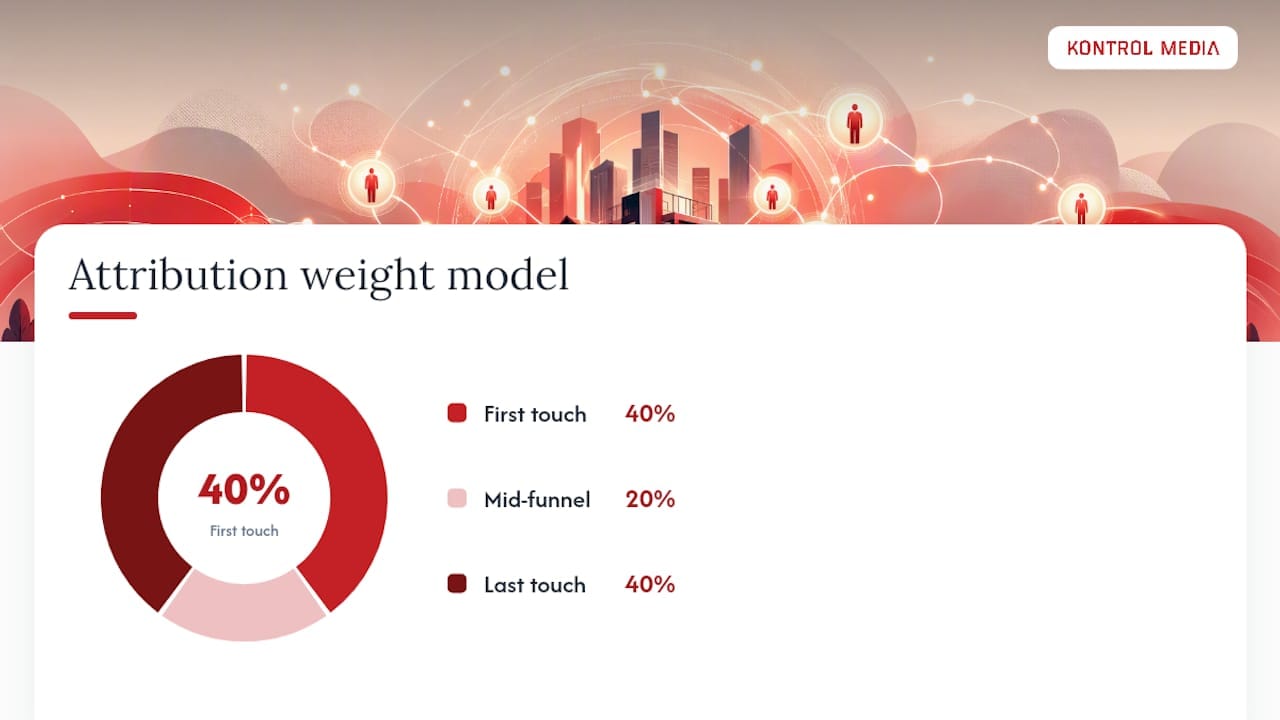
The attribution model you choose determines whether these numbers mean anything. A hybrid multi-touch model, weighting first touch around 40%, mid-funnel touches around 20%, and last touch around 40%, reflects how creator and partner-driven conversions actually accumulate across long buying journeys far better than pure last-click credit. Tie each stage to a persistent CRM flag so a closed deal eight months out still traces back to the agent event that started it.
The tracking primitives that make this possible are unglamorous but essential: unique UTM parameters per agent, dedicated landing pages, event sign-up forms, agent-specific promo codes, and a CRM source field that never gets overwritten downstream.
Statistic Callout: When brands apply full-funnel, pipeline-adjusted math instead of counting only immediate sales, realtor and real-estate influencer campaigns commonly land in the 3:1 to 5:1 ROI range, a gap wide enough to change a budget conversation entirely.
Here’s a worked example. That’s roughly 27 closed deals, or $48,600 in attributable revenue against a $15,000 spend, a 3.2:1 return before accounting for referral LTV. Kontrol Media’s approach to measuring marketing ROI walks through building that same model for other partnership channels.
How Do You Structure a Pilot to Prove Realtor Channel ROI?
Three pilot archetypes work well for testing this channel without betting the annual budget on an unproven partner. Pick the one that matches your product’s buying cycle rather than defaulting to whichever feels easiest to greenlight.
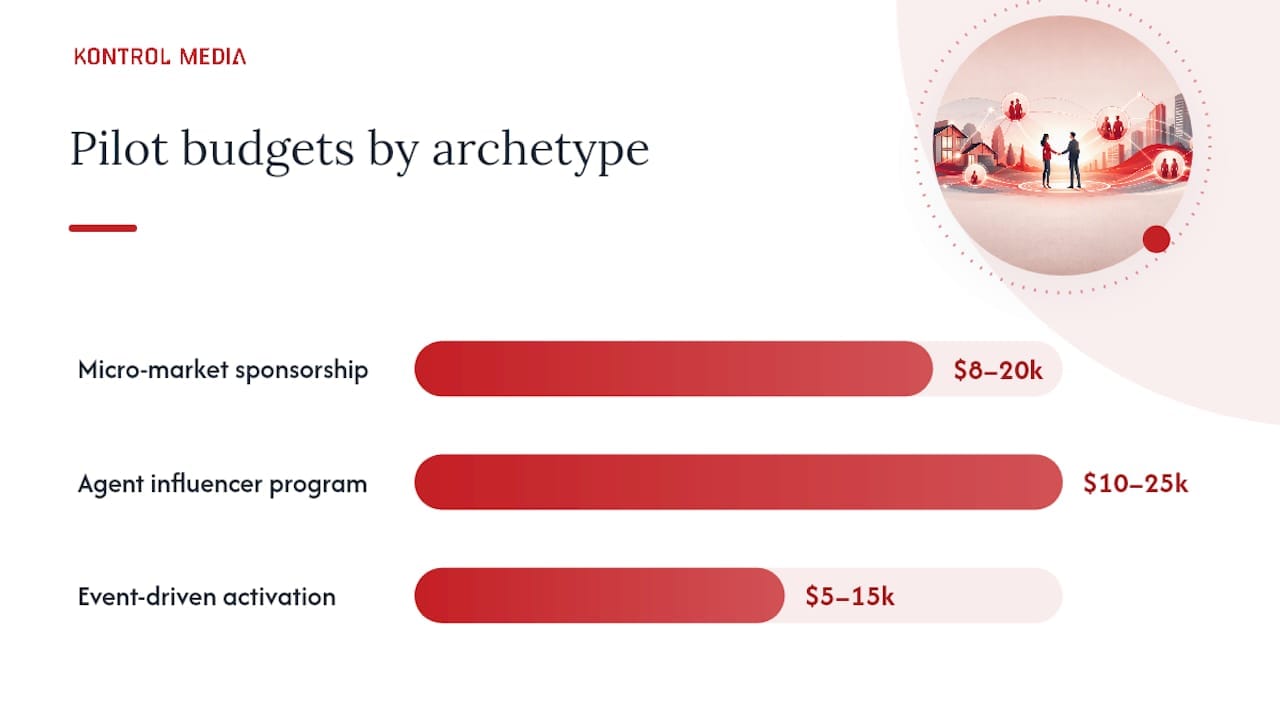
- Micro-market sponsorship plus office co-marketing: one metro, one or two brokerage offices, 8 to 12 weeks, budget typically $8,000 to $20,000.
- Agent influencer program: 5 to 10 agents posting co-branded content on a recurring cadence, budget typically $10,000 to $25,000 over a quarter.
- Event-driven community activation: sponsored buyer seminars or neighborhood events with structured data capture at the door, budget typically $5,000 to $15,000 per event cycle.
Engagement and reach show early signal within two to three weeks. CPQL stabilizes by week six. Pipeline conversion and attributable closed revenue need the full pilot window, and often longer, before they’re trustworthy, which is exactly why cutting a pilot early on soft engagement numbers is the most common mistake marketing leaders make with this channel.
Set success thresholds before you launch, not after you see the results.
Your executive dashboard should show leading and lagging indicators side by side, never just one. Pair engagement and CPQL (what you know in week three) with attributable closed revenue and LTV uplift (what you know in month six), so nobody makes a scale decision on incomplete data.
Pro Tip: Run your first pilot with 3 to 5 agents in a single micro-market instead of a multi-city rollout. A smaller test surfaces the signal you need faster and costs a fraction of a national launch if the assumptions are wrong.
For a deeper look at KPI selection by channel, Kontrol Media’s guide to the best real estate marketing channel breaks down which metrics matter at each stage.
What Happens After the Pilot Proves Out?
A successful pilot is a starting point, not a finish line. Single-sale attribution consistently undercounts realtor channel ROI because it ignores the referrals and repeat business that follow a strong first transaction, and that referral tail is often where the real lifetime value sits.
Scaling requires operational infrastructure most brands don’t build during the pilot phase:
- A creative template library agents can customize without waiting on your design team
- A brief document that sets expectations, deliverables, and compliance boundaries upfront
- Incentive structures that pair a small fixed participation fee with performance bonuses tied to lead conversion, which practitioner guidance on agent co-marketing frames as the friction-reducing standard
- An approval workflow that doesn’t bottleneck every agent post through legal
- CRM flows that keep the campaign-origin flag alive through every downstream opportunity stage
The pitfalls that sink scaled programs are predictable: treating a sponsorship like a lead-gen ad and judging it on week one clicks, skipping data capture at events because it feels like friction, offering agents no reason to prioritize your brief over three competing ones, and dropping the follow-up cadence the moment the event ends. Automation and analytics tooling can absorb a good share of that measurement overhead as the program grows, which matters once you’re managing dozens of agent relationships instead of ten, as AI for agencies delivers real productivity gains.
When We Recommend the Realtor Channel to Clients
I recommend testing realtor partnerships when three conditions line up: the audience genuinely overlaps with active home buyers or recent movers, the product carries enough consideration weight that trust transfer matters, and the sales cycle is long enough to make multi-touch attribution worth building. A low-price impulse product doesn’t need this channel. A mortgage adjacent service, a moving company, or a home goods retailer almost always does.
The first three moves are consistent across engagements. Pick one micro-market where the brand already has some organic presence. Shortlist agent or brokerage partners based on local reputation, not follower count. Build the tracking primitives, UTMs, CRM flags, promo codes, before the first piece of creative goes live, not after.
In-house teams can run this, but expect three to four months before the data is trustworthy enough to defend in a budget meeting. Working with a partner who has built these pilots before typically compresses that timeline, because the tracking mistakes that eat the first month are ones we’ve already fixed elsewhere.
— Mark Kapczynski
Let Kontrol Media Build and Measure Your Realtor Pilot
Some consultancies build the realtor channel partnerships brands and agencies need to reach home buyers, then instrument the tracking so every agent touchpoint feeds a real pipeline number, not a vanity impression count.
Some consultancies run micro-market sponsorships, agent influencer programs, and event-driven activations, designing the CPQL, pipeline value, and attribution tracking around each one from day one, so these elements do not need to be stitched together after the pilot is live. If your team is weighing whether this channel deserves budget next quarter, start with our real estate agent partnership playbook or reach out directly to scope a pilot built around your product and market.
Sources
- Active Advertising: How Local Sponsorships Bring A Brand To Life | Inman Real Estate News
- Creator attribution marketing models – Impact