


A managed media network is an advertising business you build on your own customer channels, in which your team (or a partner) handles strategy, targeting, and optimization for advertisers instead of leaving them to self-serve. It’s the right model when you’re launching, courting high-touch advertisers, or protecting the customer experience from bad creative. Kontrol Media has stood up and operated these programs for retail and commerce clients, and the pattern is consistent: managed-first wins trust before self-service ever scales.
TL;DR:
- Launch with a lean team of five roles and focus initially on on-site sponsored placements, adding off-site and in-store formats later.
- Set conservative initial prices, monitor revenue per page view by category, and prioritize advertiser retention and return on ad spend as key metrics.
- Outsource ad-tech or build in-house only if you have unique data and long-term margin goals; consider a hybrid approach for flexibility.
- Avoid rushing into self-service; proven managed service results are essential before advertisers will trust and increase their spend.
- Early measurement ownership, including attribution, is critical; assign a dedicated role to track performance before actively selling campaigns.
Table of Contents
- What Is a Managed Media Network, Exactly?
- Why Executives Are Building These Networks Now
- How a Managed Network Actually Runs, Day to Day
- Standing Up the Network: Team, Pricing, and the First 90 Days
- Build In-House, Outsource, or Run a Hybrid?
- What Most First-Time Operators Get Wrong
- How Kontrol Media Helps You Build or Run This
- Sources
What Is a Managed Media Network, Exactly?
Strip away the jargon and a managed media network is simple: it’s a retail or commerce media network where the operator, not the advertiser, runs the show. Your team (or an outsourced partner) handles campaign strategy, targeting, creative approval, and optimization on behalf of the brands paying to reach your customers. That’s the defining trait, according to the IAB Europe guide to retail and commerce media, which frames managed service as the entry point before self-service scales.
Academically, the concept is grounded in first-party data and closed-loop attribution. A peer-reviewed study in the Journal of Business Research defines it as a business model where a company builds and monetizes owned digital, and sometimes physical, channels using customer data it already owns. That’s the asset a managed network sells: access to shoppers, backed by proof they bought something.
The inventory spans more than a homepage banner. A functioning network typically monetizes:
- On-site sponsored product placements and search results
- Display and video units across owned digital properties
- Off-site programmatic extensions, including connected TV
- In-store digital signage and point-of-sale screens
- Email and loyalty-program placements tied to purchase history
Nielsen’s research on retail media networks notes that the strongest networks tie impressions directly to purchases through closed-loop reporting, which is what separates this model from ordinary digital advertising: an advertiser can see the actual sales lift, not just a click.
Why Executives Are Building These Networks Now
Retail media isn’t a side hustle anymore. US advertisers spent $60.32 billion on retail media in 2025, with eMarketer forecasting growth to $71.09 billion in 2026. That’s real budget shifting away from open-web display and into channels that can prove they drove a purchase.
The number that matters: Retail media spend in the US is projected to climb from $60.32B to $71.09B in a single year, according to eMarketer’s 2026 forecast. Any executive weighing a media network business case should treat that trajectory as the floor, not the ceiling.
The margin dynamics explain why CMOs are paying attention beyond top-line ad revenue. Retail media inventory often carries higher margins than product sales themselves, because you’re monetizing traffic you already paid to acquire. Advertisers, meanwhile, get something they rarely get from open-web buys: closed-loop attribution that ties a served impression to an actual transaction. That reporting advantage is precisely what Nielsen highlights as the reason advertisers keep renewing budgets. In practice, that translates into measurable sales lift, improved return on ad spend, and access to audiences a brand couldn’t reach through its own channels alone.
How a Managed Network Actually Runs, Day to Day
Ask any operator what “managed” means in practice, and it comes down to a workflow. An advertiser brief comes in, campaign setup and targeting get built against your first-party segments, creative goes through QA, the campaign launches, and someone is watching optimization daily, not monthly. That cadence is the product.
The workflow generally follows five stages:
- Advertiser intake and brief. Sales and strategy translate the advertiser’s goal into a media plan using your audience segments.
- Campaign setup and targeting. Ad ops configures the buy against first-party data, whether that’s loyalty tiers, purchase history, or lookalike audiences.
- Creative review. Someone checks brand safety and format compliance before anything goes live, protecting the customer experience you’ve spent years building.
- Optimization. Daily or weekly adjustments to bids, placements, and pacing based on early performance signals.
- Reporting and attribution. Closed-loop results go back to the advertiser, tied to actual purchase data where possible.
Running that loop requires five functional roles at minimum: sales (who sells the inventory), ad operations (who executes campaigns), strategy (who sets pricing and packaging), a technical lead (who manages ad serving and identity integrations), and a measurement lead (who owns attribution and reporting credibility). The tech stack underneath needs an ad server, some form of clean room or identity resolution, analytics tied to point-of-sale or transaction data, and tag management to keep it all synced.
Pro Tip: The biggest operational failure isn’t a bad ad server. It’s letting merchandising and advertising goals collide, where a sponsored placement pushes out the organic product that would have converted better. Solve this with a cross-functional service-level agreement between merchandising and media teams before you sell a single impression, a tension the IAB Europe guide flags as a recurring failure point for new networks. For a deeper breakdown of how these roles interact, Kontrol Media’s retail media network operations playbook walks through staffing and workflow design in more detail.
Standing Up the Network: Team, Pricing, and the First 90 Days
You don’t need a twelve-person department to launch. A lean five-role team, sales, ad ops, strategy, tech, and marketing, is enough to get a managed network live, according to guidance from Voyado’s launch framework, which recommends leaning on partners or consultants for the ad-tech integration work rather than hiring it all internally.
Start narrow. Launch with on-site sponsored placements first, since they require the least identity infrastructure and the most first-party data you already own. Add off-site and in-store formats once the core reporting loop is proven out.
Pricing deserves real discipline early on:
- Set conservative floor prices at launch. You can raise them once demand proves itself.
- Track average revenue per page view from day one, and monitor it by category, since benchmarks vary widely across categories and formats, per Voyado’s operational guidance.
- Watch advertiser retention and campaign ROAS as your two clearest signals that the offering is working.
- Treat measurement quality, not just fill rate, as a KPI you report on internally.
Early-stage benchmark: Networks that start conservative on pricing and track revenue per page view by category tend to protect inventory value better than those that price aggressively out of the gate, per Voyado’s 2026 launch research.
Kontrol Media’s guide on key metrics for retail media goes deeper into which numbers to report to your board versus which ones stay operational.
Build In-House, Outsource, or Run a Hybrid?
Build when you have genuinely differentiated shopper data, a long-term margin goal, and the internal appetite to own quality control indefinitely. Outsource when speed matters more than ownership, or when you simply don’t have ad-ops talent sitting idle waiting for this project.
If you’re evaluating a partner, ask about:
- Direct commerce media experience, not general ad agency work
- Case studies with measurable outcomes, not just logos
- Clear SLA and reporting commitments in writing
- Actual creative production capability, not just media buying
Pro Tip: Don’t try to decide build-versus-outsource as a permanent choice. The strongest path is managed-first for your top advertisers, where quality control matters most, and self-service added later for the long tail once your platform and data pipes are proven. Not every retailer needs to chase an Amazon-scale marketplace archetype; OC&C’s research on network archetypes makes the case that choosing a narrower lane, omnichannel grocer, vertical specialist, or otherwise, sharpens execution. Kontrol Media’s build versus buy breakdown walks through this decision in more depth.
What Most First-Time Operators Get Wrong
The mistake I see most often isn’t a technology gap. It’s sequencing. Executives want to launch self-service on day one because it looks scalable on a slide deck, and then they wonder why fill rates are low and advertisers are frustrated with the reporting. Self-service only works once you’ve proven the managed model can deliver results advertisers trust enough to renew.
The second mistake is understaffing measurement. Sales and ad ops get hired first, and attribution gets treated as a reporting afterthought. That’s backwards. Closed-loop attribution is the entire value proposition of a commerce media network over open-web advertising, and it needs a dedicated owner from the start, not a spreadsheet someone updates monthly.
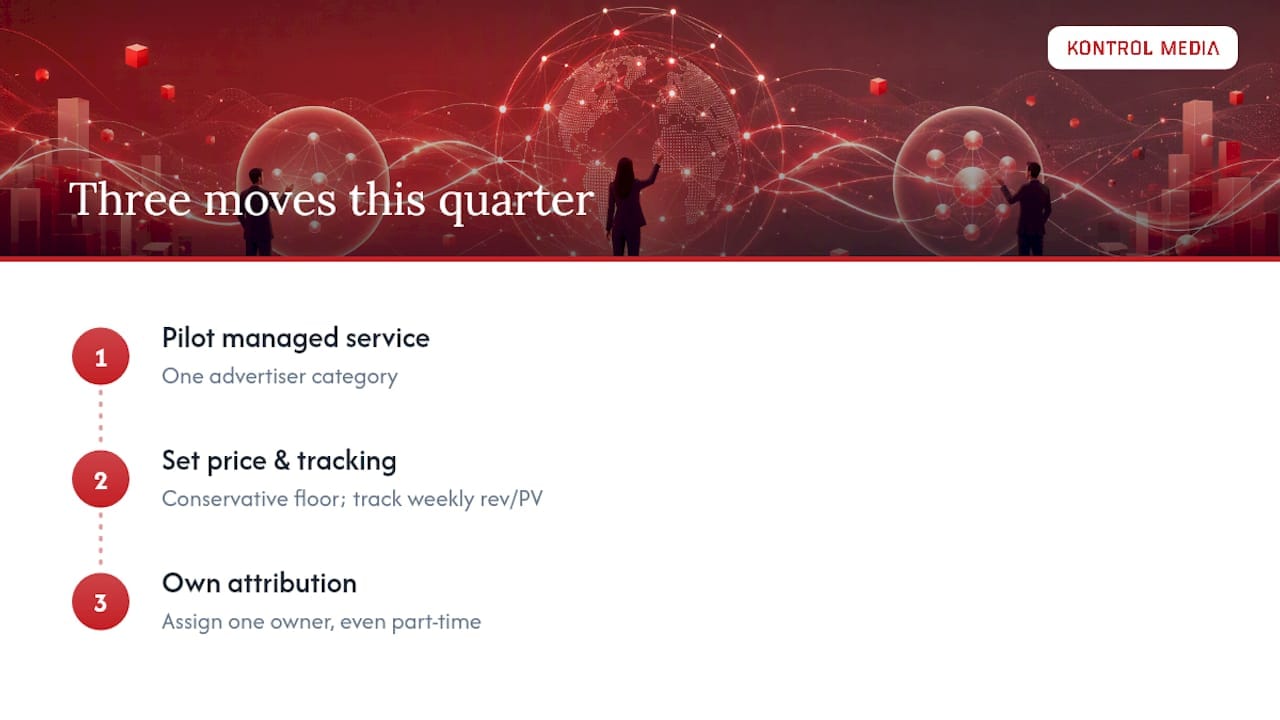
Three moves to make this quarter: pick one advertiser category to pilot managed service with, set a conservative floor price and commit to tracking revenue per page view weekly, and assign one person, even part time, to own attribution reporting before you sell a single campaign.
— Mark Kapczynski
How Kontrol Media Helps You Build or Run This
Kontrol Media is the practical alternative to hiring a full internal team from scratch or guessing your way through a pilot. Where most retailers either overbuild ad-tech before proving demand or underinvest in the ad-ops and measurement roles that make advertisers renew, Kontrol Media runs the assessment, builds the roadmap, and can operate the pilot directly, so you get a working network faster and with fewer expensive missteps.
A first engagement typically starts with an assessment of your existing traffic, data assets, and advertiser demand, followed by a roadmap that sequences formats and pricing the way this guide outlines. From there, Kontrol Media can either hand off an execution playbook to your internal team or stay on to operate the network directly, including sales, ad ops, and reporting. If you’re weighing whether to build, staff, or outsource this function, the fastest next step is a direct conversation. Reach out to Kontrol Media to scope what a pilot would look like for your business, or review the full build versus buy framework before your next planning cycle. For teams evaluating managed ad-buying tools to pair with an internal build, MediaBloom’s ad management platform is worth a look as well.
Sources
- Commerce media and retail media network research (ScienceDirect)
- IAB Europe: Guide to Retail & Commerce Media (July 2025)
- Nielsen: Need to know: what are retail media networks?
- eMarketer: FAQ on retail media networks and budget allocation (2026)