


An orchestration management system for a retail media network is the command layer that lets a retailer plan, activate, optimize, and measure ad campaigns across on-site, off-site, and in-store channels from a single point of control. Its main job is collapsing fragmented tools into one operating model built on first-party data. The payoff is faster activation and measurable ROI. Deployment happens in phases, not overnight.
TL;DR:
- Success depends on evaluating data ownership, integration capabilities, measurement accuracy, automation, and total cost of ownership before selecting a system.
- A phased rollout focusing on core data foundations, measurement, audience segmentation, and insights reduces deployment risks and builds trust with advertisers.
- Operational challenges often stem from technical and organizational frictions, making quick-win KPIs and early measurement guardrails essential for progress.
- Owning the orchestration layer creates a data advantage that accelerates optimization, improves campaign efficiency, and builds a competitive moat.
- Partnering with experienced operators like Kontrol Media can shorten time-to-revenue, lower ongoing costs, and develop a trustworthy measurement framework.
Table of Contents
- What Is an Orchestration Management System, and What Does It Actually Do?
- The Technical Building Blocks Behind Retail Media Orchestration
- What ROI Improvements Should You Expect From Orchestration?
- How Do You Evaluate and Roll Out an Orchestration System?
- What Actually Trips Up Orchestration Deployments in Practice
- Why Orchestration Ownership Is Becoming a Competitive Line in the Sand
- How Kontrol Media Helps You Build and Run Retail Media Orchestration
- Sources
What Is an Orchestration Management System, and What Does It Actually Do?
Ask five retail media leaders what orchestration means and you’ll get five slightly different answers, but the operating model underneath is consistent. Orchestration connects media inventory, first-party data, advertiser-facing tools, and measurement into a layer that governs how campaigns move from plan to proof of performance. Advertising Week frames it as a unifying layer that connects inventory, data, APIs, and measurement, without pulling buying platforms like demand-side platforms inside it. Retailers keep control of their own data while advertisers still buy through the tools they already know.
In practice, orchestration changes four things about how a retail media team operates:
- A single entry point replaces the patchwork of spreadsheets, ad servers, and email threads advertisers used to navigate campaign by campaign.
- Activation runs across on-site placements, off-site retargeting, and in-store or connected-commerce inventory from the same control plane, instead of three disconnected workflows.
- Budgets shift and creative adapts in real time as campaigns run, rather than waiting for a weekly optimization meeting.
- Measurement closes the loop across channels, tying exposure to purchase whether that purchase happened online or at the register.
That last point is where most legacy retail media setups fall apart: they can report on-site sales lift, but they can’t connect an off-site impression to an in-store transaction without manual reconciliation.
The Technical Building Blocks Behind Retail Media Orchestration
Orchestration isn’t one piece of software. It’s a stack, and understanding the pieces matters whether you’re buying a platform or building one with an integrator. The foundation is a cloud-based first-party data environment, because every other layer depends on clean, current, permissioned data about shoppers, transactions, and loyalty behavior. Retailers who treat data ownership as an afterthought end up renting insight from the same platforms they’re trying to monetize.
Here’s how the stack typically breaks down:
- Data foundation. A cloud data warehouse or lakehouse consolidating POS, loyalty, and behavioral data, structured so downstream tools can query it without custom engineering for every use case.
- Connectors and APIs. Pre-built integrations to ad platforms, point-of-sale systems, and loyalty databases. EPAM’s Retail Media Orchestration Toolkit leans on these connectors specifically to cut the friction that normally stalls in-house builds.
- Audience builder. Predictive segmentation, often powered by machine learning, that turns raw transaction history into activatable audiences advertisers can target.
- Campaign orchestration engine. The rules layer governing scheduling, budget allocation, and pacing logic across channels.
- Measurement and attribution pipeline. The KPI engine tying exposure to outcome, including closed-loop attribution back to sales data.
- Governance and permissioning. Rules controlling who can access which data, at what granularity, and under what advertiser agreement.
Pro Tip: Don’t buy the campaign engine before you’ve audited your data foundation. A brilliant activation layer sitting on messy, duplicated, or stale transaction data will optimize campaigns against bad information faster than a manual process ever could.
Governance often gets bolted on late, and that’s the mistake. Advertising Week’s analysis notes that orchestration preserves retailer control over first-party data specifically because governance is built into the architecture, not added after advertisers start asking questions.
What ROI Improvements Should You Expect From Orchestration?
The business case for orchestration comes down to speed and yield. When campaign setup, activation, and reporting all run through one system instead of four disconnected tools, the time between “advertiser signs the contract” and “campaign is live” shrinks dramatically. That speed compounds: faster activation means more campaigns per quarter, which means more advertiser revenue without adding headcount.
Vendor-reported figures back this up directionally, even if exact numbers vary by deployment. LatentView Analytics describes retail media operating systems using predictive analytics and real-time optimization delivering performance improvements during live campaigns, alongside incremental revenue gains for the retail media network itself. Separately, market research on operations suites points to reduced total cost of ownership and improved advertiser retention among retailers who consolidate fragmented point solutions into one stack.
The gains aren’t evenly distributed. Media ops teams get the biggest relief from manual reconciliation work. Analytics teams gain the most from closed-loop measurement replacing spreadsheet-stitched attribution. Sales teams close deals faster because they can promise real activation timelines instead of “a few weeks, maybe.”
The benefits stack:
- Shorter time-to-activation on new advertiser campaigns.
- Improved ROAS and POAS from real-time budget and creative adjustments.
- Lower operational overhead from retiring redundant point solutions.
- New monetization paths as unified data supports better-targeted, higher-value audience segments.
How Do You Evaluate and Roll Out an Orchestration System?
Before shopping for a platform, run an honest readiness check. Four things determine whether orchestration will succeed or stall: data maturity, governance structure, in-house technical skills, and a commercial model advertisers will actually accept. Skipping this step is why so many orchestration projects get relaunched a year later under a new vendor name.
Once you’re confident on readiness, judge any system or partner against five criteria:
- Data ownership. Does your first-party data stay yours, or does the platform become the de facto owner of your audience insight?
- Integration breadth. How many connectors exist for your specific POS, loyalty, and ad tech stack, out of the box?
- Measurement fidelity. Can it close the loop between off-site exposure and in-store purchase, not just on-site clicks?
- Automation depth. Does budget and creative optimization happen in real time, or on a delayed batch cycle?
- Total cost of ownership. What’s the real cost including services, and how hard is it to leave if the vendor relationship sours?
From there, a phased rollout reduces risk versus a big-bang launch:
- Phase 1, design. Establish the data foundation and connect core systems.
- Phase 2, measurement. Stand up multichannel measurement before adding complexity.
- Phase 3, audiences. Layer in predictive segmentation once measurement is trustworthy.
- Phase 4, insights. Turn accumulated data into advertiser-facing reporting and new monetization products.
A strong pilot use case: an omnichannel promotion with closed-loop measurement across on-site and in-store, proving the model before scaling to the full advertiser roster. For deeper guidance on structuring this rollout, see how Kontrol Media approaches retail media network operations.
What Actually Trips Up Orchestration Deployments in Practice
The technical stack is rarely what kills an orchestration rollout. It’s usually the boring stuff: POS schema that doesn’t map cleanly to audience models, brand partners who resist a new measurement standard, or leadership expecting quarter-one ROI on work that requires real data engineering first. Kontrol Media’s operating experience with retail and commerce media networks bears this out consistently.
What tends to work:
- Scope the pilot to one category or one advertiser cohort, not the whole catalog.
- Set quick-win KPIs around activation time and reporting accuracy before chasing ROAS lift.
- Build measurement guardrails early so advertisers trust the numbers before you scale volume.
Pro Tip: Pick a pilot advertiser who already trusts your data team. A skeptical first partner will slow the whole rollout down arguing about attribution methodology instead of testing the system.
Why Orchestration Ownership Is Becoming a Competitive Line in the Sand
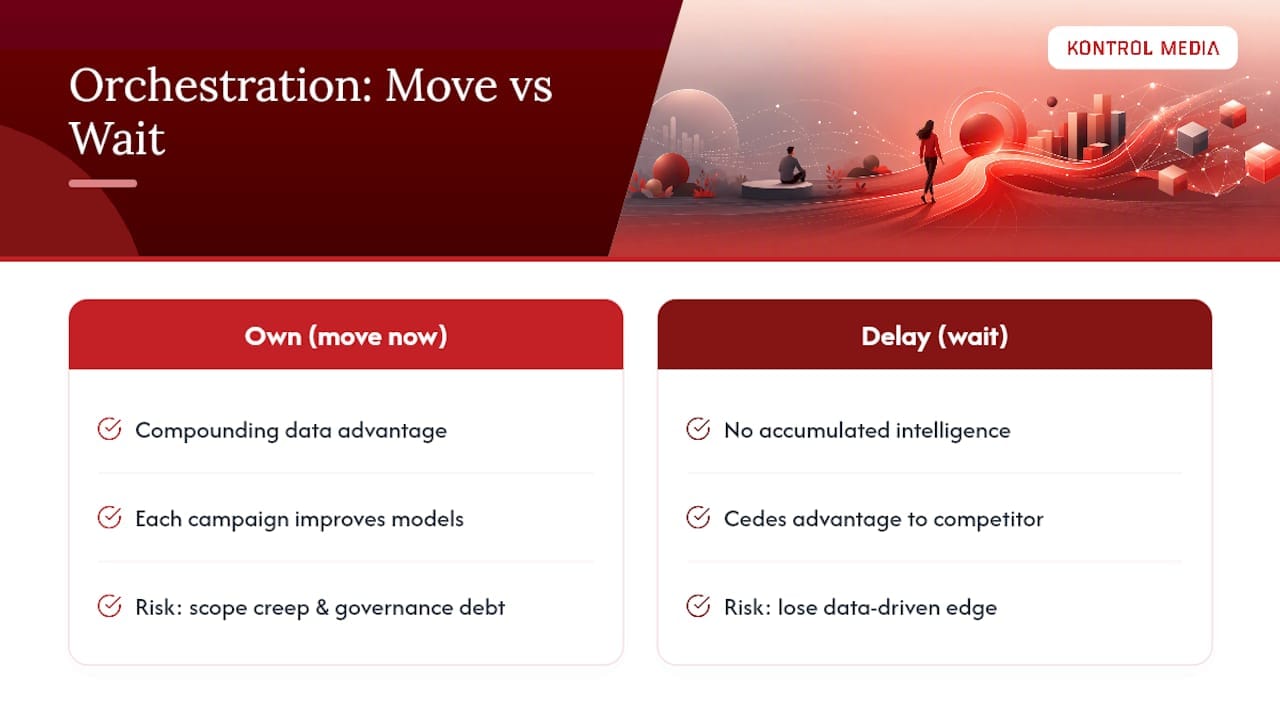
Retailers who own their orchestration layer are building something competitors can’t easily copy: a data advantage that compounds. Every campaign run through an owned system improves the audience models and measurement baseline for the next one. Retailers renting that intelligence from third parties never accumulate the same edge.
Generative AI is accelerating this gap. Real-time budget optimization and predictive audience creation, once quarterly analyst projects, are becoming automated background processes. That shift rewards retailers who move now, even with a narrow pilot, over those waiting for a “perfect” platform decision. The risk of moving early is scope creep and governance debt. The risk of waiting is ceding the data advantage to whichever competitor built theirs first. For most retail media networks with real transaction volume, a guarded pilot beats deferral.
— Mark Kapczynski
How Kontrol Media Helps You Build and Run Retail Media Orchestration
Deciding whether to build orchestration in-house, buy a platform, or blend the two is exactly the kind of decision that benefits from someone who has run both sides of that trade-off. Kontrol Media works with retail and commerce media networks on build versus buy advisory, hands-on implementation, and managed operations once the system is live, including the advertiser acquisition work that actually fills the pipeline you just built.
The outcomes clients care about are the ones that show up on a P&L: shorter time-to-revenue on new advertiser onboarding, lower ongoing operations cost versus running fragmented point solutions, and a measurement framework advertisers actually trust. If you’re weighing whether to build your orchestration layer in-house or bring in operators who’ve done it before, start with Kontrol Media’s retail media network operations playbook and reach out for a working session on your specific stack and timeline.
Sources
- Accelerate retail media success with EPAM and Google Cloud
- A Giant Leap Forward? Why Retail Media’s Next Era Depends on Orchestration
- The Future of Retail Media: From Outsourced Execution to Owned Intelligence – LatentView Analytics
- Retail Media Network Operations Suites Market Research Report 2034