


The top issues facing CMOs for 2026 fall into six buckets: AI readiness and governance, privacy-driven measurement gaps, budget and short-term pressure, capability and resourcing shortfalls, martech integration and data architecture, and fragmented discovery with content authenticity. Each one has a one-line fix a CMO can act on this quarter.
- AI readiness and governance → Map three real use cases, run guarded pilots, skip the platform-wide rollout.
- Privacy-driven measurement gaps → Shift budget toward incrementality testing and first-party cohorts now.
- Budget and short-term pressure → Marketing budgets have fallen to roughly 9.0% of company revenue, so tie every dollar to a revenue metric the CFO already tracks.
- Capability and resourcing shortfalls → Protect training spend even as headcount growth slows.
- Martech integration and data architecture → Fix one canonical data definition before buying another tool.
- Fragmented discovery and content authenticity → Audit how your brand shows up in AI search results this month.
Gartner reports that 63% of senior marketing leaders now name budget and resource constraints are the top challenge for many senior marketing leaders, while revenue growth remains the top priority… That tension defines the whole job in 2026.
Key Takeaways
CMOs who succeed in 2026 will pair fast, evidence-based experiments with a formal CMO-CFO governance rhythm, rather than choosing between speed and structure.
| Point | Details |
|---|---|
| Fix readiness before scale | AI adoption has tripled since 2022, but no martech activity scores above 5 on a 7-point readiness scale. |
| Rebuild measurement first | Prioritize incrementality testing and first-party cohorts over legacy multi-touch attribution models. |
| Protect capability budgets | Training spend has fallen to 3.8% of marketing budgets even as capability importance stays high at 5.9 out of 7. |
| Score initiatives, don’t guess | Use Revenue Velocity, Capability Fit, and Cost to Delay to rank spending in a single 15-minute session. |
| Formalize CMO-CFO reporting | A quarterly shared-KPI cadence prevents budget fights from becoming reactive cuts. |
Table of Contents
- What Each Top Issue for CMOs in 2026 Actually Means
- A Simple Framework for Prioritizing Under Budget Pressure
- Your 30/90/365-Day Playbook for 2026
- The Org Changes That Make This Roadmap Stick
- Rebuilding Measurement When Signals Are Incomplete
- Revenue Growth and Proving ROI Under Constant Budget Scrutiny
- Regulatory Pressure Beyond Data Privacy
- Sustainability as a Brand Differentiator, Not a Compliance Line Item
- Using Predictive Analytics to Get Ahead of the Decision, Not Behind It
- Balancing Personalization With the Human Touch
- Planning for Economic Uncertainty Without Freezing Marketing
- An Editorial Take on What CMOs Should Actually Prioritize in 2026
- Frequently Asked Questions
- Sources
What Each Top Issue for CMOs in 2026 Actually Means
AI adoption has outrun AI readiness. Marketing use of AI has more than tripled since 2022, and companies expect AI to power more than half of marketing activities within three years. But no marketing technology activity scores above 5 on a 7-point readiness scale. That gap is the real story, not the adoption number. A mid-market retail brand might deploy a generative AI tool for product descriptions in week one and discover by week six that nobody owns brand-voice review, so half the copy needs a rewrite. That’s not an AI failure. It’s a governance failure that AI made visible.
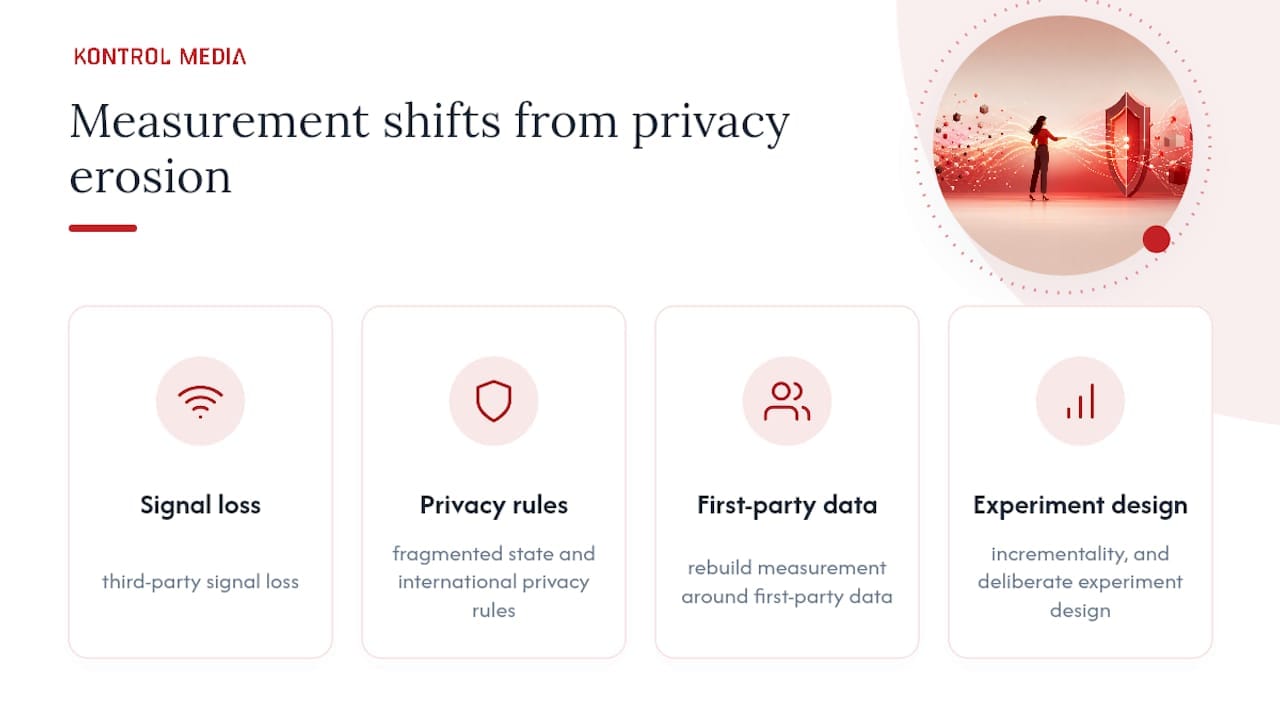
Privacy erosion has turned measurement into an engineering problem. Third-party signal loss and fragmented state and international privacy rules have made attribution noisier and harder to defend in a board meeting. As CMSWire puts it, CMOs increasingly have to rebuild measurement around first-party data, incrementality, and deliberate experiment design rather than the multi-touch models that worked five years ago.
Budget scrutiny is chronic, not cyclical. Executives cut marketing spend 45.4% of the time when company profits soften, and that reflex has only sharpened as tariff and economic pressure weigh on 2026 planning. A B2B SaaS company facing this squeeze often freezes new-market spend first and defends renewal marketing last, which quietly starves the pipeline that funds next year’s renewals.
Capability gaps are a resourcing problem wearing a skills-shortage costume. Marketing leaders rate capability development a 5.9 out of 7 in importance, yet training budgets have dropped to just 3.8% of marketing spend, down from 5.8%, while headcount growth has slowed by more than half.
That single finding from The CMO Survey explains why so many enterprise martech stacks sit half-used: the tools got funded, but the integration work and the people to run them didn’t.
Discovery is fragmenting faster than most content operations can follow. Marketers are shifting investment back toward brand and discoverability, but operational readiness to execute across AI-driven search, conversational interfaces, and social discovery is lagging behind the ambition.
A Simple Framework for Prioritizing Under Budget Pressure
Score every candidate initiative on three criteria: Revenue Velocity (how fast it moves a tracked revenue metric, 1 to 5), Capability Fit (do you already have the people and data to execute, 1 to 5), and Cost to Delay (what breaks if you wait a quarter, 1 to 5). Add the three scores; anything above 11 goes first.
Run it this way in a 15-minute exec review:
- List every initiative competing for Q1 budget.
- Score each on Revenue Velocity, Capability Fit, and Cost to Delay.
- Rank by total score, not by who’s loudest in the room.
- Fund the top two fully before spreading dollars thin across five.
- Revisit scores every 90 days as new data arrives.
Applied to two real 2026 debates, this framework usually surprises people. A measurement rebuild often scores 13 (high revenue velocity, moderate capability fit, high cost to delay), while a broad AI governance rollout scores 8 (lower revenue velocity, low capability fit today). Fix measurement first; govern AI in parallel, not ahead of it.
Pro Tip: Bring your CFO into the scoring session, not just the final readout. When finance helps set the Cost to Delay numbers, they stop treating the ranking as a marketing opinion and start treating it as a shared model.
Your 30/90/365-Day Playbook for 2026
The near-term goal is simple: stabilize measurement, prove one fast AI win, and start building the capability you’ll need all year.
In 30 days: Run a martech and data audit to find your single biggest integration gap. Align the executive team on the top three 2026 priorities in writing. Launch one AI pilot with explicit guardrails on data use and brand voice. Ship one measurement quick-win, like an incrementality test on your highest-spend channel. Owner: CMO with marketing ops lead. KPI: time-to-decision on the pilot.
In 90 days: Fold pilot learnings into a broader rollout plan. Start fixing shared data definitions with IT and finance. Fill one or two critical roles, whether that’s an AI governance lead or a data product owner. Run retention-focused experiments tied directly to revenue, not just engagement. Owner: marketing ops and revenue marketing leads. KPI: marketing-to-revenue ratio and retention rate.
In 365 days: Formalize AI governance across the function. Scale the AI use cases that proved out in the pilot phase. Lock in a quarterly CMO-CFO reporting cadence built on shared KPIs. Set a permanent capability and training budget line, not a discretionary one. Owner: CMO with CFO sign-off. KPI: revenue lift attributable to marketing and year-over-year training investment.
Kontrol Media’s growth marketing frameworks walk through how to sequence these moves without stalling day-to-day campaign work.
The Org Changes That Make This Roadmap Stick
The single most important shift is moving to a composable, revenue-aligned marketing org with explicit CMO-CFO KPIs, because governance and reporting rituals fail when they’re bolted onto an org chart that wasn’t built for them.
- Add an AI governance lead who owns guardrails, not just tool selection.
- Create a marketing data product owner who treats data definitions as a product, not a side project.
- Name a retention growth lead distinct from acquisition marketing.
- Pair a measurement partner from finance with marketing ops on every major campaign.
Red flags that your current org is blocking progress: marketing and finance run separate roadmaps, budget reviews happen only monthly with no interim checkpoints, and no shared KPI exists between the CMO and CFO. Gartner’s research on the future of marketing recommends composable, human-AI hybrid team structures precisely because rigid, single-track orgs can’t absorb AI agents fast enough to capture their upside. Fix roles immediately, install 90-day governance rituals next, and treat the full structural shift as a 12-month project.
Rebuilding Measurement When Signals Are Incomplete
Design for partial signals: prioritize first-party data and experiment-driven evidence over any model that assumes complete visibility into the customer journey.
That means leaning on incrementality testing, synthetic control groups, probabilistic modeling, and cohort-based KPIs instead of last-touch attribution. None of these are new techniques, but they’re now the primary toolkit rather than a backup plan. Build a data governance checklist alongside them: canonical metric definitions everyone in the company uses the same way, access controls on customer data, clear labeling on any dataset used to train models, and version tracking so you know which model produced which result.
Pro Tip: Before generative AI touches customer-facing content, run every output through a human brand-voice review for the first 90 days. It’s the cheapest insurance against the trust damage one bad AI-written email can cause.
Training budgets have fallen to 3.8% of marketing spend, which is precisely the wrong moment to under-invest in the measurement literacy your team needs to run these methods well.
How Kontrol Media Helps CMOs Fix These Issues
Kontrol Media builds the go-to-market execution and revenue infrastructure that turns this roadmap from a slide deck into signed engagements.
Our work with brands like Experian and REMAX has centered on one repeated pattern: clients gain the most ground when they fix measurement and channel structure before they scale spend.
A mid-market client used this sequencing to open a new partnership-driven revenue channel within a single quarter. Explore Kontrol Media’s business strategy consulting to see how the engagement model works.
Revenue Growth and Proving ROI Under Constant Budget Scrutiny
Revenue growth is the top CMO priority for 2026, according to Gartner, but proving marketing’s contribution to that growth has gotten harder, not easier, as budgets tighten. Marketing spend now sits around 9% of company revenue, a level that leaves little room for initiatives that can’t show their math within a quarter or two.
This is where the incrementality-first measurement approach from earlier pays off directly. A CMO who can point to a controlled experiment showing a channel drove 8% incremental lift has a fundamentally stronger position in a budget review than one citing a multi-touch attribution model the CFO doesn’t fully trust. Boards and finance teams have grown skeptical of marketing metrics that can’t survive a skeptical question, and that skepticism isn’t going away in 2026.
The practical response is to build a small portfolio of always-on experiments, not a single annual measurement project. Test one pricing message, one channel mix, one retention offer, continuously, and roll the results into quarterly business reviews rather than an annual marketing report nobody outside the department reads. Aligning marketing and sales around shared revenue targets makes this reporting cadence far easier to sustain, because both functions are already looking at the same numbers.
Short-term proof and long-term brand investment aren’t opposites here. The CMOs who win budget fights in 2026 are the ones who can show both a quarterly win and a credible multi-year growth story in the same meeting.
Regulatory Pressure Beyond Data Privacy
Data privacy dominates the compliance conversation, but it’s no longer the only regulatory risk on a CMO’s desk. Advertising standards bodies and state attorneys general have started scrutinizing AI-generated marketing claims, synthetic endorsements, and algorithmic pricing disclosures with the same intensity once reserved for traditional deceptive advertising cases.
This matters because the guardrails a marketing team builds for generative AI tools often double as compliance infrastructure. A content workflow that requires human review before an AI-drafted claim goes live isn’t just a brand-safety measure. It’s also the paper trail a legal team wants if a regulator asks how an ad claim was substantiated.
CMOs should treat three areas as active regulatory risk in 2026: AI-generated content disclosure requirements, which vary significantly across the U.S. and internationally; algorithmic personalization and pricing rules, which are tightening in several states; and influencer and endorsement disclosure standards, which now extend to AI-generated personas and synthetic spokespeople. None of these require a dedicated legal hire on day one, but they do require a documented review process that connects marketing, legal, and whoever owns the AI governance function described earlier. Waiting for a regulator’s letter to build that process is the expensive way to learn this lesson.
Sustainability as a Brand Differentiator, Not a Compliance Line Item
Sustainability and corporate responsibility have moved from the investor-relations page to the marketing brief, and that shift accelerates in 2026 as consumers and B2B buyers alike treat environmental and social claims as a filter, not a footnote.
The differentiation opportunity is real, but so is the risk of getting caught making a claim you can’t back up. Greenwashing accusations move fast on social platforms and even faster through AI-generated search summaries that compress a brand’s public claims into a single confident sentence, whether that sentence is accurate or not.
The practical move for a CMO is to treat sustainability messaging the same way the measurement section above treats attribution: build it on verifiable, first-party evidence rather than aspirational language. If a supply chain claim can’t survive a journalist’s or a regulator’s follow-up question, it doesn’t belong in a campaign. That standard sounds conservative, but it’s what lets sustainability actually function as a durable differentiator instead of a liability waiting to surface.
For enterprise brands weighing new-market entry, strategies for expanding into new markets increasingly need to account for how local sustainability expectations and disclosure norms differ from the home market, particularly in regulated categories like finance and consumer goods.
Using Predictive Analytics to Get Ahead of the Decision, Not Behind It
Most marketing analytics still describe what already happened. The CMOs pulling ahead in 2026 are using predictive modeling to flag what’s about to happen, whether that’s churn risk, demand shifts, or a channel’s diminishing returns, early enough to act on it.
This isn’t about buying a bigger dashboard. It’s about connecting the cohort-based measurement approach discussed earlier to forward-looking models that flag, for example, a customer segment showing early churn signals two months before renewal, or a paid channel whose efficiency is about to drop based on early-funnel signal decay. A predictive model built on clean first-party cohorts is far more trustworthy than one bolted onto noisy, privacy-degraded third-party data.
The organizational prerequisite matters here: predictive modeling only works when the canonical data definitions from the measurement checklist are actually in place. A model built on inconsistent customer definitions across regions or business units will produce confident, wrong answers, which is worse than no model at all. This is also where the martech integration barrier, cited by 19.1% of marketing leaders as a top obstacle, does the most damage. Fix the data architecture first, and predictive analytics becomes a genuine advantage rather than an expensive experiment that never ships.
Balancing Personalization With the Human Touch
Customers in 2026 expect personalization that feels earned, not automated for its own sake, and the gap between those two experiences has become one of the fastest ways to lose trust in a single interaction.

Automation genuinely improves speed and consistency at scale: a well-trained system can route a support question, tailor a product recommendation, or personalize an email subject line faster and more consistently than any human team could manage across a large customer base. But automation without a visible human option, especially at moments of friction or complaint, reads as indifference rather than efficiency. Post-pandemic customers, who grew comfortable with digital-first service out of necessity, are now more willing to reward brands that offer a real person when the stakes are high.
The practical line is straightforward: automate the routine, and staff the exceptions. A returns process can run entirely through AI-driven workflows. A high-value customer threatening to churn should reach a human within minutes, not a chatbot loop. Getting that handoff wrong, either by over-automating sensitive moments or under-automating routine ones, is a more common failure than most CMOs expect walking into 2026 planning. A category label like “enterprise AI agents” describes the tooling well, but the deployment discipline around when to use them is where brand trust actually gets won or lost.
Planning for Economic Uncertainty Without Freezing Marketing
Scenario planning has moved from a nice-to-have to a required input for 2026 marketing budgets, given how quickly tariff pressure and shifting profit forecasts have already forced reactive cuts across the industry.
The fix isn’t a single fixed budget. It’s a small number of pre-approved scenarios, typically a base case, a downside case triggered by a defined revenue or margin threshold, and an upside case, each with pre-agreed spending adjustments attached. When a downside scenario hits, the CMO isn’t negotiating cuts in real time under pressure. The cuts were already planned, sequenced, and approved months earlier.
This structure also protects the initiatives that matter most. Rather than an across-the-board percentage cut, which tends to punish the highest-performing channels along with the weakest ones, a scenario plan can specify exactly which programs get protected and which get paused first. That’s a far stronger negotiating position with a CFO than reopening the whole budget every time the economic outlook shifts. Reviewing long-term versus short-term strategy trade-offs during scenario planning, rather than after a downturn hits, keeps brand investment from becoming the first and easiest casualty of a rough quarter.
An Editorial Take on What CMOs Should Actually Prioritize in 2026
The conventional advice for 2026 tells CMOs to chase AI maturity first and fix measurement later. That ordering is backward. Every AI pilot depends on clean, canonical data to produce trustworthy output, and most organizations don’t have that yet. Build the measurement foundation first, and the AI pilots that follow will actually be worth scaling.
The most overrated fix I see pitched to CMOs right now is the platform-wide AI rollout, sold as a way to leapfrog the readiness gap The CMO Survey documents. It doesn’t work that way. Readiness gaps close through a handful of well-scoped pilots with real governance attached, not through buying more seats.
What deserves the most attention isn’t AI at all. It’s the CMO-CFO relationship. Every issue in this piece, from budget scrutiny to measurement credibility to scenario planning, gets easier to solve the moment marketing and finance share a KPI. Start there.
Frequently Asked Questions
What are the top issues facing CMOs for 2026?
The top issues facing CMOs for 2026 are AI readiness and governance, privacy-driven measurement gaps, budget and short-term pressure, capability and resourcing shortfalls, martech integration and data architecture, and fragmented digital discovery.
Why is AI adoption outpacing AI readiness among marketing teams?
AI use in marketing has more than tripled since 2022, but organizational readiness, including data quality, governance, and staff training, hasn’t kept pace, leaving a gap between what AI tools can do and what teams can safely deploy.
How should CMOs respond to shrinking training budgets?
Protect a fixed capability and training budget line even when overall marketing spend tightens, since capability gaps tend to be resourcing problems rather than genuine skills shortages.
What’s the fastest way for a CMO to rebuild measurement confidence?
Shift investment toward incrementality testing and first-party cohort analysis instead of relying on multi-touch attribution models weakened by third-party signal loss.
How does Kontrol Media help CMOs execute on these 2026 priorities?
Kontrol Media provides hands-on business strategy and execution support, from go-to-market planning to revenue channel development, for CMOs turning these priorities into funded, sequenced projects. Contact Kontrol Media to discuss a specific engagement.
Sources
- The_CMO_Survey-Highlights_and_Insights_Report-2026.pdf
- CMOs’ Top Challenges & Priorities For 2026 (Gartner press release)
- The top challenges facing CMOs in 2025 (CMSWire)
Recommended
- Growth Marketing Frameworks CMOs Use to Drive Revenue | Kontrol Media Consultancy
- 5 Things Brands Should Prioritize in 2025 | Kontrol Media Consultancy
- Do Brands Still Advertise on News Sites? A CMO’s Guide | Kontrol Media Consultancy
- How to Align Marketing to Business Goals in 2026 | Kontrol Media Consultancy