


Yes, you can outsource your media sales function to a modern rep firm that acts like an embedded revenue team, not a commission-only middleman. The term “rep firm” is decades old, but the model behind it has changed completely. Today’s version brings sales development reps, sellers, campaign managers, and account managers who plug directly into your CRM, review your media kit, and often manage billing and collections on your behalf.
This shift matters because publisher sales teams are living through what Digiday calls the “outcomes era”, where advertisers expect strategic partners, not order-takers. A modern rep firm like Kontrol Media builds ad products, not just fills inventory.
You’re probably a candidate for outsourcing if any of these sound familiar:
- New sales hires take more than three to four months to ramp and start closing deals.
- Your ad products haven’t changed in a year, and brands are asking for something you don’t have.
- You have a short-term revenue gap (a launch, a seasonal push, a leadership transition) and no time to hire.
- Billing and collections are eating hours your team should spend selling.
Two signals worth noting before you go further: the outcomes-era shift documented by Digiday, and Kontrol Media’s own model, which explicitly embeds a full sales function inside a client’s existing systems rather than working alongside them.
Key Takeaways
Outsourcing your media sales function to a modern rep firm works when the firm supplies a full team, ad-product development, and billing support, not just a commission-based seller.
| Point | Details |
|---|---|
| Modern rep firms are full teams | SDRs, sellers, campaign managers, and account managers replace the old solo commission rep model. |
| Pricing maps to risk | Commission-only, retainer plus commission, project pricing, and managed retainers each shift risk differently between you and the firm. |
| Vet product development directly | Ask for a real ad product a firm built and the revenue result before signing any contract. |
| Onboarding runs on a 90 to 120 day cycle | Audit, packaging design, pilot, and scale are the standard milestones with defined owners. |
| Kontrol Media offers an audit-to-pilot path | Its model embeds sales, ad-product development, and billing support, with clients including Experian and BuzzFeed. |
Table of Contents
- Using a Rep Firm to Outsource Your Media Sales Function: What It Actually Means Today
- Why Media Businesses Outsource Sales and When It Pays Off
- Who Actually Does the Work: Team Roles and Services
- How Rep Firms Price Their Services
- What to Ask Before You Sign a Rep Firm
- What Onboarding and the First 90 Days Look Like
- Which KPIs Prove an Outsourced Sales Team Is Working
- What Can Go Wrong and How to Prevent It
- Why Kontrol Media’s Approach to Outsourced Sales Works
- Get Started With a Media Sales Audit and Pilot
- Sources
Using a Rep Firm to Outsource Your Media Sales Function: What It Actually Means Today
The old picture of a “rep firm” is a lone commission-only salesperson working a territory, collecting a check when a deal closes, and disappearing when the market shifts. That model still exists, but it’s a shrinking slice of what outsourcing your media sales function actually looks like now.
A modern rep firm is a full outsourced sales function: a team, a process, and a set of deliverables that mirror what an in-house department would produce, minus the payroll and ramp time. The Pressbooks Principles of Marketing chapter on outsourced sales lays out the classic taxonomy of distributors, independent agents, and manufacturers’ reps. Media businesses have adapted that same logic into several distinct engagement types:
- Publisher representation (commission-only): Still common for niche verticals or long-tail inventory. Low commitment, lower control.
- Fractional retained sales: A senior seller or small pod works your accounts on a retainer plus commission, filling a specific gap (usually a named vertical or region).
- Project-based pipeline builds: A firm is hired to stand up a pipeline, qualify leads, and hand off warm opportunities, often used to launch a new ad product fast.
- Fully outsourced managed sales function: The entire commercial operation, prospecting through billing, sits with the rep firm, running under your brand.
The difference between the old and new model isn’t just headcount. It’s scope. An old-school rep sells what’s already packaged. A modern rep firm helps design what gets sold, builds the pitch deck, runs the campaign once it’s live, and chases the invoice when the campaign ends.
Kontrol Media operates at the top end of that taxonomy: a fully outsourced managed sales function that layers in ad-product development and billing support, which is the part most legacy rep arrangements never touched.
Why Media Businesses Outsource Sales and When It Pays Off
The business case for outsourcing rarely comes down to a single reason. It’s usually a stack of pressures that hit at once: a hiring freeze, a stalled ad product, an advertiser relationship nobody on staff can reach.
The primary benefits show up in a handful of places:
- Faster time-to-revenue. You skip the three-to-six month hiring and ramp cycle entirely.
- Lower fixed cost. No base salaries, benefits, or severance risk if the engagement doesn’t pan out.
- Access to vertical relationships. A firm with existing advertiser contacts in gaming, retail, or real estate shortens the sales cycle.
- Packaged ad-product development. Rep firms that build products for a living tend to spot revenue opportunities your team has stopped seeing.
- Predictable pipeline. A structured outsourced process often produces more consistent activity than an understaffed internal team stretched across too many priorities.
Here’s a practical checklist for deciding if now is the time:
- Ramp time for a new hire in your market exceeds three months.
- You need to launch a new ad product but lack the internal bandwidth to design it.
- Billing and collections are inconsistent or fall on someone without the time to chase them.
- You need buyer relationships in a specific vertical (gaming, commerce media, real estate) that nobody on staff owns.
- Leadership needs to show revenue traction on a shorter timeline than a hiring plan allows.
Gartner’s research on CMO priorities points to a consistent theme: marketing and revenue leaders face growing pressure to prove measurable outcomes, often with flat or shrinking headcount. That pressure is exactly what pushes hybrid execution models, including outsourced sales, from “nice to have” to operationally necessary. The media representative firms industry itself reflects this shift toward digital, outcomes-based representation rather than the legacy print-era commission model.
Who Actually Does the Work: Team Roles and Services
This is where the “rep firm” label stops matching reality. Outsourcing your media sales function today means hiring a team, not a person, and each role does something specific.
Sales development reps (SDRs) handle prospecting and qualification, filling the top of the funnel so sellers spend their time closing rather than cold-calling. Sellers or account executives run the actual sales conversations, build proposals, and negotiate terms. Campaign managers take over once a deal closes, making sure the creative runs correctly and the advertiser sees the results they were promised. Account managers own the renewal conversation and the long-term relationship, which is often where the real revenue compounds. Behind all four, a product developer and revenue operations function build the ad products being sold and keep the CRM, reporting, and forecasting honest.
The service list that comes with this team structure typically includes:
- Prospecting and lead qualification against a defined vertical or account list.
- Proposal packaging, including pricing logic and rate-card discipline.
- Ad-product engineering, meaning new sponsorship formats, bundles, or data products designed to fit what advertisers are actually buying in 2026.
- Billing and collections, so revenue booked actually turns into cash received.
- Weekly and monthly reporting on pipeline, forecast, and renewal risk.
Pro Tip: Ask any prospective rep firm to show you one ad product they built from scratch for a past client, along with the before-and-after revenue number. If they can only describe process, not a product, that’s a signal they sell activity, not outcomes.
Digiday’s reporting on the outcomes era backs this up directly: publishers are restructuring sales teams to include copywriters, designers, and product developers because advertisers no longer buy raw impressions, they buy stories with proof attached, as explained by modern content creation services that support this shift. A single commission rep working alone can’t build that. A team can.

The difference in outcomes is measurable in ramp time alone. A solo rep hired in-house typically needs a full quarter before closing meaningful revenue. A rep firm with SDRs already prospecting and a campaign manager ready to onboard new advertisers can often show pipeline activity inside 30 days, because the infrastructure already exists before your contract starts. Kontrol Media’s approach to advertising sales strategy for media networks reflects this exact structure: strategic packaging paired with the execution team to sell it.
How Rep Firms Price Their Services
Pricing models vary by how much risk each side is willing to carry, and that risk allocation is the real negotiation, not just the headline number.
Commission-only arrangements (classic publisher representation) put nearly all the risk on the rep firm. You pay only on closed revenue, typically a percentage that ranges depending on vertical and deal complexity. This model works best for established inventory that mostly sells itself.
Retainer plus commission (fractional models) split the risk. You pay a fixed monthly fee for dedicated capacity, plus a smaller commission on closed business. Independent ad-sales partners often use this structure because it gives the firm the security to invest real strategic time in your account rather than chasing only the fastest close.
Project or pipeline pricing is a fixed fee for a defined deliverable, often used to launch a new ad product or break into a new vertical, with success measured against pipeline volume rather than closed revenue.
Managed service retainers cover the fully outsourced model: one predictable monthly fee for the whole function, prospecting through billing.
A useful way to think about the tradeoff: a full-time senior seller costs salary, benefits, commission, ramp time, and the opportunity cost of a bad hire. MarketStar’s analysis on scaling ad sales frames outsourcing as avoiding that overhead entirely, converting a fixed cost with hiring risk into a variable cost tied to output.
When negotiating, a few contract levers protect both sides:
- Floor guarantees: A minimum monthly fee regardless of closed revenue, protecting the firm’s capacity investment.
- Commission waterfalls: Rates that increase once revenue crosses defined thresholds, rewarding growth.
- Clawbacks: Commission repayment if an advertiser churns within a defined window.
- Performance milestones: Fee increases tied to hitting specific pipeline or revenue targets rather than time elapsed.
The media representative firms industry reports average industry profit margins around 25.1%, a useful benchmark when you’re evaluating whether a proposed fee structure is reasonable or padded.
What to Ask Before You Sign a Rep Firm
Choosing the wrong partner costs more than a bad hire because you often don’t discover the mismatch until an advertiser relationship has already gone sideways. A structured evaluation process catches most of the risk before contracts are signed.
The core criteria worth scoring every candidate against:
- Vertical expertise specific to your business (gaming, commerce media, real estate, publishing).
- Documented advertiser relationships, not just a client logo list.
- A demonstrated ability to build new ad products, not just sell existing ones.
- CRM and reporting integration that gives you live visibility, not a monthly PDF.
- Billing and collections capability, ideally with a described process, not a vague promise.
- References and case studies with real numbers attached.
Bring these questions into the RFP or interview stage:
- Walk me through an ad product you built for a client in a similar vertical, and what revenue resulted.
- What’s your average ramp time from contract signing to first closed deal?
- Who owns the advertiser relationship contractually, you or us, if we end the engagement?
- Can we see your CRM dashboard before we sign, not after?
- How do you handle collections on past-due accounts, and who absorbs the loss if an advertiser doesn’t pay?
- What does your reporting cadence look like week to week?
Watch for these red flags: a firm that can’t produce a single product-development example, vague answers about who “owns” the advertiser relationship, no willingness to grant CRM visibility before signing, or a billing process that’s described in generalities rather than steps. Kontrol Media’s work on identifying and capitalizing on business development opportunities is a useful reference point for how a serious evaluation framework should look before any contract gets signed.
What Onboarding and the First 90 Days Look Like
The first three months determine whether an outsourced sales engagement becomes a long-term asset or a six-month regret. A well-run onboarding follows a predictable sequence.
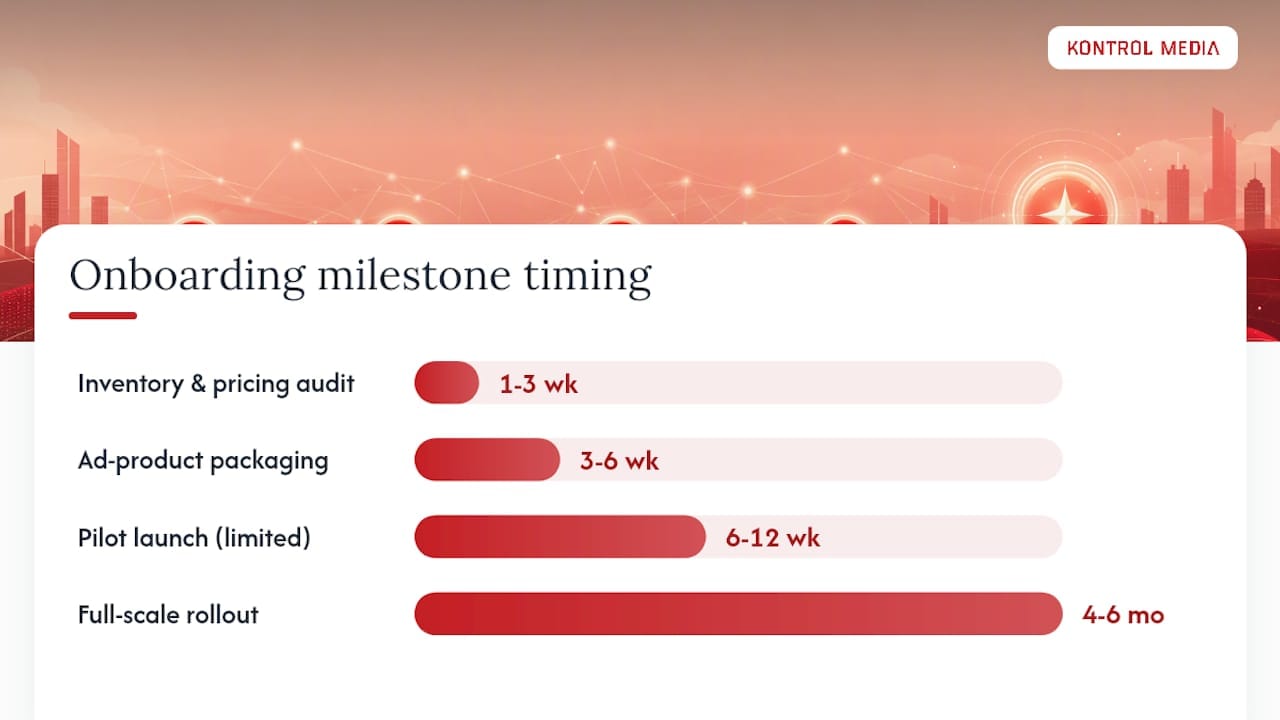
The typical milestone path runs: audit your current inventory, pricing, and advertiser list; design or refine ad-product packaging based on that audit; run a pilot with a limited account list or vertical; then scale to the full book of business once the pilot proves the model works.
| Milestone | Owner | Typical Timing |
|---|---|---|
| Inventory and pricing audit | Rep firm, with client data access | Weeks 1 to 3 |
| Ad-product packaging design | Rep firm, client sign-off | Weeks 3 to 6 |
| Pilot launch (limited accounts) | Joint | Weeks 6 to 12 |
| Full-scale rollout | Rep firm, client oversight | Months 4 to 6 |
Before the pilot begins, get four things in writing. First, an SLA covering response times, pipeline activity metrics, and how revenue gets attributed between existing house accounts and new business the firm generates. Second, tech access: CRM permissions, reporting dashboards, tracking rules, and a clear process for creative handoffs. Third, a contract section on IP and advertiser ownership, meaning what happens to those relationships if the engagement ends. Fourth, termination terms and billing responsibilities spelled out clearly enough that nobody’s guessing six months in.
Kontrol Media’s guide on ad operations for revenue leaders covers the technical integration side of this in more depth, particularly around how tracking and reporting should be structured before a pilot ever launches.
Which KPIs Prove an Outsourced Sales Team Is Working
You can’t judge an outsourced sales engagement on gut feel. You need numbers that show up on a dashboard, reviewed on a schedule everyone agreed to upfront.
Primary KPIs worth tracking every month:
- Revenue by product line, so you can see which ad products are actually working.
- Close rate on qualified opportunities.
- Pipeline velocity, meaning how fast deals move from first contact to signed.
- Average deal size and whether it’s trending up or down.
- Renewal rate on existing advertisers.
- Advertiser lifetime value.
- Accounts receivable aging and collections rate.
Secondary metrics that give an earlier read on health: meetings set per week, proposals sent, and campaign delivery metrics like viewability, clicks, or conversions when those are available.
A sensible reporting rhythm looks like weekly pipeline reviews, monthly revenue and forecast reports, and a quarterly strategic review where both sides assess whether the ad-product mix still matches what advertisers want. Digiday’s outcomes-era coverage makes the point that advertisers increasingly expect campaign performance data as proof of value, not just impression counts, so your KPI dashboard should reflect that expectation rather than lag behind it.
Whatever KPI set you land on, make sure it’s tied directly to the commercial terms in the contract. If commission accelerates above a revenue threshold, that threshold should appear on the same dashboard as the KPI tracking it. Kontrol Media’s breakdown of key metrics for retail media is a useful reference for readers building this dashboard from scratch.
What Can Go Wrong and How to Prevent It
Outsourcing media sales carries real risk, and pretending otherwise sets up a bad renewal conversation later.
The most common failure points: misaligned incentives (a firm optimizing for quick commission rather than long-term advertiser health), advertiser churn when a relationship was never really transferred to your brand, brand misrepresentation in how the firm pitches your inventory, gaps in who owns the CRM data once the contract ends, and billing failures that leave revenue booked but never collected.
Each of these has a direct mitigation:
- Write clear ownership clauses into the contract specifying who controls the advertiser relationship, during and after the engagement.
- Require transparent, real-time CRM access rather than periodic exports.
- Build a structured renewal cadence so advertiser health gets reviewed before a contract lapses, not after.
- Include audit rights letting you verify billing and collections activity on demand.
- Escrow a portion of performance-based fees against defined milestones.
If the engagement isn’t working, have a transition plan ready before you need it: a defined data handoff, a 30 to 60 day overlap period, and a clear list of which advertiser relationships come back in-house versus which the firm retains contractually.
Why Kontrol Media’s Approach to Outsourced Sales Works
Kontrol Media builds its outsourced sales model around the same structure this article has laid out: a full team, not a single rep. That means sales development reps handling prospecting, sellers running the pitch, campaign managers executing once a deal closes, and account managers protecting the renewal.
Kontrol Media also manages billing and collections directly when clients need it, reviews existing media kits, and helps design new ad products that give advertisers a reason to say yes. That combination, sales execution plus product development plus back-office support, is what separates a modern rep firm from the commission-only model most people still picture.
Kontrol Media has worked with organizations including Experian, BuzzFeed, HuffPost, RE/MAX, Enthusiast Gaming, and West Monroe, spanning media, gaming, and real estate verticals.
The point isn’t to hand off your sales function and walk away. It’s to add a team that operates inside your systems, sells your inventory like it’s their own, and hands you back a revenue engine you couldn’t have built as fast on your own.
The practical path most engagements follow: an audit of current inventory and pricing, a pilot with a defined account list or vertical, then a scale-up to a full retainer or hybrid arrangement once the pilot proves out. It mirrors the fully outsourced managed model described earlier in this article, applied to a real client relationship rather than a hypothetical one.
A Practical Take on When Outsourcing Actually Makes Sense
Outsourcing your media sales function works best when you treat it as adding capability, not just capacity. The businesses that get burned by rep firms usually hired one to fill an empty seat, expecting the same output as an internal hire at a lower cost. The businesses that see real growth hired a firm to do something they couldn’t do alone: build a new ad product, break into gaming or commerce media, or fix a billing process that had quietly been leaking revenue for years.
If you’re evaluating this move, do three things this week. Audit your current inventory and pricing so you know what you’re actually asking a partner to sell. Request CRM access terms in writing before any contract conversation goes further. Then propose a 60 day pilot scoped to one account list or vertical, so both sides can judge fit with real data instead of a sales pitch.
Kontrol Media’s audit-to-pilot model, outlined here, is built around exactly that sequence.
Get Started With a Media Sales Audit and Pilot
Kontrol Media is the alternative to hiring and hoping. Instead of a slow build-out of SDRs, sellers, and account managers, you get that full team embedded inside your systems within weeks, not quarters, and you only scale the engagement once a pilot proves the model works on your inventory.
The engagement starts with an audit of your current inventory, pricing, and advertiser relationships. From there, Kontrol Media designs or refines your ad-product packaging, including reviewing your existing media kit for gaps advertisers are already asking about. A pilot follows, scoped to a defined account list or vertical, typically running long enough to generate real pipeline data before either side commits to a broader retainer.
If you’re weighing whether to outsource media sales or keep stretching an understaffed internal team, the fastest way to get a real answer is to see the plan built around your actual numbers. Start by reviewing Kontrol Media’s approach to crafting a comprehensive business strategy and schedule an exploratory call to scope your audit.
Sources
- Digiday — Media briefing: Publishers rewire sales teams for the outcomes era
- IBISWorld — Media Representative Firms in the US
- 13.6 Outsourcing the Sales Function (Principles of Marketing)