


An enterprise sales playbook is a compact, enforceable system that captures your team’s winning plays, enforces qualification, and powers repeatable deal execution across complex, multi-stakeholder accounts. This guide delivers exactly what you need to build one that reps actually use: the mandatory components, ready-to-use templates, a week-by-week rollout plan, measurement dashboards, governance structure, and a practical launch checklist.
Here is what you will walk away with:
- A component checklist with ownership mapped to each section
- One-page play card templates and a Mutual Action Plan (MAP) format
- A pilot-to-scale rollout timeline with adoption tactics
- KPI and dashboard guidance for RevOps and sales leadership
- Governance rules: who owns the playbook, how often it updates, and how to version it
- Guidance on building in-house versus engaging Kontrol Media for hands-on implementation
Tools referenced throughout include Salesforce for CRM enforcement, Varicent for compensation alignment, and Docket for meeting and MAP management.
Key Takeaways
A well-built enterprise sales playbook starts with five one-page plays from your closed-won data, enforces MEDDPICC in the CRM, and uses MAPs and continuous coaching to close the gap between training and execution.
| Point | Details |
|---|---|
| Start with five plays | Build from closed-won call audits; five one-page play cards cover the majority of enterprise deal scenarios. |
| Enforce MEDDPICC in CRM | Required fields at stage gates in Salesforce drive qualification discipline and forecast accuracy. |
| MAPs for significant deals | Use Mutual Action Plans on deals above your ACV threshold; MAP adoption above 60% is the pilot success gate. |
| Tie comp to behaviors | Align at least one Varicent compensation rule to a playbook action to accelerate adoption across the team. |
| Kontrol Media for speed | Kontrol Media builds, pilots, and embeds playbooks in six to eight weeks for enterprise teams that need execution, not another internal project. |
Table of Contents
- What is an enterprise sales playbook, and how does it differ from an SMB playbook?
- Why your enterprise sales team needs a structured playbook
- What every enterprise sales playbook must include
- How to build your enterprise sales playbook step by step
- Ready-to-use templates and sample plays
- Rollout plan: training, adoption, and change management
- How to measure success and iterate on your playbook
- Where the playbook lives: tech stack and content organization
- Governance: who owns the playbook and how to keep it current
- Common pitfalls when building or using a playbook
- Practical launch checklist from pilot to scale
- When to build internally versus when to bring in Kontrol Media
- Kontrol Media builds and operates playbooks for enterprise teams
- Sources
What is an enterprise sales playbook, and how does it differ from an SMB playbook?
A play is a documented, repeatable sequence of actions a rep takes in a specific selling scenario: a competitive displacement, a multi-product expansion, an executive cold approach. A playbook is the organized collection of those plays, plus the qualification framework, personas, stage gates, and collateral that make each play executable.
Enterprise playbooks differ from SMB or transactional versions in three structural ways. First, they are built for multi-stakeholder buying committees, not single-decision-maker deals. Second, they incorporate artifacts like Mutual Action Plans that align the seller and buyer on a shared timeline. Third, they enforce a qualification framework, typically MEDDPICC (Metrics, Economic Buyer, Decision Criteria, Decision Process, Identify Pain, Champion, Competition), at every stage gate rather than relying on rep judgment alone.
| Dimension | Enterprise Playbook | SMB / Transactional Playbook |
|---|---|---|
| Buying committee size | 6 or more stakeholders | 1–3 decision-makers |
| Average sales cycle | 3 months or longer | Days to 6 weeks |
| Qualification framework | MEDDPICC or equivalent | BANT or lightweight scoring |
| Key artifacts | MAPs, multi-thread maps, executive briefs | One-pager, demo script |
| Stage gate enforcement | Required CRM fields at each gate | Optional or informal |
| Discovery approach | Hypothesis-driven, pre-call POV | Open-ended questions |
An organization should upgrade from lightweight plays to a full enterprise playbook when average deal size crosses a threshold where a single lost deal meaningfully affects quarterly revenue, when sales cycles routinely exceed 90 days, or when more than three stakeholders appear consistently in the buying process. At that point, informal tribal knowledge stops scaling and starts costing you deals.
Why your enterprise sales team needs a structured playbook
The business case for a structured playbook is not abstract. Reps who follow a documented qualification framework and use stage-specific plays close at materially higher rates than those operating on instinct alone. MEDDPICC fields enforced in the CRM correlate with higher win rates and larger deal sizes when required at stage gates, not just recommended.
Beyond win rates, the playbook changes three things that matter to sales leaders:
- Forecast accuracy. When every rep uses the same stage exit criteria, pipeline data becomes comparable. You stop guessing which deals are real.
- Onboarding speed. New reps ramp faster when the plays are documented and the CRM reflects the methodology. The playbook becomes the training curriculum.
- Manager coaching quality. Managers shift from deal-by-deal firefighting to pattern recognition. They coach to the play, not to the rep’s personality.
The coaching shift is where the leverage compounds. When a manager can pull a dashboard showing MEDDPICC field completion rates by rep, they know exactly where to spend their one-on-one time. That specificity is what separates a playbook-driven team from one that holds weekly pipeline reviews and hopes for the best.
Pro Tip: Tie at least one compensation behavior, such as a SPIFF or accelerator, to a playbook behavior like MAP creation on deals above a defined ACV threshold. Comp alignment is the fastest adoption lever available.
What every enterprise sales playbook must include
A complete enterprise playbook has nine mandatory components. The table below maps each to its purpose, owner, and home in your tech stack.
| Component | Purpose / Outcome | Owner | Where It Lives | Success Metrics |
|---|---|---|---|---|
| Ideal Customer Profile (ICP) | Defines who to pursue and who to disqualify early | Marketing + RevOps | CRM account fields, enablement repo | ICP match rate in pipeline |
| Persona maps | Identifies stakeholder roles, pain points, and influence | Product Marketing | Enablement platform or shared drive | Multi-thread depth per deal |
| Qualification framework (MEDDPICC) | Enforces deal quality at every stage gate | RevOps | Required CRM fields | Field completion rate by stage |
| Stage exit criteria | Prevents deals from advancing without evidence | Sales Leadership | CRM stage definitions | Stage conversion rates |
| One-page play cards | Gives reps a reference card for each scenario | Enablement | Enablement repo, linked from CRM | Play usage rate, win rate by play |
| Mutual Action Plans (MAPs) | Aligns seller and buyer on a shared close timeline | AE + Champion | Docket or shared doc, linked in CRM | MAP adoption rate on deals above ACV threshold |
| Battlecards | Equips reps to handle competitive situations | Product Marketing | Enablement repo | Competitive win rate |
| Collateral map | Matches content to stage and persona | Marketing | Enablement platform | Content engagement by stage |
| KPI and measurement dashboard | Tracks playbook health and deal quality | RevOps | CRM reporting layer | Dashboard review cadence |
Multi-threading deserves a specific call-out. Engaging multiple stakeholders early correlates with material lifts in win rates. The persona map is not a static document; it is a live tool reps update as they identify champions, economic buyers, and blockers. Aim to have at least two named contacts in the CRM before the first meeting ends.

For building a high-performing sales team, the playbook components above are the foundation. Without them, coaching is anecdotal and onboarding is inconsistent.
How to build your enterprise sales playbook step by step
The most durable playbooks are built from the bottom up, not the top down. Audit your top performers’ calls first and build plays from behaviors that have actually correlated with won deals, not from what leadership believes should work.
The audit: what to pull before you write a single play
Before designing anything, spend two weeks on discovery:
- Sample 20–30 closed-won calls from your top quartile of reps using your conversation intelligence tool
- Pull CRM data on average stage duration, multi-thread depth, and MEDDPICC field completion for won versus lost deals
- Interview five to eight recently won champions: what moved them, what almost killed the deal, and what collateral they shared internally
- Analyze three to five lost deals at the same ACV band for contrast
This audit tells you which plays actually exist in your organization, which ones win, and which ones are myths.
The build sequence: minimum viable playbook in four weeks
- Week 1: Define ICP and stage exit criteria. Lock the ICP definition with marketing and RevOps. Write stage exit criteria as binary yes/no questions, not descriptions. Map required MEDDPICC fields to each stage in Salesforce or your CRM.
- Week 2: Write five one-page play cards. Cover the five scenarios that appear most often in your closed-won data. Each card fits on one page: scenario, ICP fit, trigger event, five-step sequence, two objection responses, and a clear next step.
- Week 3: Build the MAP template and collateral map. Create a standard MAP format in Docket or a shared doc. Map existing collateral to stage and persona. Identify gaps and flag them for marketing.
- Week 4: Embed in CRM and run a pilot. Make MEDDPICC fields required at the appropriate stage gates in Salesforce. Brief three to five reps on the pilot. Run one deal review using the playbook as the reference.
Buyers in 2026 arrive at calls already partially educated. This means your discovery play needs to change. Replace open-ended openers with a two-minute point of view and a testable hypothesis the buyer can correct. That structure earns attention and shortens the time to a real conversation.
Pro Tip: Keep the initial playbook to five plays. Expansion should be demand-driven: reps request a new play when they hit a scenario the existing cards do not cover. This keeps the playbook lean and the team invested in its growth.
Ready-to-use templates and sample plays
One-page play card template
Every play card uses the same six-field format:
- Scenario: The specific situation this play addresses (e.g., “Competitive displacement of incumbent vendor at renewal”)
- ICP fit: The account and persona signals that make this play relevant
- Trigger event: What prompts the play (e.g., contract renewal date, new executive hire, funding announcement)
- Five-step sequence: The ordered actions the rep takes, from first touch to next meeting booked
- Objection scripts: Two to three likely objections with a one-sentence response for each
- Next step: The single, specific action that advances the deal (e.g., “Book a 30-minute technical deep-dive with the economic buyer”)
Mutual Action Plan (MAP) template
Use a MAP on every deal above your defined ACV threshold. The MAP belongs in Docket or a shared document linked directly from the CRM opportunity record. Core fields:
- Shared goal and success definition (buyer’s language, not yours)
- Key milestones with dates and owners on both sides
- Decision criteria the buyer will use to evaluate
- Stakeholders required for each milestone
- Risk flags and contingency steps
The MAP is not a sales tool. It is a co-owned project plan. When a champion shares it internally, it does your multi-threading for you.
Five starter plays that cover most enterprise deals
Starting with five one-page play cards covers roughly 80% of the scenarios your reps encounter. The five plays to build first:
- New logo outreach: Executive cold approach using a trigger event and a point of view
- Champion enablement: Equipping an internal advocate to sell on your behalf
- Competitive displacement: Positioning against an incumbent at renewal or mid-cycle
- Multi-product expansion: Growing an existing account into a second product line
- Executive alignment: Gaining access to the economic buyer after the champion relationship is established
For the executive outreach play, replace generic discovery openings with a short, evidence-based point of view plus a hypothesis the buyer can correct. A sample structure: “Based on what we see in your segment, [observation]. Our hypothesis is [specific claim]. We could be wrong. Is that worth 20 minutes?” That framing earns a response in a way that “I’d love to learn more about your challenges” no longer does.
Pro Tip: For the champion enablement play, build a one-page internal sell sheet the champion can forward without editing. If they have to customize it, they probably won’t send it.
Rollout plan: training, adoption, and change management
A playbook that lives in a shared drive is not a playbook. It is a document. The difference between the two is enforcement, and enforcement requires a deliberate rollout.
Pilot timeline: weeks one through six
Weeks 1–2: Brief the pilot cohort (three to five reps, ideally a mix of tenures). Run a two-hour enablement session covering the five plays, the MAP template, and the CRM field requirements. Record it.
Weeks 3–4: Managers review one deal per rep per week using the play cards as the reference. Flag MEDDPICC field gaps in the weekly pipeline review. Collect rep feedback on what is missing or unclear.
Weeks 5–6: Measure pilot metrics: MAP adoption rate, MEDDPICC field completion, stage conversion for pilot deals versus baseline. Hold a retrospective. Decide whether to scale or iterate first.
Scaled rollout: the adoption levers that actually work
- Make MEDDPICC fields required in Salesforce at the appropriate stage gates. If the field is optional, it will be empty.
- Embed play card review into the weekly deal review cadence. The manager asks: “Which play are you running? Where are you in the sequence?”
- Use conversation intelligence to flag calls where the rep deviated from the play. Coach to the deviation, not to the outcome.
- Align at least one compensation behavior to a playbook action using Varicent or your incentive compensation tool.
- Publish a simple adoption dashboard showing MAP creation rate and MEDDPICC completion by rep. Visibility alone moves behavior.
The execution gap is the central failure mode for playbooks. Making guidance available during the live call, not just in a pre-call training, removes much of the training-to-execution loss. A live enablement layer that surfaces the right play card or objection response during a call prevents methodology drift in real time.
Continuous methodology reinforcement through observing all calls and providing immediate feedback is more effective than episodic training programs. The goal is not a quarterly playbook refresh meeting. It is a weekly coaching loop where managers and reps are looking at the same data and the same plays.
Pro Tip: Start the scaled rollout with your top performers, not your bottom quartile. When strong reps visibly use the playbook and win, adoption from the rest of the team follows without a mandate.
How to measure success and iterate on your playbook
The metrics that actually tell you if the playbook is working
A healthy playbook shows up in five places in your data:
- Stage conversion rates: Are deals moving through each stage at the expected rate? A drop at a specific stage points to a play or messaging gap.
- MEDDPICC field completion rate: Tracks qualification discipline by rep and by stage. Low completion at a specific field (e.g., Economic Buyer identified) tells you where coaching is needed.
- MAP adoption rate: What percentage of deals above your ACV threshold have an active MAP? Below 60% is a signal that the MAP template or the training needs work.
- Multi-threading depth: Average number of named contacts per opportunity at each stage. Deals with only one contact at the proposal stage are high-risk.
- Drag signals: Days in stage by ACV band. Calibrate stage duration benchmarks by ACV band and set drag-signal thresholds that trigger a manager intervention. A deal sitting in “Proposal” for 45 days on a $200K ACV opportunity is a flag, not a forecast.
Dashboard fields for RevOps and sales leadership
| Metric | Owner | Refresh Cadence | Alert Threshold |
|---|---|---|---|
| Stage conversion rate by play | RevOps | Weekly | Drop of several points vs. prior 4-week average |
| MEDDPICC field completion by stage | RevOps | Weekly | Below 80% at any required gate |
| MAP adoption rate | Sales Enablement | Weekly | Below 60% on deals above ACV threshold |
| Multi-thread depth by stage | RevOps | Bi-weekly | Below 2 contacts at proposal stage |
| Days in stage by ACV band | RevOps | Weekly | Exceeds drag-signal threshold by ACV band |
| Play usage rate by play card | Sales Enablement | Monthly | Below 30% usage on any active play |
Running experiments to improve plays
Treat play improvement like a controlled test. Pick one variable per experiment: the subject line in the executive outreach play, the hypothesis framing in the discovery play, or the timing of the MAP introduction. Run it across 15–20 deals before drawing a conclusion. Log the result in the play card’s version history and update the card if the experiment wins.
Where the playbook lives: tech stack and content organization
The playbook is not a single document. It is a system of interconnected artifacts, and where each artifact lives determines whether reps find it and use it.
The minimum viable tech stack
- CRM (Salesforce or equivalent): Stage definitions, required MEDDPICC fields, opportunity fields for MAP status and multi-thread depth, and play card links embedded in the opportunity layout. If the playbook is not reflected in CRM stages and required fields, it effectively does not exist to the team.
- Enablement platform or content repo: One-page play cards, battlecards, persona maps, collateral map, and the MAP template. Organized by play name and stage, not by content type.
- Conversation intelligence tool: Call recording, keyword tracking, and coaching flags tied to play behaviors. This is where the live enablement layer lives.
- Incentive compensation tool (Varicent or equivalent): Compensation rules tied to playbook behaviors such as MAP creation and MEDDPICC field completion.
- Meeting and MAP management (Docket or equivalent): Shared MAPs co-owned by rep and champion, linked from the CRM opportunity record.
How to organize content for discoverability
- Name every artifact by play name first, then content type: “Competitive Displacement — Play Card,” “Competitive Displacement — Battlecard,” “Competitive Displacement — Email Sequence.”
- Link play cards directly from the CRM opportunity layout so reps access them in the context of a live deal, not by searching a shared drive.
- Archive outdated versions with a clear date stamp. Never delete; always archive. Reps lose trust in the playbook when they find conflicting versions.
For strategic product consulting and technical enablement during a playbook rollout, the same principle applies: the right guidance needs to surface at the right moment, not sit in a folder nobody opens.
Governance: who owns the playbook and how to keep it current
Roles and responsibilities
| Role | Responsibility | Cadence |
|---|---|---|
| Playbook Owner (Head of Enablement or RevOps) | Overall playbook health, version control, update coordination | Ongoing |
| RevOps | CRM field mapping, dashboard maintenance, drag-signal thresholds | Quarterly review, ad hoc updates |
| Product Marketing | Battlecard updates, persona map refreshes, competitive intelligence | After major competitive events or product releases |
| Sales Leadership | Stage exit criteria sign-off, pilot approval, adoption accountability | Quarterly |
| Frontline Managers | Play coaching, MEDDPICC field review, rep feedback collection | Weekly |
Update cadence and versioning rules
- Quarterly: Full playbook review. Update ICP criteria, stage exit criteria, and MEDDPICC field definitions. Version bump (v1.0 → v1.1).
- After major competitive events: Battlecard update within two weeks of a significant competitive win or loss. Version note added.
- After a product launch: Collateral map and relevant play cards updated before the launch date, not after.
- On rep request: New play cards added when three or more reps report the same unaddressed scenario. Version note added.
Every version carries a date stamp and a one-line change summary. The playbook owner sends a brief update note to the team when a play card changes. Reps should never discover a change by accident during a live deal.
Continuous observation and immediate feedback are what keep the playbook honest. AI coaching tools that flag deviations from documented plays give the playbook owner a signal that a play needs updating, not just that a rep needs coaching.
Common pitfalls when building or using a playbook
Most playbook failures are predictable. Here are the ones we see most often, and the fix for each.
- Pitfall: The 50-page PDF nobody reads. Fix: Reduce every play to one page. If a play cannot fit on one page, it is two plays. Archive the long-form document as reference material, not the working tool.
- Pitfall: No CRM enforcement. Fix: Make MEDDPICC fields required at stage gates in Salesforce. Optional fields are invisible fields. Static playbooks built for documentation rather than execution fail precisely because they never connect to the system reps use every day.
- Pitfall: No coachable signals. Fix: Build a manager dashboard showing MEDDPICC completion and MAP adoption by rep. Without data, managers coach to gut feel, and the playbook becomes decoration.
- Pitfall: Outdated battlecards. Fix: Assign battlecard ownership to product marketing with a mandatory update trigger: any competitive win or loss above a defined ACV threshold requires a battlecard review within two weeks.
- Pitfall: Training without reinforcement. Fix: A live enablement layer that surfaces guidance during calls prevents the methodology from dying between the kickoff session and the next deal. Episodic training alone does not hold.
Pro Tip: The trickiest pitfall is the one that looks like success: reps say they are using the playbook, but CRM data tells a different story. Build the adoption dashboard before the rollout, not after. You need the baseline to know whether behavior actually changed.
Pro Tip: When battlecards go stale, reps stop trusting the playbook entirely, not just the battlecard. Freshness in one section signals freshness across the whole system.
Practical launch checklist from pilot to scale
Pilot phase (weeks 1–6)
- Complete the closed-won call audit (20–30 calls, top quartile reps).
- Lock ICP definition and stage exit criteria with RevOps and marketing.
- Write five one-page play cards from audit findings.
- Build the MAP template in Docket and link it from the CRM opportunity layout.
- Configure required MEDDPICC fields in Salesforce at the appropriate stage gates.
- Brief the pilot cohort (three to five reps) in a two-hour enablement session.
- Run weekly deal reviews using play cards as the reference for six weeks.
- Measure pilot metrics at week six: MAP adoption rate, MEDDPICC field completion, stage conversion.
Pilot success gates before scaling:
- MAP adoption rate above a reasonable minimum threshold on deals above the ACV threshold
- High MEDDPICC field completion at required stage gates
- At least two pilot reps report the play cards as useful in live deals
- No play card requires more than one page after the pilot feedback round
Scale phase (weeks 7–16)
- Incorporate pilot feedback: update play cards, MAP template, and CRM fields as needed.
- Run a two-hour scaled enablement session for the full team. Record it.
- Publish the adoption dashboard (MAP rate, MEDDPICC completion, play usage) to sales leadership.
- Align compensation behaviors in Varicent to at least one playbook action.
- Embed play card review into the standard weekly deal review agenda.
- Assign battlecard ownership and set the update trigger rules.
- Schedule the first quarterly playbook review at week 16.
- Open the play request process: reps submit new scenario requests through a simple form.
When to build internally versus when to bring in Kontrol Media
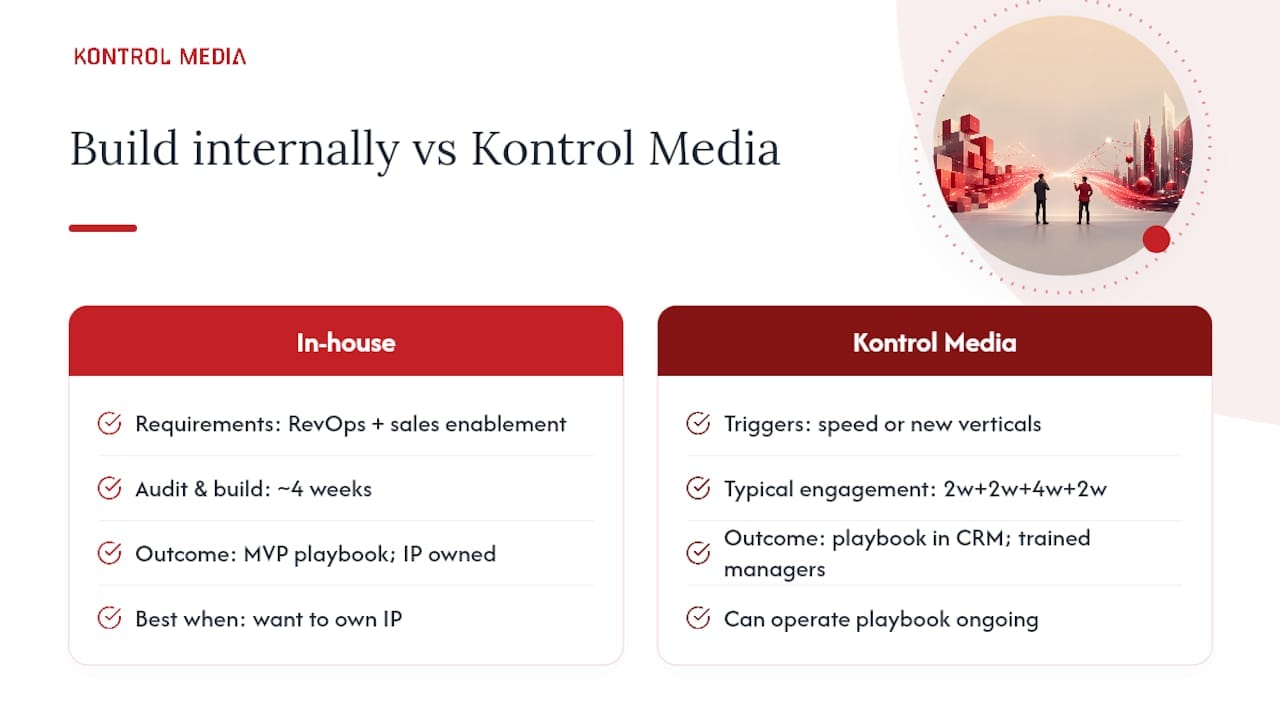
The honest answer is that most organizations can build a minimum viable playbook in-house if they have an experienced RevOps function, a sales enablement lead, and a sales leader willing to dedicate four weeks to the audit and build sequence. The in-house path makes sense when you have the time, the internal expertise, and a strong desire to own the IP from day one.
The calculus shifts when any of those three conditions is missing. Speed is the most common forcing function. A PE-backed company with a 90-day window to show pipeline improvement cannot afford a four-month internal build cycle. An enterprise entering a new vertical needs plays built from external pattern recognition, not just internal closed-won data. A team that has tried to build a playbook twice and abandoned it both times needs outside accountability, not another internal project plan.
A typical Kontrol Media engagement follows four phases: a two-week discovery and audit, a two-week play design sprint, a four-week pilot with the rep cohort, and a two-week enablement and handoff. The output is a fully operational playbook embedded in the client’s CRM, with trained managers and a governance structure the internal team can run independently. For outsourced sales execution and GTM functions, Kontrol Media can also operate the playbook on an ongoing basis rather than handing it off.
When selecting a consultant for this work, look for three things: evidence that they have built from closed-won data rather than templates, a clear CRM enforcement deliverable (not just a document), and a handoff plan that leaves the internal team capable of running the governance cadence without ongoing dependency.
Clients like Experian, West Monroe, and Enthusiast Gaming have engaged Kontrol Media for exactly this kind of hands-on GTM execution. The pattern across those engagements is consistent: the playbook is the artifact, but the behavior change is the outcome.
Kontrol Media builds and operates playbooks for enterprise teams
Kontrol Media works with enterprise sales leaders who need a playbook built, piloted, and embedded in their CRM fast, without adding headcount or running a six-month internal project. The engagement covers discovery, play design, CRM configuration, rep enablement, and a governance handoff your team can own from day one.
The starting point is a short discovery workshop: a focused session where we audit your closed-won data, map your current plays, and identify the five scenarios worth building first. From there, the build-to-pilot timeline runs six to eight weeks. If you are weighing the scope of the engagement against your current strategy priorities, the comprehensive business strategy guide on our site lays out how playbook work fits into a broader GTM execution plan.
To book a discovery workshop or talk through your situation, reach out through the Kontrol Media services page.
Sources
These sources expand on specific components of the playbook build and are worth bookmarking for your team:
- Enterprise Sales Playbook: Build One Reps Use (2026)
- The 2026 Enterprise B2B Sales Playbook | SalesTap
- Enterprise Sales Playbook: From Static Doc to Live System | Backdrop
- The Playbook Problem: Why Your Sales Methodology Dies Between Training and Execution – Pathfinder Ventures
- Why Don’t Sales Playbooks Drive Behavior Change? | Zime AI
Recommended
- The Role of Executive Branding in Enterprises: 2026 Playbook | Kontrol Media Consultancy
- Building a High-Performing Sales Team: Strategies and Best Practices | Kontrol Media Consultancy
- How to Create a Marketing Strategy from Scratch in 2026 | Kontrol Media Consultancy
- Everyone Sells: How Every Role Drives Trust and Revenue | Kontrol Media Consultancy