


For most North American marketing teams, the right starting point is a managed MMM solution rather than an open-source framework. If your team has limited dedicated data scientists and a moderate media budget, vendors like Nielsen Marketing Mix Modeling, Analytic Partners, or Kontrol Media’s consultancy-led engagement will get you to a working model faster than Meta Robyn or Google Meridian ever will. The delivery model is the decision, not the tool name.
Here is the shortlist worth evaluating first:
- Kontrol Media — Best for mid-market and enterprise teams that need a consultancy to own readiness, modeling, and activation end-to-end, without building an internal data science function.
- Nielsen Marketing Mix Modeling — Best for large enterprise teams with complex, multi-channel media mixes and a need for third-party credibility with finance stakeholders.
- Analytic Partners — Best for global brands running multi-market campaigns that need scenario planning and always-on refresh at scale.
- Google Meridian — Best for in-house data science teams with Python fluency and a Google-heavy media mix; native geo-level support is its clearest technical advantage.
- Meta Robyn — Best for R-fluent analytics teams that want open-source Bayesian MMM with strong community documentation and no licensing cost.
- Circana Marketing Mix / Liquid Mix — Best for CPG and retail brands that need store-level POS data integrated directly into the model.
- Measured — Best for direct-to-consumer and ecommerce brands that want incrementality testing paired with MMM outputs.
Three factors determine which path fits your team: data readiness (do you have clean, historical spend and sales data going back two or more years?), analytics capacity (do you have the engineering bandwidth to run and maintain a model?), and media spend scale (does your budget justify the cost of a managed engagement?). The Marketing Accountability Standards Board (MASB) and Gartner both recommend matching vendor delivery model to organizational capacity before evaluating features.
Table of Contents
- Which marketing mix modeling tools compare best side by side?
- Top picks explained: what each vendor actually delivers
- How do you choose the right MMM tool for your team?
- Detailed vendor profiles: modeling approach, integrations, and fit
- Managed vs. open-source MMM: which path fits your team?
- Real-world effectiveness: what the evidence shows
- Data privacy and security compliance for North American teams
- Key Takeaways
- The honest truth about MMM selection that most guides skip
- Kontrol Media’s managed MMM services for marketing teams
- Useful sources and further reading
Which marketing mix modeling tools compare best side by side?
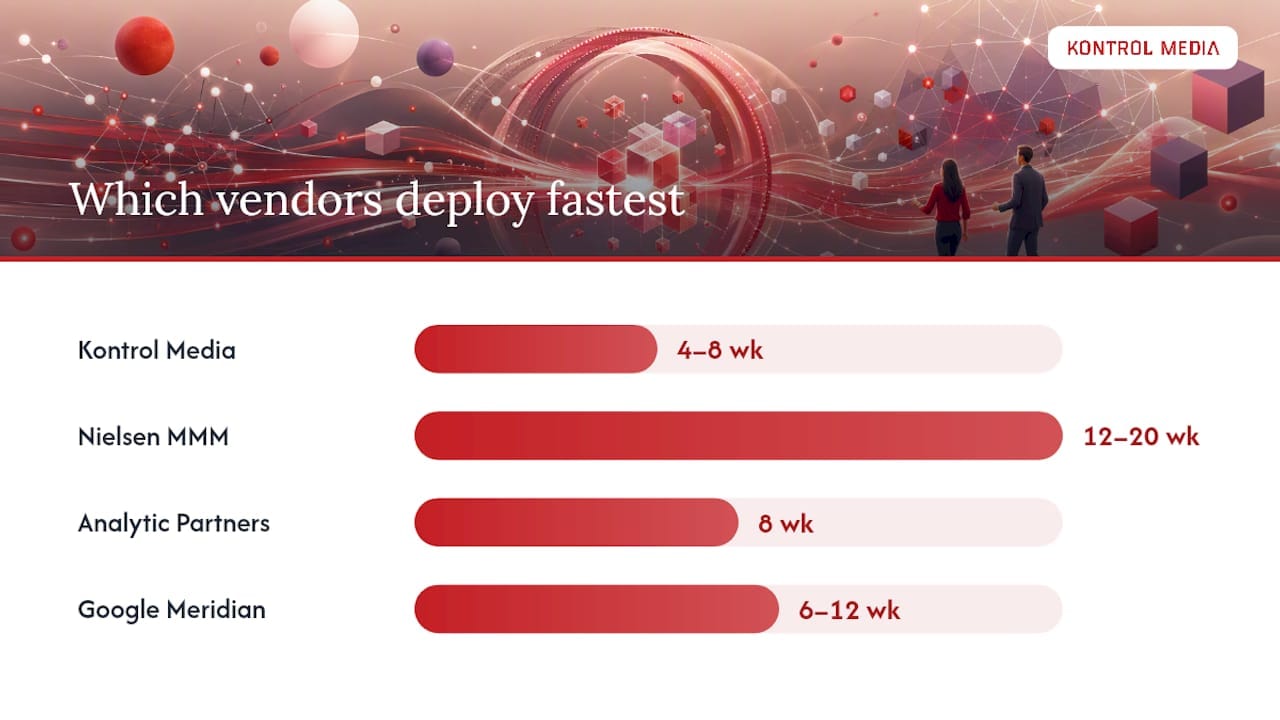
The table below covers the fourteen vendors and tools the market currently features. Delivery model definitions: Managed means the vendor owns modeling and delivery; SaaS means a licensed platform your team operates; Open-source means a free framework your engineers run. Time-to-value measures the period from contract to a first actionable model output, recognizing that data preparation often dominates timelines.
| Vendor / Tool | Best for | Delivery model | Key data integrations | Refresh cadence | Transparency | Forecasting & scenario planning | Time-to-value | Pricing shape | Support model |
|---|---|---|---|---|---|---|---|---|---|
| Kontrol Media | Mid-market & enterprise; PE portfolio companies | Managed consultancy | Ad platforms, CRM, POS, first-party data | Flexible; project or ongoing retainer | High; client owns outputs | Yes; strategy-linked | 4–8 weeks | Retainer or project fee | Dedicated consultant team |
| Nielsen MMM | Large enterprise, multi-channel | Managed | TV, digital, retail, offline | Monthly to quarterly | Moderate (proprietary) | Yes; advanced | 12–20 weeks | Custom enterprise contract | Full-service |
| Analytic Partners | Global brands, multi-market | Managed (ROVA platform) | Cross-media, offline, ecommerce | Always-on | Moderate | Yes; ROVA scenario engine | 8 weeks | Custom retainer | Full-service |
| Google Meridian | In-house data science, Google-heavy mix | Open-source | Google Ads, GA4, custom | User-defined | Very high (open code) | Yes; built-in | 6–12 weeks (data prep) | Free | Community + Google support |
| Meta Robyn | R-fluent analytics teams | Open-source | Meta Ads, custom connectors | User-defined | Very high (open code) | Yes | 4–10 weeks (data prep) | Free | Community |
| Adobe Mix Modeler | Adobe Experience Cloud users | SaaS | Adobe stack, ad platforms | Configurable | Moderate | Yes | 6–10 weeks | Adobe license | Adobe support |
| Circana Marketing Mix / Liquid Mix | CPG, retail, grocery | Managed + self-serve SaaS | POS (store-level), syndicated data | Always-on (weekly) | Moderate | Yes | 2 weeks (connected teams) | Custom | Full-service |
| Measured | DTC, ecommerce | SaaS + managed | Ad platforms, Shopify, ecommerce | Continuous | Moderate | Yes; incrementality-linked | 4–6 weeks | SaaS subscription | Managed onboarding |
| Prescient AI | Ecommerce, DTC brands | SaaS | Shopify, ad platforms | Daily | Moderate | Yes | 2–4 weeks | SaaS subscription | Managed |
| Northbeam | DTC, performance marketing | SaaS | Ad platforms, Shopify | Daily | Moderate | Limited | 2 weeks | SaaS subscription | Self-serve + support |
| Recast | Mid-market, privacy-first | SaaS | Ad platforms, CRM | Weekly | High (Bayesian, documented) | Yes | 4–6 weeks | SaaS subscription | Managed onboarding |
| Sellforte | Retail, CPG, Nordic/EU-origin | Managed + SaaS | Retail POS, ad platforms | Always-on | Moderate | Yes | 6–10 weeks | Custom | Full-service |
| C5i (Demand Drivers) | CPG, retail analytics | Managed | POS, syndicated, digital | Monthly | Moderate | Yes | 8–14 weeks | Custom | Full-service |
| Gain Theory (ROVA) | Global enterprise | Managed | Cross-media, offline, digital | Always-on | Moderate | Yes; ROVA engine | 8 weeks | Custom | Full-service |
A note on transparency: “Very high” in this table means the model code is publicly available and auditable. “Moderate” means the vendor documents methodology but the model itself is proprietary. This distinction matters when your CFO asks how the budget recommendation was derived.
A note on time-to-value: For open-source tools, the data preparation phase can commonly take several weeks before modeling even begins, because pre-built connectors are absent. Commercial platforms with native integrations compress that window materially.
Before finalizing a shortlist, request a data readiness checklist from each vendor and run a demo with your actual data, not sample data.
Top picks explained: what each vendor actually delivers
How do you choose the right MMM tool for your team?
The primary determinant is delivery model alignment, not feature lists. Before you open a single vendor deck, answer three questions honestly: Do you have clean, historical spend and outcome data going back at least two years? Do you have data engineers and analysts who can own a model after the vendor engagement ends? And does your media budget justify the cost of a managed engagement?
Matching the vendor’s delivery model to your team’s internal capacity is the single most important selection criterion, and it is the one most teams skip in favor of comparing feature matrices.
Data inventory and quality. Run a data audit before you talk to vendors. You need at minimum two years of weekly spend data by channel, matched to sales or conversion outcomes at the same granularity. If your data lives in five different systems with inconsistent naming conventions, add 6–10 weeks to any implementation timeline, regardless of which vendor you choose. Data preparation is consistently the longest phase of any MMM project.
Required integrations. Map your media mix to the vendor’s native connectors. A platform with pre-built connectors for your ad platforms, CRM, and POS system will compress implementation time materially. A platform that requires custom API work for your primary data sources will not.
Refresh cadence needs. If your team makes budget decisions monthly, a quarterly model refresh is adequate. If you are running always-on performance campaigns and need to react to in-market shifts weekly, you need a platform with continuous or weekly refresh capability. Mismatching cadence to decision rhythm is one of the most common reasons MMM outputs go unused.
Stakeholder evidence threshold. Decide before the vendor demo what level of evidence will move budget. If your CFO requires a Bayesian credible interval and a documented methodology, open-source or high-transparency SaaS platforms are more defensible. If your CMO needs a clean dashboard with scenario outputs, a managed service with strong visualization may be more practical.
Expected outputs. Know whether your team needs API access to model outputs, a PowerPoint-ready report, or a self-serve dashboard. Not all platforms deliver all three, and the gap between what the vendor demos and what your team can actually use is where adoption breaks down.
Change governance. Appoint a model owner before the engagement starts. Someone on your team needs to own the model after the vendor delivers it, validate inputs as data changes, and present outputs to stakeholders. Without that owner, even a well-built model goes dark within six months.
Pro Tip: Ask every vendor to run a demo with a sample of your actual data, not their showcase dataset. The gap between a polished demo and a model built on your messy real-world data is where most implementation surprises live.
Vendor questions to ask in demos:
- What does your data ingestion process look like, and what does my team need to provide?
- How do you handle missing data or channel-level data gaps?
- What is the documented methodology, and can I share it with my data science team for review?
- What does model maintenance look like after delivery, and who owns it?
- What is a realistic timeline from contract to first model output, given our data environment?
Red flags to watch for:
- Vendors who cannot explain their methodology in plain language.
- Timelines that do not account for data preparation.
- Contracts that lock you into a proprietary data format with no export option.
- Scenario planning outputs that cannot be traced back to model assumptions.
Typical time-to-first-model ranges from two weeks (Prescient AI, Northbeam for digital-only) to 20 weeks (Nielsen, Gain Theory for complex enterprise). Pricing shapes range from free (open-source) to SaaS subscriptions (Recast, Measured, Northbeam) to custom retainers and project fees (Nielsen, Analytic Partners, Kontrol Media, Gain Theory).
Detailed vendor profiles: modeling approach, integrations, and fit
| Vendor | Modeling approach | Delivery | Typical data inputs | Refresh cadence | Scenario planning | North America availability |
|---|---|---|---|---|---|---|
| Kontrol Media | Bayesian / econometric (consultancy-configured) | Managed consultancy | Ad platforms, CRM, POS, first-party | Flexible | Yes | Full |
| Nielsen MMM | Classical econometrics + proprietary | Managed | TV, digital, retail, offline | Monthly–quarterly | Yes | Full |
| Analytic Partners | Econometric + ML (ROVA) | Managed + platform | Cross-media, offline, ecommerce | Always-on | Yes (ROVA engine) | Full |
| Google Meridian | Bayesian (TensorFlow Probability) | Open-source | Google Ads, GA4, custom | User-defined | Yes | Full (global) |
| Meta Robyn | Bayesian + ridge regression | Open-source | Meta Ads, custom | User-defined | Yes | Full (global) |
| Adobe Mix Modeler | ML + econometric | SaaS | Adobe stack, ad platforms | Configurable | Yes | Full |
| Circana Liquid Mix | AI-powered econometric | Managed + SaaS | POS (store-level), syndicated | Always-on (weekly) | Yes | Full (CPG/retail) |
| Measured | Bayesian + incrementality | SaaS + managed | Ad platforms, Shopify, ecommerce | Continuous | Yes | Full |
| Prescient AI | ML-based | SaaS | Shopify, ad platforms | Daily | Yes | Full |
| Northbeam | Attribution + MMM-adjacent | SaaS | Ad platforms, Shopify | Daily | Limited | Full |
| Recast | Bayesian | SaaS | Ad platforms, CRM | Weekly | Yes | Full |
| Sellforte | Econometric + ML | Managed + SaaS | Retail POS, ad platforms | Always-on | Yes | Full (expanding) |
| C5i (Demand Drivers) | Econometric | Managed | POS, syndicated, digital | Monthly | Yes | Full |
| Gain Theory (ROVA) | Econometric + ML | Managed | Cross-media, offline, digital | Always-on | Yes (ROVA engine) | Full |
Demo and procurement checklist:
- Request a sandbox environment with your own data before signing.
- Ask for SLAs on model delivery timelines and data refresh guarantees.
- Confirm data export rights: can you take the model outputs and underlying data if you switch vendors?
- Request references from clients in your industry vertical and budget range.
- For open-source tools, confirm your team’s language fluency (R for Robyn, Python for Meridian) before committing.
Proprietary platforms trade transparency for ease of use, while open-source options offer full auditability at the cost of heavier technical investment. Neither is universally better; the right choice depends on your team’s capacity and your stakeholders’ evidence threshold.
For North America specifically, confirm that the vendor’s data partnerships cover your primary channels. Nielsen’s TV data, Circana’s POS network, and the major ad platform APIs (Google, Meta, Amazon) are the integrations that matter most for most North American media mixes.
Managed vs. open-source MMM: which path fits your team?
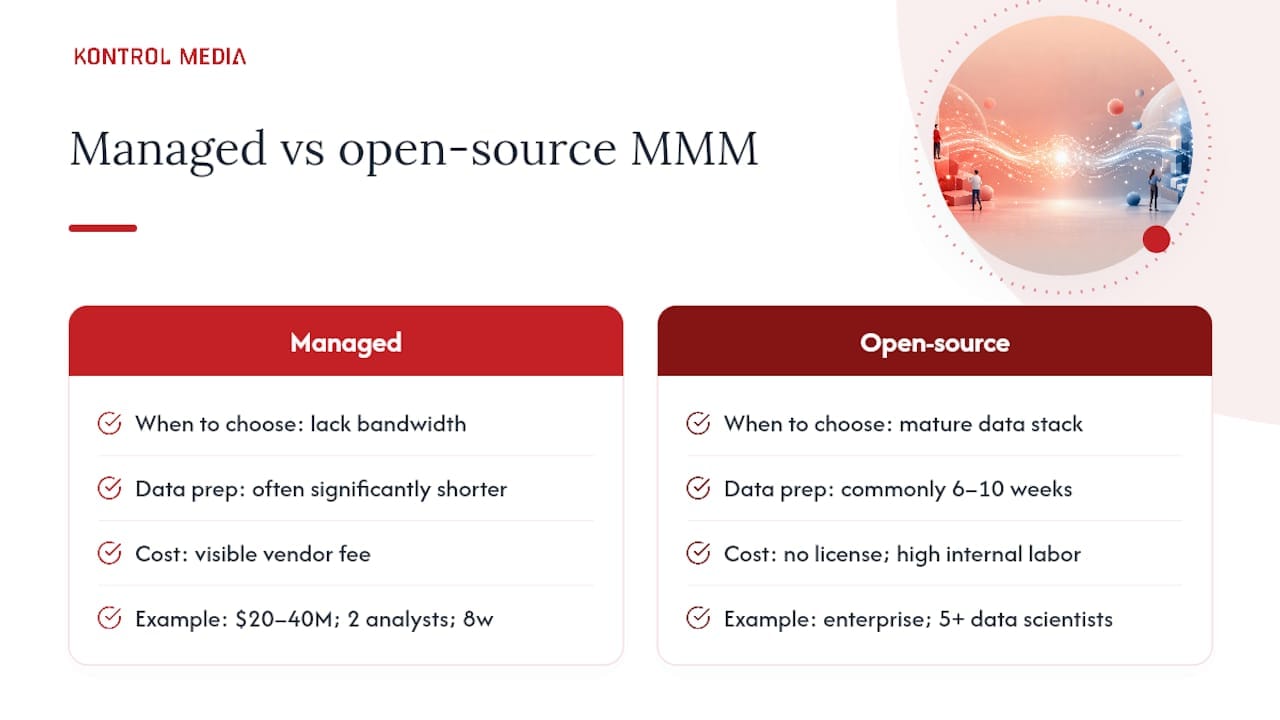
Choose managed when you lack data engineering bandwidth and stakeholder alignment time. Choose open-source or self-serve when you have a mature data stack, Python or R fluency, and analysts who can own the model after it is built.
Open-source Bayesian MMM tools like Robyn, Meridian, and LightweightMMM have made modern MMM faster to adopt than it was five years ago, but “faster” is relative. Data preparation still dominates the timeline. Without pre-built connectors, data work commonly runs 6–10 weeks before a single model run. A managed vendor with native integrations compresses that window, often significantly.
The cost trade-off is real but frequently misread. Open-source tools carry no licensing cost, but they carry substantial internal labor cost: data engineering hours, analyst time, and the ongoing maintenance burden. A managed engagement has a visible line-item cost, which makes it easier to scrutinize, but the total cost of ownership for an internally managed open-source stack is rarely cheaper once you account for staff time.
When managed wins: A mid-market brand with a $20–40 million media budget, a two-person analytics team, and a CMO who needs model outputs in a board presentation within eight weeks. That team does not have the bandwidth to run a data engineering sprint, build a Bayesian model from scratch, and produce stakeholder-ready outputs simultaneously. A managed engagement delivers the output; the team focuses on activation.
When open-source wins: An enterprise brand with a mature data warehouse, a data science team of five or more, and a media budget large enough to justify the internal investment. Google Meridian is the right call if that team is Python-fluent and Google Ads is the dominant channel. Meta Robyn fits if the team is R-fluent and Meta is the primary platform.
Pro Tip: If you are evaluating open-source tools, run a data readiness sprint first: inventory your data sources, map gaps, and estimate the engineering hours needed to build clean inputs. That exercise alone will tell you whether open-source is realistic for your team’s current capacity.
Kontrol Media’s consultancy model is designed specifically for the gap between these two paths: teams that want the rigor and transparency of a well-built Bayesian model but do not have the internal capacity to build and maintain one. A typical Kontrol Media engagement starts with a readiness assessment, moves into a 4–6 week pilot, and then scales into a managed or hybrid model depending on the client’s internal capacity growth. That structure lets teams build internal understanding of the model without bearing the full engineering burden from day one. For teams at PE portfolio companies or mid-market firms navigating growth equity through marketing, that phased approach tends to produce faster stakeholder buy-in than a full open-source build.
Real-world effectiveness: what the evidence shows
The most credible evidence for MMM effectiveness comes from documented vendor case studies and published methodologies, not from vendor-produced ROI claims. Gartner’s Magic Quadrant for Marketing Mix Modeling Solutions recommends using third-party validation and documented methodologies as primary trust signals when evaluating vendors, precisely because self-reported case studies vary widely in rigor.
Analytic Partners has published case studies showing budget reallocation decisions driven by ROVA model outputs across CPG and retail clients. Nielsen’s MMM practice has documented engagements where TV spend optimization, informed by model outputs, shifted budget toward higher-ROI channels. Circana’s Liquid Mix has published CPG case examples where store-level POS integration revealed promotional lift patterns that national-level models had missed entirely.
For open-source tools, the evidence base is different: it comes from the practitioner community. The Robyn and Meridian GitHub repositories include documented examples from teams at brands and agencies who have published their implementations. That transparency is itself a form of validation, because the methodology is auditable by anyone with the technical capacity to review it.
What the evidence consistently shows across managed and open-source implementations is that the model is rarely the bottleneck. Stakeholder alignment and model activation are where value is lost. A well-built MMM that sits in a data warehouse and never informs a budget decision is worth nothing. The teams that extract measurable value from MMM are the ones that appointed a model owner before the engagement started, defined the evidence threshold that would move budget, and built the model outputs into their planning cycle. Understanding how to measure marketing ROI before you commission a model is not a preliminary step; it is the step that determines whether the model ever gets used.
Data privacy and security compliance for North American teams
MMM platforms process sensitive commercial data: media spend by channel, sales data, customer acquisition costs, and in some cases CRM and POS records. For North American teams, the relevant compliance frameworks are CCPA (California Consumer Privacy Act) for California-resident data, PIPEDA (Personal Information Protection and Electronic Documents Act) for Canadian operations, and sector-specific requirements under HIPAA for healthcare advertisers.
Before signing with any vendor, confirm the following:
Data residency. Where is your data stored and processed? For Canadian operations, PIPEDA requires that personal information be protected with comparable standards to Canadian law even when processed outside Canada. Confirm whether the vendor’s infrastructure is US-based, EU-based, or multi-region, and what that means for your compliance posture.
Data processing agreements. Every managed MMM vendor should offer a Data Processing Agreement (DPA) that specifies what data they collect, how it is used, how long it is retained, and whether it is used to train shared models. Vendors that use client data to improve their proprietary models without explicit disclosure create compliance risk.
Anonymization and aggregation. Most MMM platforms work with aggregated, anonymized data rather than individual-level records, which reduces CCPA and PIPEDA exposure. Confirm that the vendor’s data ingestion process does not require individual-level identifiers, and ask specifically whether any PII flows through their pipeline.
SOC 2 Type II certification is the baseline security standard to request from any SaaS or managed MMM vendor operating in North America. It confirms that the vendor has undergone independent audit of their security controls. For enterprise procurement, also request penetration testing documentation and incident response SLAs.
Open-source tools like Meridian and Robyn run on your own infrastructure, which means data security is your team’s responsibility. That is an advantage from a data sovereignty perspective but requires that your cloud environment meets your organization’s security standards before you begin.
Key Takeaways
The best marketing mix modeling tools for North American teams are the ones matched to your delivery model, data readiness, and internal analytics capacity, not the ones with the longest feature list.
| Point | Details |
|---|---|
| Delivery model first | Match the vendor’s model (managed, SaaS, open-source) to your team’s data engineering capacity before evaluating features. |
| Data prep dominates timelines | Without pre-built connectors, data preparation runs 6–10 weeks; prioritize vendors with native integrations for your key channels. |
| Open-source requires real capacity | Robyn and Meridian are free but demand Python or R fluency, clean data infrastructure, and ongoing internal maintenance. |
| Stakeholder alignment is non-negotiable | Appoint a model owner and define your evidence threshold before the engagement starts, or the model will not drive decisions. |
| Kontrol Media for managed implementation | Kontrol Media’s consultancy-led model suits mid-market and enterprise teams that need end-to-end MMM ownership without building an internal data science function. |
The honest truth about MMM selection that most guides skip
There is a version of this conversation that treats MMM tool selection as a feature-comparison exercise, and it produces the wrong answer almost every time. The real question is not which platform has the best scenario planning engine. It is whether your organization is actually ready to use a model, and whether the vendor you choose will help you get there or hand you a deliverable and disappear.
What I see consistently is that teams underestimate the activation problem. They spend weeks evaluating vendors, negotiate a contract, survive the implementation, and then produce a model that sits in a Confluence page because no one owns the outputs and no one defined what evidence would move the CMO’s budget allocation. The model was technically sound. The activation was absent.
The vendors that tend to produce the best outcomes are not always the ones with the most sophisticated technology. They are the ones that treat stakeholder alignment as part of their delivery scope, not as the client’s problem. That is a meaningful distinction when you are evaluating proposals.
Open-source tools are genuinely excellent, and I would not discourage any team with real data science capacity from exploring Meridian or Robyn. But the framing that open-source is “better” because it is transparent misses the point for most mid-market teams. Transparency is only valuable if someone on your team can read and interpret the model. If your analytics team is two people running campaign reporting, open-source transparency is theoretical, not practical.
The other thing worth saying plainly: Kontrol Media offers these services, and that shapes the perspective here. The recommendation to consider a managed consultancy engagement is not neutral. What I can tell you is that the reasoning behind it is consistent with what independent guidance on MMM partner selection recommends for teams without large internal analytics functions, and the comparison table above includes every major option so you can make that judgment yourself.
Kontrol Media’s managed MMM services for marketing teams
Most marketing teams evaluating MMM tools are not short on options. They are short on the internal capacity to turn those options into working models that actually inform decisions. Kontrol Media’s managed MMM engagement is built for exactly that gap: teams that need the rigor of a well-constructed econometric model but cannot dedicate a data science team to build and maintain one.
The engagement structure is straightforward. It starts with a readiness assessment that maps your data environment, identifies gaps, and sets a realistic timeline. From there, a 4–6 week pilot produces a first working model with your actual data, validated against your media mix and business outcomes. If the pilot confirms fit, the engagement scales into a managed or hybrid model that integrates with your planning cycle. Kontrol Media’s clients include Experian, BuzzFeed, REMAX, and West Monroe, which reflects the range of data environments and business contexts the team has navigated.
Kontrol Media is a provider in this space, and that is worth stating directly. The comparison table and vendor profiles above are designed to give you an honest view of the full market. If a self-serve SaaS platform or an open-source framework is the right fit for your team, those options are documented above. If a consultancy-led engagement is the right fit, Kontrol Media’s strategic consulting services are the place to start. Contact Kontrol Media to schedule a readiness assessment and get a clear picture of what a pilot would look like for your specific data environment and media mix.
Useful sources and further reading
The sources below are grouped by decision stage. Vendor-produced content is noted where relevant; third-party sources are flagged accordingly.
Vendor evaluation and benchmarks (third-party):
- How to Choose the Right Marketing Mix Modeling (MMM) Partner | AW360
- Gartner Magic Quadrant for Marketing Mix Modeling Solutions
- Proprietary MMM: Easy-to-use, scalable, and vendor-dependent (eMarketer)
- Marketing Mix Modelling (MMM) — A 2026 Practical Guide · d-dat
Open-source tools and developer documentation:
Conceptual primers and measurement context:
- Measuring the ROI of your marketing campaigns | Kontrol Media — Kontrol Media’s framework for interpreting MMM outputs and connecting them to ROI measurement. Publisher-produced.
Suggested reading order: If you are early in evaluation, start with the Advertising Week partner selection guide and the eMarketer proprietary vs. open-source piece. If you are ready to shortlist vendors, use the Gartner Magic Quadrant. If you are evaluating open-source tools specifically, go directly to the Meridian documentation and the d-dat practical guide.