


Executive branding in enterprises is a company-funded, governed business system — not a personal marketing project — whose primary KPIs are company-level outcomes: pipeline influence, talent acquisition velocity, and strategic partnership development. When you treat it as infrastructure rather than a campaign, the returns compound in ways a corporate page simply cannot replicate.
The outcomes executive branding must deliver:
- Pipeline influence: Active executive presence on LinkedIn generates significantly more inbound interest than a company page with the same follower count.
- Talent acquisition: Many job candidates prefer to work for a leadership team that visibly demonstrates industry expertise.
- Partner and deal acceleration: Buyers who consume executive content regularly enter sales conversations already half-convinced, shortening cycles before a single call is booked.
- Institutional credibility: Personal branding opens the door; corporate brand closes the deal. Both must run in parallel.
Board-ready TL;DR: Executive branding is a governed company asset. Fund it, assign an owner, and measure it against revenue and talent metrics — or leave pipeline on the table.
Table of Contents
- Why the role of executive branding in enterprises demands a system, not a campaign
- Who owns executive branding, and how should you fund it?
- What does a minimum viable executive presence actually look like?
- How do you tie executive activity to company-level KPIs?
- A phased roadmap for enterprise implementation
- Risks and guardrails: keeping the program legally safe
- Enterprise use cases where executive branding moves the needle
- How to choose a vendor or partner for executive branding
- Key Takeaways
- Why executive branding is infrastructure, not a content calendar
- How Kontrol Media and Qnary help you operationalize executive branding
- Useful sources and further reading
Why the role of executive branding in enterprises demands a system, not a campaign
The difference between a system and a campaign is durability. A campaign runs for a quarter; a system compounds for years. Most executive thought-leadership programs fail because they are designed as campaigns rather than leadership infrastructure with a narrative engine, governance layer, research backbone, and measurement framework.

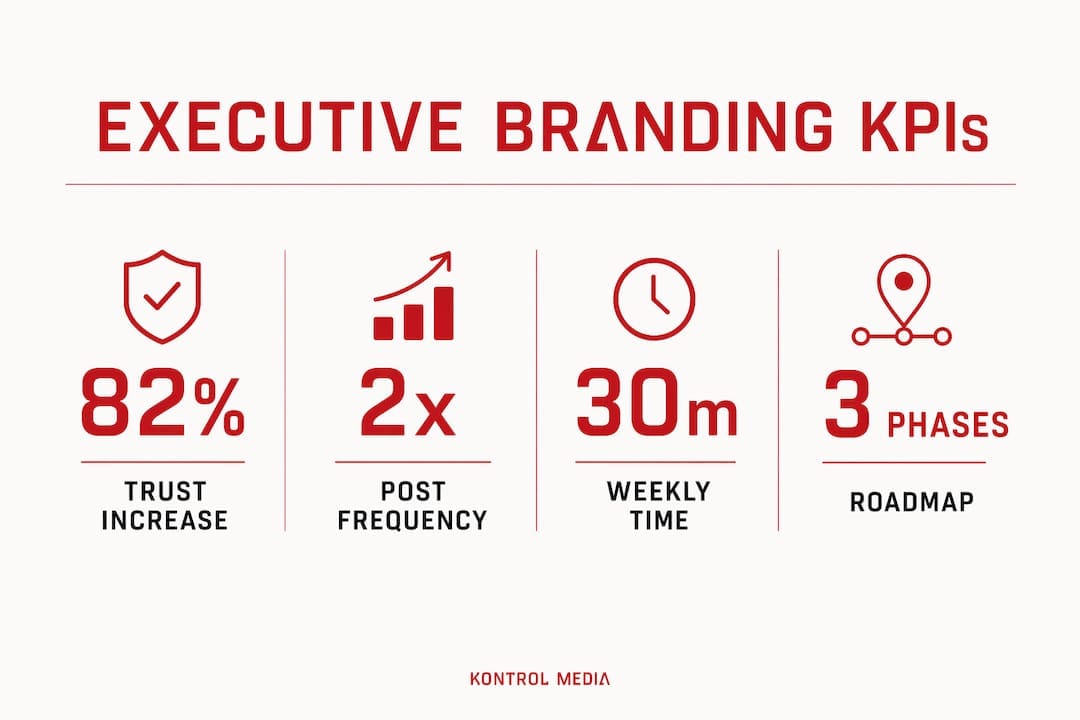
The evidence for system-level investment is hard to ignore. 82% of people trust a company more when its senior leaders are active on social media, and 73% of B2B decision-makers say thought leadership is more trustworthy than traditional marketing materials. Those numbers describe a trust channel that corporate pages cannot replicate, because people follow people, not logos.
The practical implication: executive visibility is a GTM pipeline lever that belongs in your demand-generation budget, not in a discretionary “executive comms” line item that disappears at the first budget review.
Who owns executive branding, and how should you fund it?
The short answer: in mid-market companies, the head of marketing or chief of staff typically owns the program. In enterprises, a dedicated executive visibility lead reporting to the Chief Communications Officer or CMO is the right structure. Ownership ambiguity is the single fastest way to kill a program before it starts.
A governance checklist every enterprise needs before launch:
- Content charter: defines approved topics, tone, and the 80/20 content mix (80% value-first, 20% product-adjacent) that prevents audience fatigue
- Disclosure controls: SEC Regulation FD implications mean executive social posts can constitute corporate disclosure; approval SLAs must exist before any executive publishes
- Publishing rights agreement: clarifies who owns the audience if the executive departs
- Audience portability clause: specifies that followers and content built during employment belong to the company, not the individual
- Approval SLA: 24–48 hours maximum; longer and executives disengage
Budget ranges vary by scope. A pilot program for one executive typically runs $3,000–$8,000 per month covering strategy, ghostwriting, and distribution. A full-service enterprise program across three to five executives runs $15,000–$40,000 per month. Corporate funding, not personal expense, is the right model — the audience being built is a company asset.
Pro Tip: Draft the audience-portability clause before the program launches, not after. Include it in the executive’s employment addendum and have legal review it alongside your social media policy. Retrofitting this clause after an executive has built a 50,000-follower audience is a negotiation you do not want.
What does a minimum viable executive presence actually look like?
The minimum viable presence for an enterprise executive includes regular posting and intentional engagement several times per week. Consistency and relevance drive long-term authority far more reliably than chasing viral moments.
Three content pillars work consistently for enterprise executives:
- Market point of view — positions the executive as a category thinker, shapes buyer perception upstream of the sales cycle
- Company building — behind-the-scenes decisions, hiring philosophy, product direction; builds institutional credibility
- Human leadership moments — values, team recognition, candid observations; Many consumers cite social presence as impacting brand trust
The production workflow that actually scales is capture-then-publish. Executives record voice notes or share bullet points in a briefing; a ghostwriter or content lead converts those inputs into polished posts. Expect 15–20 iterations before a ghostwriter reliably matches an executive’s voice — plan for a three-month ramp before cadence stabilizes.
| Channel | Recommended frequency | Executive time commitment |
|---|---|---|
| LinkedIn (posts) | 2x per week | 20–30 min/week (review + approve) |
| LinkedIn (engagement) | 2x per week | 10–15 min per session |
| Industry newsletter / blog | 1x per month | 60 min (interview or voice note) |
| Podcast / video | 1x per quarter | 60 min per appearance |
Pro Tip: Never give multiple executives the same voice brief. Distinct voice strategies per leader preserve authenticity and prevent the “corporate chorus” effect that undermines credibility when audiences notice identical phrasing across profiles.
How do you tie executive activity to company-level KPIs?
Use a two-layer measurement model. The first layer tracks platform health; the second tracks business impact. Review both monthly with the executive and quarterly with the C-suite.
Platform health metrics: reach per post, engagement rate, profile visits, follower growth rate, share of voice in target topic clusters.
Business impact metrics: inbound demo requests tagged to executive social, influenced pipeline (deals where the buyer cited executive content in discovery), talent pipeline lift (candidates who mention the executive’s content in applications), and partnership introductions sourced from executive network activity.
| Metric | Layer | Reporting owner |
|---|---|---|
| Reach and engagement rate | Platform health | Content lead |
| Profile visits | Platform health | Content lead |
| Inbound demos (social-tagged) | Business impact | Sales ops |
| Influenced pipeline | Business impact | Revenue operations |
| Talent pipeline lift | Business impact | People/HR |
| Partnership introductions | Business impact | Business development |
Attribution works when sales ops tags social-sourced leads at entry and tracks them through the funnel. A simple UTM parameter on the executive’s LinkedIn bio link, combined with a “how did you hear about us?” field in your CRM, captures the majority of attributable inbound. It is not perfect, but it is enough to defend the budget.
A phased roadmap for enterprise implementation
Success at month 12 looks like: two to three executives publishing consistently, a governed content operation, and at least one measurable business outcome (pipeline lift, recruiting speed, or a partnership introduction) tied to the program.
| Phase | Duration | Key outcomes |
|---|---|---|
| Pilot | Months 1–3 | One executive, voice brief complete, cadence established, baseline metrics set |
| Scale | Months 4–6 | Two to three executives added, governance docs finalized, sales ops integration live |
| Institutionalize | Months 8–12 | Program embedded in comms calendar, quarterly C-suite reporting, budget renewed |
Staffing matrix: executive (30 min/week), executive comms lead or chief of staff (10 hrs/week), ghostwriter/content lead (15–20 hrs/week), legal reviewer (2 hrs/month), distribution specialist (5 hrs/week). For most mid-market companies, a fractional or outsourced content lead is more practical than a full-time hire in the pilot phase.
Risks and guardrails: keeping the program legally safe
The three highest-risk areas are selective disclosure, regulatory disclosure, and reputational tone drift. The single most important mitigation is a clear, pre-approved disclosure framework that lets executives publish specific insights without triggering Regulation FD violations or securities law exposure.
Practical guardrail checklist:
- No material non-public information (MNPI) in any post without legal pre-clearance
- All forward-looking statements include standard safe-harbor language
- Approval SLA enforced: no post goes live without a 24-hour review window
- Crisis escalation matrix defined before launch (see below)
- Quarterly policy refresh aligned with legal and IR teams
Crisis escalation matrix:
- Tier 1 (monitor): Negative comments, minor factual disputes. Response: content lead replies within 4 hours using pre-approved language.
- Tier 2 (edit/pause): Post generates press inquiry or regulatory question. Response: legal and comms review within 2 hours; post edited or temporarily hidden.
- Tier 3 (block): Post contains MNPI or triggers a formal complaint. Response: immediate removal, legal counsel notified, IR team briefed within 1 hour.
Pro Tip: Pre-draft five to seven evergreen response templates for the most predictable crisis scenarios (competitor comparison, earnings-adjacent comment, employee relations question). Executives who have language ready respond faster and more consistently than those improvising under pressure.
Enterprise use cases where executive branding moves the needle
Three use cases where the impact is most measurable:
Demand generation: A B2B SaaS founder who shifted from zero LinkedIn activity to two posts per week saw a ~40% increase in demo requests within one quarter. The content mix was 80% market perspective, 20% product-adjacent. No paid amplification.
Talent acquisition: A CHRO at a mid-market professional services firm began posting weekly about culture and hiring philosophy. Inbound applications from senior candidates increased meaningfully within 60 days, and candidates consistently cited the CHRO’s posts as the reason they applied. The cost per qualified applicant dropped without any change to the recruiting budget.
Strategic partnerships: A CEO active on LinkedIn with a clear category point of view regularly receives inbound from potential partners who have been following the content for months before reaching out. These introductions arrive pre-warmed, which compresses the partnership development cycle significantly.
Which executives to prioritize: CEO for category vision and institutional credibility, CTO or Chief Product Officer for technical buyer trust, CHRO or Head of People for talent acquisition. Start with the executive whose audience overlap with your ICP is highest.
How to choose a vendor or partner for executive branding
The single most important criterion: can the vendor operationalize a low-friction capture-to-publish workflow that genuinely matches the executive’s voice? Everything else is secondary. A vendor who produces polished content that sounds nothing like the executive will see that executive stop approving posts within 60 days.
Vendor evaluation checklist:
- Voice-matching process: how many iterations do they budget for onboarding?
- Compliance process: do they have a legal review step built into their workflow?
- Content ownership: who owns the posts, the audience data, and the content archive?
- Pricing model: project-based, monthly, or per-executive? What does overage look like?
- References: can they provide a client in your industry or a comparable company size?
Red flags in proposals: vendors who promise virality over consistency, who cannot explain their voice-capture methodology, or whose contracts assign content ownership to the agency rather than the client.
Pro Tip: Ask every vendor: “Walk me through what happens in the first 30 days.” The answer reveals whether they have a real onboarding process or are winging it. You want a structured voice brief, a discovery session with the executive, and a defined approval workflow before a single post goes live.
Key Takeaways
Executive branding works as a company-funded, governed system tied to pipeline, talent, and partnership KPIs — not as a personal project managed outside the marketing budget.
| Point | Details |
|---|---|
| Fund it corporately | Executive branding builds a company audience; corporate budget and governance must reflect that. |
| Minimum viable presence | The minimum viable presence is two posts per week plus 10–15 minutes of intentional engagement twice weekly, which sustains authority and aligns with research-backed benchmarks. |
| Two-layer measurement | Track platform health monthly and business impact (pipeline, talent, partnerships) quarterly for C-suite reporting. |
| Phased 12-month roadmap | Pilot one executive first, scale to three, then institutionalize governance and reporting before renewing budget. |
| Kontrol Media | Kontrol Media designs and executes pilot-to-scale executive branding programs, working with partners like Qnary to solve the time and voice-capture challenges that stall most enterprise programs. |
Why executive branding is infrastructure, not a content calendar
There is a version of this conversation that gets stuck on tactics: how often to post, which hashtags to use, whether to go long-form or short. Those details matter, but they are downstream of a more important question — does your organization treat executive visibility as a governed business asset, or as something executives do when they have a spare hour?
The companies I see getting real traction from executive branding have made a structural decision. They have assigned an owner, allocated a budget that does not disappear at Q3, and built a workflow that does not depend on the executive finding time to write. The executives who show up consistently are not the ones with the most free time. They are the ones whose teams have made it frictionless.
The other thing worth saying plainly: executive branding and corporate branding are not competing priorities. Personal presence opens the door; institutional credibility closes the deal. The enterprises that understand this are building both simultaneously, with a clear relationship between the two — and that coordination is what turns individual visibility into company-level growth.
How Kontrol Media and Qnary help you operationalize executive branding
The two execution problems that kill most enterprise programs are executive time and voice capture. Executives do not have the bandwidth to write, and most content teams do not know how to extract and replicate an executive’s authentic perspective at scale. Kontrol Media solves both.
Working with partners like Qnary, Kontrol Media designs and runs pilot-to-scale executive branding programs that handle strategy, governance setup, ghostwriting, and distribution — so your executives contribute their expertise without becoming content creators. Clients including Experian, BuzzFeed, HuffPost, REMAX, Enthusiast Gaming, and West Monroe have seen what a well-structured business strategy behind executive visibility can do for pipeline and partnership development.
If you are ready to move from “we should do this” to a governed, measured program, request a pilot scoping call with Kontrol Media at kontrolmedia.com.
Useful sources and further reading
- What is Executive Branding? Complete 2026 Definition — Clash; best starting point for governance definitions and audience-portability concepts
- Why Most Executive Thought Leadership Programs Fail — Doovo; covers structural failure modes, the Executive Influence System, and disclosure controls
- Executive Social Presence as a GTM Pipeline Lever — GTMStack; pipeline data, 80/20 content mix, and voice-capture workflow guidance
- Social Media for Executives: A 2026 Survival Plan — InfluencerDB; minimum viable presence cadence and time-budgeting benchmarks
- The Crucial Role of Social Media for Leadership — Signium; engagement tactics and brand trust data for C-suite leaders
- Thought Leadership for Executives: Linking Personal Brand to the B2B Bottom Line — Csuite Outlook; ROI data, talent acquisition signals, and Edelman-LinkedIn research summary
Recommended
- 5 Things Brands Should Prioritize in 2025 | Kontrol Media Consultancy
- Branding and Messaging Strategies for Marketers | Kontrol Media Consultancy
- The Role of Trust in Influence: CMO Notes from CES 2026 | Kontrol Media Consultancy
- The Role of Brand Positioning Strategy in 2026 | Kontrol Media Consultancy