


Growth equity through marketing is expansion capital deployed specifically to scale a company’s marketing and sales capacity, typically via a minority stake that leaves founders in control while accelerating ARR growth, improving customer acquisition cost (CAC), and building the repeatable unit economics investors need to see. Mid-market companies with proven revenue, identifiable acquisition patterns, and a product that customers actually renew are the natural fit. Kontrol Media works directly in this space, helping PE-backed and growth-stage companies translate capital into measurable go-to-market outcomes.
Three things define whether this concept applies to your business right now:
- You have recurring or predictable revenue and a CAC-to-LTV ratio that already works, even if it is not yet optimized.
- You need capital to scale what is working, not to fix a broken product or pivot a business model.
- You want a partner who executes alongside you, not just a firm that writes a strategy deck and leaves.
Table of Contents
- What is growth equity through marketing, and how does it differ from VC and buyouts?
- Why do investors use marketing as the primary growth lever?
- Is your company ready for growth equity-led marketing acceleration?
- Where does growth equity capital actually go inside marketing and sales?
- What KPIs do investors expect from marketing spend?
- What does marketing due diligence look for, and what are the red flags?
- How do you choose the right marketing partner for a growth-equity-funded program?
- What do engagement models and timelines look like in practice?
- Key Takeaways
- The part most executives underestimate about growth equity
- How Kontrol Media accelerates growth-equity-funded marketing programs
- Useful sources and further reading
What is growth equity through marketing, and how does it differ from VC and buyouts?
Growth equity sits between venture capital and traditional buyouts on the investment spectrum. VC funds early-stage bets where the product thesis is still unproven. Buyouts typically involve majority control, heavy leverage, and cost restructuring. Growth equity takes a minority stake in a company that already has a working business model and uses capital to accelerate expansion, not to engineer a turnaround.
The marketing-led version of this is specific: capital is earmarked for scaling sales and marketing, channel expansion, GTM hiring, and demand-gen infrastructure rather than product R&D or back-office consolidation. Investors expect the business to grow into a higher valuation through revenue acceleration, not through cost cuts.
The typical company profile looks like this:
- Annual recurring revenue or consistent revenue with visible retention signals
- A repeatable customer acquisition motion, even if it is channel-concentrated
- Product-market fit confirmed by renewal rates or net revenue retention at or above 100% for SaaS, and strong for other recurring models.
- A leadership team capable of executing at the next level of scale
Pro Tip: If your company still relies on founder-led sales with no documented acquisition playbook, growth equity conversations will stall. Investors need to see a process they can fund, not a personality they cannot replicate.
Why do investors use marketing as the primary growth lever?
Marketing is the highest-leverage, non-destructive way to accelerate ARR in an established business. Unlike acquisitions or product pivots, a well-structured marketing program can show measurable CAC improvement within 90 days and cohort-level payback data within a single quarter. That speed of feedback is exactly what growth equity investors need to validate their thesis before deploying the next tranche.

The levers investors fund most often include paid acquisition at scale, enterprise sales enablement, content and demand-gen engines, channel and partner programs, and retail or commerce media networks. Each of these can be instrumented, measured, and tied directly to ARR growth. That measurability is the point.
Pro Tip: Structure every marketing experiment to produce investor-grade outputs: cohort-level payback curves, LTV modeling by channel, and a clear go/no-go threshold before the next spend tranche. Investors who see that discipline in your reporting will move faster and argue less about valuation.
Is your company ready for growth equity-led marketing acceleration?
Companies at the commercialization or expansion stage are the natural targets. Use this diagnostic before you pitch or accept capital:
- Predictable revenue: Can you forecast next quarter’s revenue within 15%? If not, attribution and planning will break down under investor scrutiny.
- CAC below LTV threshold: Your blended CAC should recover within 12–18 months on a gross-margin basis. If payback is longer, fix unit economics before scaling spend.
- Basic attribution in place: You need channel-level visibility, even if it is imperfect. Investors will not fund a black box.
- Repeatable sales motion: At least one documented acquisition playbook that a new hire could execute within 60 days.
- Revenue or marketing leadership: A head of revenue, VP of marketing, or equivalent who owns the number and the plan.
- Minimum viable martech stack: CRM, marketing automation, and a reporting layer. HubSpot, Salesforce, or equivalent.
- Customer success capacity: Retention is half the growth equity story. If churn is unmanaged, scaling acquisition only accelerates the leak.
If you answered “no” to more than two of these, the right move is internal stabilization first, then a growth equity conversation.
Where does growth equity capital actually go inside marketing and sales?
Growth capital is most commonly deployed across paid media scale, GTM hiring (account executives, SDRs, and demand-gen managers), martech and attribution infrastructure, content and SEO engines, channel and partner programs, and occasionally bolt-on acquisitions that add distribution. The mix depends on where the unit economics are strongest.
“A phased approach reduces investor risk and allows measurable go/no-go decisions at each stage. Discovery validates channels and assumptions. The pilot proves unit economics at modest spend. Scale deploys the larger tranche only after the pilot clears its CAC and payback thresholds.” — FasterCapital
Growth equity firms also provide operational support beyond capital: executive recruiting, sales strategy refinement, and identification of bolt-on acquisition targets. That means the capital comes with a network, and a good marketing partner knows how to activate it. For companies considering market expansion as a primary use case, that network effect compounds quickly.
What KPIs do investors expect from marketing spend?
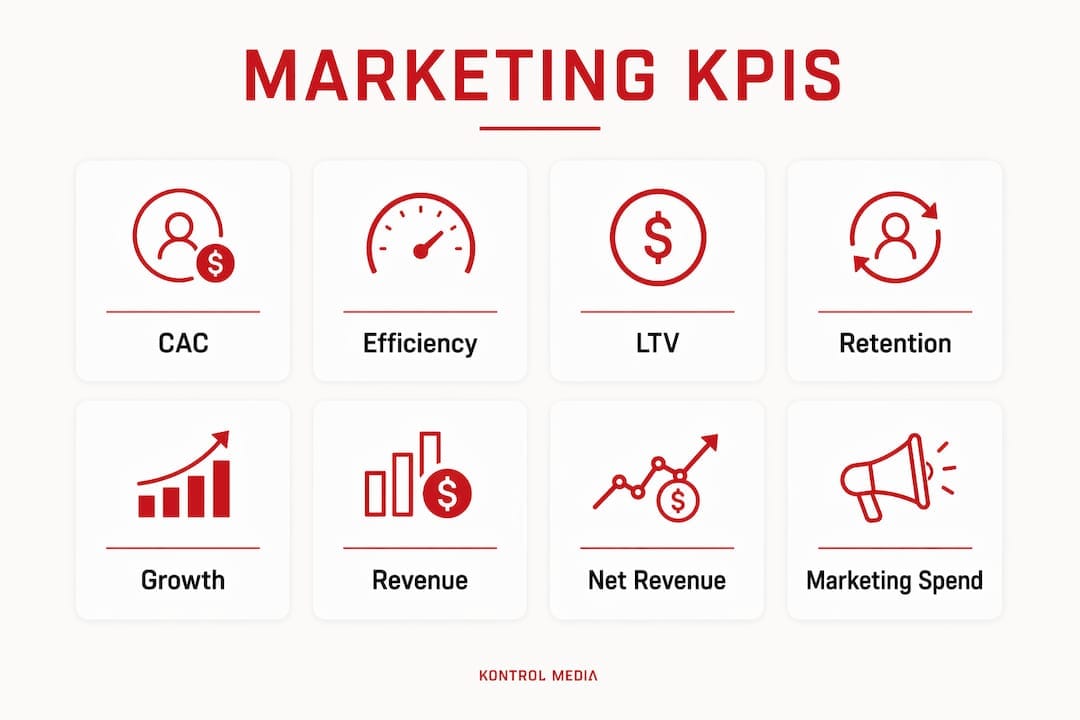
Investors expect measurable improvement across six core metrics: CAC, LTV, ARR growth rate, net revenue retention, marketing-attributed revenue, and CAC payback period. Each one tells a different part of the story.
| KPI | Why it matters | Investor expectation |
|---|---|---|
| CAC | Efficiency of acquisition spend | Declining or stable as spend scales |
| LTV | Revenue durability per customer | LTV:CAC ratio of 3:1 or better |
| ARR growth rate | Top-line velocity | Consistent quarter-over-quarter acceleration |
| Net revenue retention | Retention and expansion signal | At or above 100% for SaaS; strong for recurring models |
| Marketing-attributed revenue | Accountability of spend | Clear channel-level attribution, not blended |
| CAC payback period | Capital efficiency | Under 18 months on a gross-margin basis |
Supporting metrics investors also monitor include churn rate by cohort, expansion ARR from upsell and cross-sell, channel-level ROAS, funnel conversion rates by stage, and pipeline velocity. Tying each spend decision to a specific KPI and a reporting cadence is not optional. Without it, capital gets misallocated and investor confidence erodes fast.
What does marketing due diligence look for, and what are the red flags?
Marketing due diligence evaluates whether your marketing investments can scale predictably and be measured. Investors and their advisors will examine attribution fidelity, martech stack ownership and maturity, experiment history, team depth, channel concentration, and any legal or brand risks tied to active campaigns.
The red flags that consistently discount valuations or kill deals:
- Over-reliance on a single acquisition channel (one channel above 60% of pipeline is a concentration risk)
- Weak or absent attribution, where marketing spend cannot be traced to revenue
- Founder-led growth with no documented process a hired team could replicate
- No experiment history, which signals a team that spends without learning
- Shallow marketing team depth, where one departure breaks the function
Mitigation is straightforward but requires lead time. Build standardized dashboards before the diligence conversation starts. Commission a third-party marketing due diligence audit to surface gaps on your terms. Hard-wire retention experiments into your quarterly cadence so you have cohort data to show.
Pro Tip: Investors read your experiment history as a proxy for organizational learning. A company that has run 12 structured tests and failed 4 of them looks far more fundable than one that has never tested anything.
How do you choose the right marketing partner for a growth-equity-funded program?
The partner selection process deserves the same rigor as the investor selection process. Ask these questions before signing anything:
- Have you worked with PE-backed or growth-equity-funded companies before? Can you show ARR lift evidence from those engagements?
- How do you measure CAC and LTV improvement, and what does your attribution methodology look like?
- Can you embed with our revenue operations and sales teams, or do you operate in a separate lane?
- What is your governance and reporting cadence? How do you communicate with the board?
- Can you provide references from companies at our stage and in our vertical?
Red flags to walk away from: vague measurement frameworks, vendor-only playbooks that cannot flex to your model, and consultancies that cannot explain how their work connects to ARR.
Kontrol Media brings hands-on execution to this work, with a client list that includes Experian, BuzzFeed, HuffPost, RE/MAX, Enthusiast Gaming, and West Monroe. That breadth across fintech, media, real estate, and B2B SaaS means the playbooks are tested across contexts, not recycled from a single vertical.
For companies evaluating outbound pipeline execution as part of their growth equity plan, a specialized B2B demand generation partner can complement a broader marketing strategy effectively.
What do engagement models and timelines look like in practice?
Most growth-equity-aligned marketing engagements follow one of three models: advisory and strategy only, retained execution where the partner runs programs directly, or a blended retainer with performance incentives tied to KPI milestones. The right model depends on your internal team’s capacity and the speed the investor thesis demands.
On pricing posture: advisory-only engagements tend to be the lightest investment; retained execution with embedded team members sits in a mid-range; outcome-based or blended models with performance components vary by scope and vertical. Exact fees are always scoped to the engagement.
The timeline typically unfolds in three phases:
- Discovery (30–60 days): Audit existing channels, attribution, and unit economics. Identify the highest-leverage opportunities and validate assumptions before committing spend.
- Pilot (3–6 months): Run structured experiments on the top two or three channels. Measure CAC, payback, and conversion at modest spend levels. Go/no-go decision gates at each milestone.
- Scale (6–18 months): Deploy the larger capital tranche against proven channels. Hire incrementally as channel-level CAC meets targets. Report to the board on a monthly or quarterly cadence.
Presenting a tranche-based plan in this structure shortens diligence and makes valuation conversations cleaner. Investors know exactly what they are funding at each gate.
Key Takeaways
Growth equity through marketing works when capital is deployed against proven unit economics, structured experiments, and a measurement framework investors can actually read.
| Point | Details |
|---|---|
| Growth equity definition | Minority-stake expansion capital used to scale marketing, sales, and GTM capacity in proven businesses. |
| Readiness signals | CAC below LTV threshold, basic attribution, repeatable sales motion, and revenue leadership in place. |
| Top investor KPIs | CAC, LTV, ARR growth, net revenue retention at or above 100% for SaaS (strong for recurring models), and CAC payback under 18 months are the core reporting metrics. |
| Due diligence priority | Build standardized dashboards and commission a third-party audit before the investor conversation starts. |
| Kontrol Media | Provides strategy plus hands-on execution for PE-backed and mid-market companies, with proof points across Experian, BuzzFeed, RE/MAX, and more. |
The part most executives underestimate about growth equity
The capital is not the hard part. Structuring the marketing program so it produces investor-grade evidence at every phase — that is where most companies stumble. I have watched well-funded teams spend six months on brand awareness campaigns they could not connect to a single ARR data point, then face a brutal board conversation about whether the thesis was wrong or the execution was.
The thesis was usually fine. The execution lacked discipline.
What actually separates companies that use growth equity well from those that burn through it is a simple habit: every experiment is designed before it runs, with a clear hypothesis, a defined measurement window, and a go/no-go threshold. That sounds obvious. It is rarely practiced. When Kontrol Media works with clients like West Monroe or Enthusiast Gaming, the first conversation is always about what “success” looks like in 90 days, not 18 months. The 18-month vision matters, but the 90-day proof point is what keeps the investor relationship healthy and the capital flowing.
Growth equity is a collaboration, not a transaction. The firms that treat it that way, and find partners who treat it that way, tend to build something worth owning.
How Kontrol Media accelerates growth-equity-funded marketing programs
If you are preparing for a growth equity raise or already have capital to deploy, the gap between a good plan and a measurable outcome is almost always execution. Kontrol Media provides comprehensive business and marketing strategy alongside hands-on execution across demand generation, GTM hiring, martech and attribution setup, channel and partner programs, and outbound sales for media and partnerships.
For PE-backed portfolio companies specifically, Kontrol Media’s private equity marketing programs are built around the KPI frameworks and reporting cadences investors actually expect. The work is scoped to your phase: discovery audit, pilot execution, or full-scale program management. Clients like Experian, BuzzFeed, HuffPost, and RE/MAX have worked with Kontrol Media precisely because the team embeds with revenue operations and delivers results the board can read. Request a discovery audit to see where your marketing program stands before the next investor conversation.
Useful sources and further reading
- Growth Equity: Overview, Uses, and Lifecycle — Carta’s primer on growth equity structure, ownership, and capital deployment priorities.
- Growth Equity vs. Private Equity: An In-Depth Comparison — Dealroom’s breakdown of how growth equity differs from buyouts and VC, including due diligence focus areas.
- Growth Equity Primer — Wall Street Prep’s guide to stage profiles, deployment buckets, and investor expectations.
- How to Use Growth Equity Investment to Fuel Your Marketing Strategy — FasterCapital’s practical guide to phased capital deployment and KPI-linked marketing plans.
- Private Equity Marketing Due Diligence: 2026 Guide — Kontrol Media’s detailed checklist for marketing DD preparation.
- Scaling Up: Strategies for Sustainable Business Growth — Kontrol Media’s resource on scale-phase execution and timeline planning.
Recommended
- What Is Marketing-Led Growth? A Strategic Guide | Kontrol Media Consultancy
- Marketing for Private Equity Portfolio Companies: 2026 Guide | Kontrol Media Consultancy
- Unlocking Business Potential: Strategic Marketing and Consulting for Growth | Kontrol Media Consultancy
- Growth Through Acquisition Marketing Explained for Leaders | Kontrol Media Consultancy