


Keyword block lists reduce obvious brand risk, but they are a blunt instrument that routinely over-blocks valuable inventory and should never be your only line of defense. The clearest evidence of this: a study conducted by Integral Ad Science (IAS) in partnership with Reuters found that more than half of brand-suitable pages on Reuters.com were flagged by typical keyword block lists. That is not a rounding error. That is a structural problem.
Where block lists genuinely help:
- Blocking universally unacceptable content: child sexual abuse material, graphic violence, explicit illegal activity
- Rapid response during breaking crises when a specific term is unambiguously toxic
Where they consistently fail:
- Context blindness: “shot” blocks sports coverage, vaccine articles, and photography features simultaneously
- False positives averaging around 20% under normal conditions, spiking tenfold during sensitive news events
- Disproportionate demonetization of quality journalism and niche publishers
The honest verdict: block lists are a safety floor, not a safety strategy.
Table of Contents
- How do keyword block lists actually work in programmatic buying?
- When do keyword block lists actually add value?
- Why do keyword block lists fail, and what does that cost you?
- How should you use keyword block lists responsibly?
- What works better than keyword blocking alone?
- How do you measure the real trade-off between reach and risk?
- Step-by-step checklist to deploy or audit a keyword block list program
- Kontrol Media’s perspective: protect brands without demonetizing quality news
- Key Takeaways
- The long arc of keyword blocking in programmatic buying
- Useful sources and further reading
How do keyword block lists actually work in programmatic buying?
Block lists operate by matching terms against one of three signals: the page URL, the page body text, or a combination of both. URL-only matching is the most common and the most error-prone, because it reads the article slug rather than the actual content. A Reuters lifestyle piece about a film shoot for The Devil Wears Prada 2 gets blocked because its URL contains the word “shot.” The page itself is perfectly brand-safe.
Match methods vary in precision:
- Exact keyword match: Blocks any URL or page containing the literal string. Fast to implement, high false-positive rate.
- Wildcard matching: Catches variations (e.g., “shoot,” “shooting,” “shooter”) but widens the blast radius considerably.
- RegEx (regular expressions): Allows pattern-based rules for more surgical matching, but requires technical expertise to write and maintain without creating new gaps.
The operational flow runs in three stages:
- Feed: The DSP or verification vendor receives the page URL or content signal before or during the bid request.
- Match: The system checks the signal against the active block list.
- Block or report: Pre-bid filters suppress the bid entirely; post-bid blocks flag the impression after purchase, which often means the advertiser already paid. Verification vendors like IAS apply contextual layers at this stage, but keyword-only blocking bypasses that context entirely.
The gap between pre-bid and post-bid matters operationally. Pre-bid filtering protects spend but depends on the accuracy of the incoming signal. Post-bid blocking is a reporting mechanism, not a true prevention tool.

When do keyword block lists actually add value?
Block lists earn their place in a narrow but important set of scenarios. The clearest use case is content that is universally unacceptable regardless of context: explicit illegal activity, child exploitation material, graphic gore. For these categories, the word itself is a reliable proxy for the content, and IAB guidance confirms that keyword lists work best when applied to content a brand is hypersensitive to.
A second legitimate use case is crisis response. When a specific executive’s name surfaces in a breaking scandal, or a product is linked to a safety incident, a targeted keyword block buys time while a more considered response is built. Speed matters in those moments, and a narrow list can be deployed in hours.
The third case is compliance documentation. For tightly scoped situations, a keyword list is easy to audit, easy to explain to a client, and easy to archive. That has real governance value.
- Universally harmful content where the word is an unambiguous signal
- Narrow, time-limited crisis blocks tied to specific named entities
- Compliance and client reporting in regulated industries
Pro Tip: Reserve block lists for your brand safety floor, the absolute minimum content your brand can never appear next to, and handle everything above that floor with contextual classification instead.
Why do keyword block lists fail, and what does that cost you?
The core failure is contextual blindness. A block list reads a word; it does not read a sentence. “Fire” blocks coverage of the Notre Dame cathedral fire in 2019 and, because those lists are famously not updated consistently, it also blocked Reuters’ coverage of the 2024 Paris Olympics. “Paris” became a blocked term because of its association with a fire years earlier. That is not brand safety. That is brand avoidance theater.
The homonym problem compounds this. Semantic NLP research from Viant shows that words like “shot” carry entirely different meanings across sports, medicine, photography, and entertainment. A keyword-only rule cannot distinguish between them. The result is that an outdoor brand blocking “shooting” for obvious reasons inadvertently misses the entire photography audience.
The scale consequences are severe. Over-aggressive keyword filtering can eliminate a large portion of otherwise high-quality inventory, with little corresponding reduction in actual brand risk. During sensitive news events, flag rates for certain keywords multiplied tenfold to 8–10% of total impressions. That is a significant reach and CPM penalty for what is often a false alarm.
Multilingual campaigns face an additional layer of risk. A single English-language list applied globally creates disproportionate false positives in Spanish, French, or Portuguese markets where the same character string carries a different meaning entirely. Maintenance costs grow with every language added, and most teams underestimate the ongoing resource commitment.
The governance trap is real too. Practitioners have labeled this “brand safety theater”: organizations default to block lists because they are easy to document for clients (“we blocked X terms”), not because they are the most effective control available. The list becomes a compliance artifact rather than a precision tool.
How should you use keyword block lists responsibly?
The single most important principle: use block lists for brand safety, not brand suitability. IAB Australia’s guidance draws this distinction clearly. Brand safety is the universal floor, content no brand should ever appear next to. Brand suitability is brand-specific preference, and using a keyword list as a proxy for suitability is where most of the damage happens.
- Define your brand safety floor first. Document the specific content categories that are universally off-limits, separate from content you merely prefer to avoid. Only the former belongs in a block list.
- Make lists narrow and localized. Avoid global, language-agnostic blocks. Maintain region- and language-specific lists and test each market’s impact independently.
- Document every keyword with a business case. Each term on the list should have a written rationale, an owner, and an expiration review date. If you cannot explain why a word is there, it should not be there.
- Test changes before full deployment. Run a controlled experiment: assign a holdout group to run without the proposed list change and measure the delta in blocked-impression share, CPM, and brand-incident rate over 30 days before committing.
- Combine block lists with contextual controls. Allowlists, category filters, and contextual verification should sit alongside the block list, not beneath it. The list is one layer, not the whole architecture.
- Require quarterly reviews. TAG’s Brand Safety Certified program mandates quarterly internal reviews of keyword exclusion lists. Build that cadence into your governance calendar regardless of certification status.
Pro Tip: When a keyword has a high false-positive risk (common words, homonyms, proper nouns), replace it with a contextual category rule in your verification platform rather than adding it to the block list.
What works better than keyword blocking alone?
The most meaningful upgrade is contextual classification. Semantic NLP models analyze full sentences and paragraphs rather than isolated strings, which means they can distinguish a sports “shot” from a violent one. Tools built on natural language processing, machine learning taxonomies, and sentiment analysis consistently produce fewer false positives than keyword-only approaches while maintaining comparable brand protection.
Site-level controls offer a complementary layer. Allowlists of vetted, premium publishers give you affirmative control over where your ads run, rather than relying entirely on exclusion logic. Publisher vetting, direct deals, and private marketplace agreements all reduce dependence on keyword filtering for premium placements.
Third-party verification vendors provide a structured middle layer. IAS offers Context Control Targeting as a direct alternative to keyword blocking, along with Quality Connect, which gives publishers visibility into how their content is being blocked so they can address over-blocking directly. TAG’s Keyword Exclusion List Toolset (KELT) provides an industry-coordinated framework for managing exclusion workflows with the metadata context needed to evaluate lists more rigorously. The Oasis Consortium has also emerged as an industry body working to establish shared standards for brand safety governance across programmatic channels.
For video and display campaigns where images carry meaning independent of text, multimodal AI adds another layer of precision. Human review remains the right call for edge cases where automated systems produce ambiguous signals.
- Contextual NLP classification for semantic precision
- Allowlists and publisher vetting for premium inventory protection
- IAS Context Control Targeting and Quality Connect for verification
- TAG KELT for coordinated exclusion list governance
- Human review for ambiguous or high-stakes edge cases
How do you measure the real trade-off between reach and risk?
Measurement starts with four core metrics: blocked-impression share, false-positive rate, incremental reach loss, and brand-incident rate. CPM and eCPM shifts tell you the cost of the block; viewability changes tell you whether the inventory you retained is actually performing.
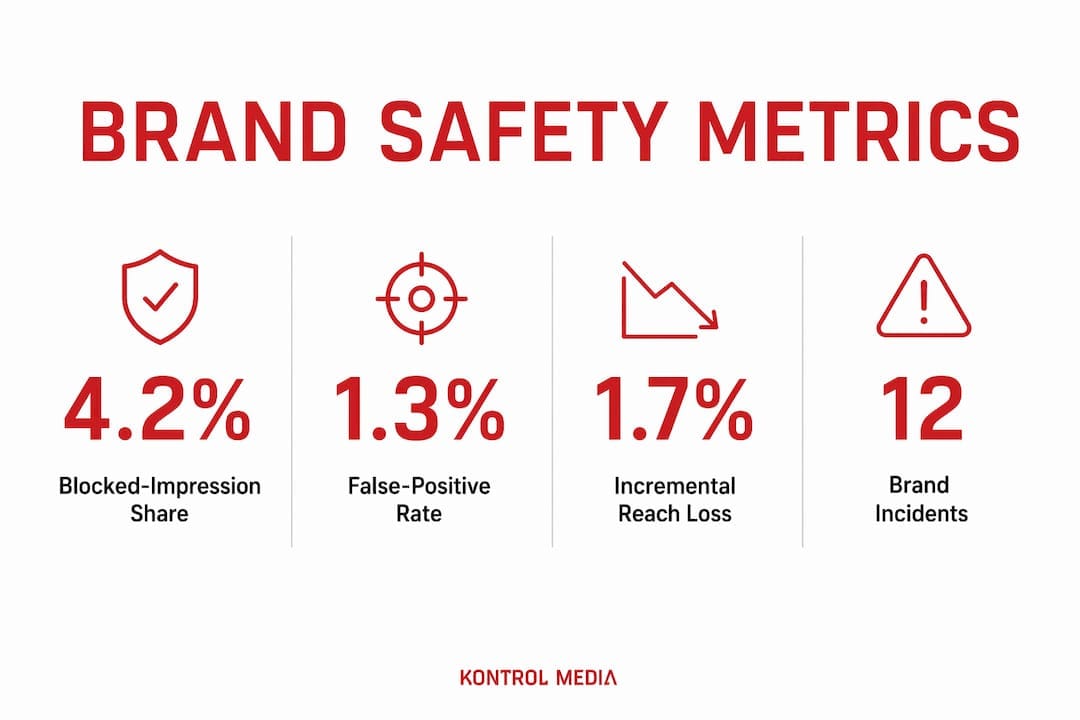
| Metric | What it tells you | How to collect it |
|---|---|---|
| Blocked-impression share | Volume of inventory excluded by the list | Verification vendor reporting dashboard |
| False-positive rate | Share of blocked impressions that were actually brand-safe | Manual audit sample or IAS Quality Connect |
| Incremental reach loss | Unique users lost due to blocking | DSP reach reporting, holdout comparison |
| CPM / eCPM shift | Cost impact of reduced supply | DSP billing data, pre/post comparison |
| Brand-incident rate | Actual unsafe placements that occurred | Verification vendor incident log |
A practical experiment design: assign 10% of traffic to a control group with no list change and 90% to the treatment group with the proposed modification. Run for 30 days and measure all five metrics above. Peer39 recommends this holdout approach as the cleanest way to isolate the net effect of a list change before committing it to full scale.
When results come in, the decision logic is straightforward. If blocked-impression share is high and brand-incident rate is unchanged, the list is over-blocking and should be narrowed. If brand-incident rate drops materially with modest reach loss, the list is earning its place. If CPMs spike without a corresponding safety improvement, replace the keyword rule with a contextual category filter.
Step-by-step checklist to deploy or audit a keyword block list program
- Define your brand safety floor. Document the specific content categories that are universally unacceptable. Separate them from suitability preferences before writing a single keyword.
- Map languages and regions. Identify every market the campaign will run in and assign a list owner for each language variant.
- Establish stakeholder sign-off. Require written approval from marketing, legal, and media teams before any list goes live or is modified.
- Apply narrow pre-bid filters. Deploy only the safety-floor keywords as pre-bid exclusions. Route suitability preferences to contextual category controls.
- Set monitoring dashboards. Configure real-time reporting for blocked-impression share and CPM in your DSP and verification platform from day one.
- Enable rollback hooks. Document the exact steps to revert a list change within 24 hours if metrics deteriorate unexpectedly.
- Run 30/60/90-day audit reports. Review false-positive samples, publisher impact, and reach loss at each interval. Archive every version of the list with a change log.
- Schedule quarterly governance reviews. Assign a named list owner, require a documented business case for every keyword retained or added, and align the review with TAG Brand Safety Certified requirements.
- Test before expanding. Any new keyword addition should go through the holdout experiment process described in the measurement section before full deployment.
- Retire stale terms. Remove keywords tied to resolved crises or outdated brand concerns. A list that grows but never shrinks is a governance failure.
Kontrol Media’s perspective: protect brands without demonetizing quality news
At Kontrol Media, we have seen this pattern play out more than once. A brand running a national awareness campaign arrives with a block list built conservatively and not meaningfully audited. While the list prevents ads from appearing next to genuinely harmful content, it also blocks a substantial portion of premium news inventory that IAS or a comparable verification tool would have cleared as brand-suitable.
One anonymized example: a consumer packaged goods brand came to us after noticing a sharp drop in premium news delivery. Their block list included broad terms like “crisis,” “death,” and “fire,” applied globally in English. The result was that their ads were being excluded from health journalism, environmental reporting, and lifestyle content that was entirely appropriate for their audience. We rebuilt their approach using contextual category rules in their verification platform, moved the broad terms off the keyword list and into sentiment-based filters, and built an allowlist of vetted news publishers. Reach on premium news inventory recovered, and their brand-incident rate did not increase.
The practical lesson: prioritize publisher relationships and use brand safety controls that distinguish between content that is genuinely harmful and content that merely contains a sensitive word. Those are not the same thing, and treating them as equivalent is costing brands real reach with real audiences.
Pro Tip: Ask your verification vendor to run a Quality Connect-style audit before your next campaign. It will show you exactly which brand-suitable pages your current block list is excluding, and the results are usually surprising.
If your brand is navigating the balance between safety and scale in programmatic buying, Kontrol Media’s retail media and commerce media practice can help you identify high-quality inventory alternatives when news placements are constrained by safety controls.
Key Takeaways
Keyword block lists are a necessary but insufficient brand safety tool: they work for universally harmful content but consistently over-block quality inventory, and the IAS-Reuters study found that more than half of brand-suitable Reuters pages would have been flagged by a typical block list.
| Point | Details |
|---|---|
| Block lists are a floor, not a strategy | Use them only for universally unacceptable content; handle suitability with contextual controls. |
| False positives are costly | Industry false-positive rates tend to be significant and increase substantially during sensitive news events. |
| Over-blocking hurts reach | Aggressive keyword filtering can eliminate 40%–70% of high-quality inventory with little safety gain. |
| Combine with contextual tools | Pair block lists with semantic NLP, allowlists, and verification platforms like IAS for precision. |
| Audit quarterly, not annually | TAG’s Brand Safety Certified program requires quarterly reviews; treat that cadence as a minimum. |
The long arc of keyword blocking in programmatic buying
Block lists will remain part of the programmatic toolkit for the foreseeable future. They are fast to deploy, easy to explain, and genuinely effective for a narrow category of content. But the strategic center of brand safety is moving, and it is moving fast. Semantic models, multimodal AI, and suitability frameworks built on NLP taxonomies are already outperforming keyword-only approaches on precision, and the gap will widen as these tools mature.
What concerns me about the current state is not that block lists exist. It is that they persist as the primary control for too many programs, long after better options became available. The “brand safety theater” label is uncomfortable but accurate: a list of blocked terms is visible, auditable, and easy to present in a client deck. That visibility creates inertia. The harder work of building a contextual suitability framework, vetting publishers, and running holdout experiments does not fit as neatly into a slide, but it produces materially better outcomes.
The path forward is not to abandon block lists. It is to govern them honestly: narrow, documented, regularly audited, and always paired with tools that actually understand context. Brand safety should be measurable, publisher-friendly, and grounded in what the content actually says, not just what words appear in a URL.
Useful sources and further reading
- IAB Brand Safety & Suitability Guide (industry guidance): IAB 2020 Brand Safety Guide — foundational definitions, false-positive data, and operational recommendations.
- TAG Keyword Exclusion List Best Practices (industry governance): TAG KELT Best Practices, March 2024 — the most current industry standard for building, managing, and auditing keyword exclusion lists.
- Peer39 Brand Safety Guide (vendor white paper): Peer39 Brand Safety Guide — practical guidance on suitability taxonomies and contextual targeting as alternatives to keyword blocking.
- IAS-Reuters Study via AdExchanger (case study): AdExchanger IAS-Reuters Report — quantified evidence of keyword over-blocking on a major news publisher.
- Viant Programmatic Brand Safety (vendor perspective): Viant Brand Safety Blog — semantic NLP advantages and homonym problem analysis.
- IAB Australia Brand Safety & Suitability Guidance (regional industry guidance): IAB Australia Guidance — contextual layering recommendations and localization best practices.
- Beeler.Tech Brand Safety Theater (practitioner commentary): Brand Safety Theater — candid analysis of why block lists persist despite better alternatives.
- Kontrol Media Brand Safety Resources (implementation help): Advertising on HuffPost: A Brand Safety Guide and Consumer Brand Media Network Best Practices — practitioner guidance for protecting brand outcomes while preserving publisher revenue.