


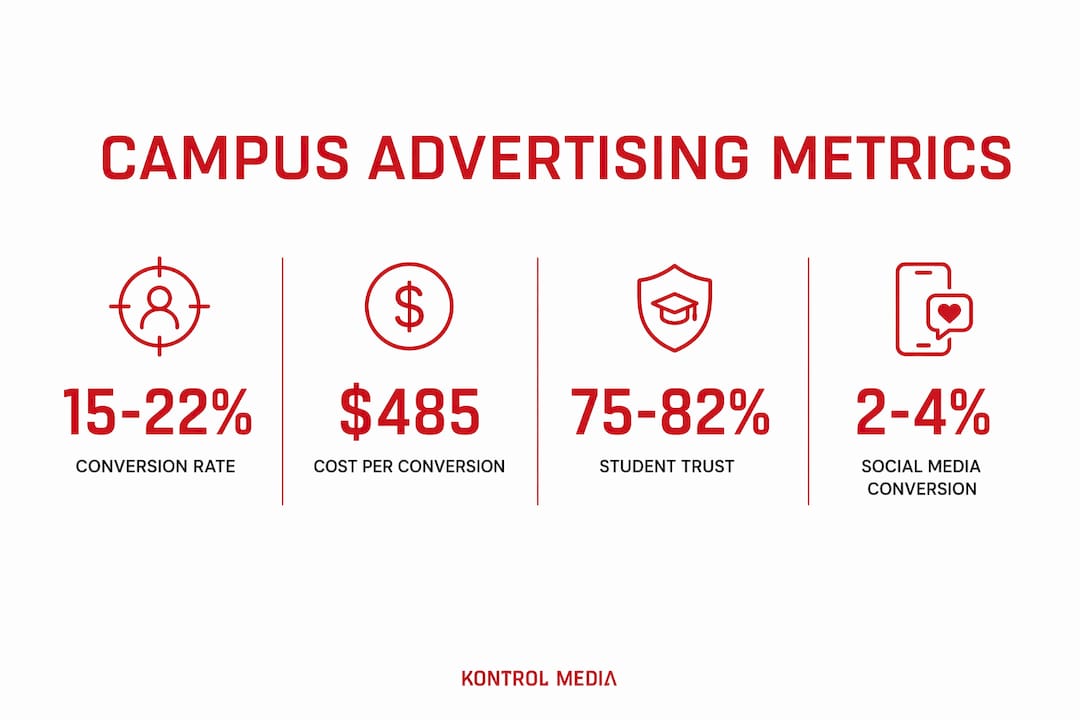
Campus advertising is the most effective method for reaching college students because it combines physical on-campus presence with digital touchpoints to drive conversion rates that social media alone cannot match. Integrated omnichannel campus platforms achieve conversion rates of 15–22%, compared to just 2–4% for social media advertising. That gap is not a rounding error. It reflects a fundamental difference in how students receive and trust brand messages depending on where they encounter them. For marketing professionals building college marketing strategies in 2026, understanding that gap is the starting point for every budget decision.
What makes campus advertising uniquely effective for college students?
Campus advertising works because students trust the channels woven into their daily environment. College newspapers, campus events, digital screens, and flyers generate trust levels of 75–82% among students. That trust directly translates into action, producing the 15–22% conversion rates that make on-campus media so compelling.
Social media, by contrast, earns only 56% trust from the same audience and converts at 2–4%. The difference is context. A brand appearing in a student newspaper or on a residence hall screen feels like part of campus life. A brand appearing in a social feed feels like an interruption. Students have grown up with ad blockers and algorithmic feeds, and they are skilled at filtering out messages that feel transactional.

Peer influence amplifies this effect. When a student sees a brand at a campus event and then hears a classmate mention it, the brand enters organic conversation. That kind of word-of-mouth is not something you can buy directly, but you can create the conditions for it by showing up where students already gather. Physical presence on campus creates the social proof that digital ads cannot manufacture.
The channels that perform best in effective campus advertising share one trait: they feel native to the campus experience. A well-placed flyer in a dining hall, a sponsored segment in a student podcast, or a branded activation at a campus fair all carry the implicit endorsement of the campus itself.
- College newspapers and editorial content build credibility through association with trusted student journalism
- Campus events and activations create memorable, shareable brand moments
- Digital out-of-home (DOOH) screens in high-traffic areas like libraries and student unions deliver repeated exposure
- Flyers and physical collateral in residence halls reach students in their most receptive, low-distraction moments
- Student ambassador programs turn peer influence into a structured, measurable channel
Pro Tip: Run your campus activation the week before midterms, not during them. Students are present on campus but not yet in full study-mode lockdown, making them more receptive to brand engagement.
How do integrated omnichannel campus platforms outperform isolated advertising?
The case for omnichannel campus advertising is not just philosophical. The numbers make it concrete. Centralized buying across 2,300+ campuses reduces cost per conversion to approximately $485, compared to $3,850 for decentralized buys through individual student groups. That is an 87% reduction in cost per conversion. For any marketing professional managing a finite budget, that efficiency gap changes the entire campaign math.
The reason centralized platforms outperform fragmented buys goes beyond price. When a student encounters a brand across multiple campus touchpoints, each exposure reinforces the previous one. A student who sees a brand on a DOOH screen, then reads about it in the campus paper, then encounters it at a campus event has received three distinct signals from three trusted sources. That multi-source exposure builds the kind of brand familiarity that drives purchase intent.
| Channel | Conversion rate | Cost per conversion |
|---|---|---|
| Integrated omnichannel campus platform | 15–22% | ~$485 |
| Social media advertising | 2–4% | $2,849+ |
| Decentralized campus media buys | Lower than centralized | ~$3,850 |
The table above reflects data from platforms operating at national scale. The cost advantage of centralized buying compounds as campaign scope grows. A brand running across 50 campuses through a single integrated platform pays far less per conversion than one managing 50 separate relationships with individual campus media groups.
Best practice for omnichannel campus campaigns means pairing complementary channels deliberately. Editorial content builds credibility. DOOH delivers frequency. Campus activations create emotional memory. Each channel does a different job, and the combination produces results that no single channel achieves alone. Integrating social media into this mix adds a digital amplification layer that extends campus reach beyond the physical footprint.
Pro Tip: Establish a single measurement framework before the campaign launches. Consistent tracking across all channels is the only way to know which touchpoints are driving conversion and which are just adding impressions.
What are effective campus promotion ideas for diverse student segments?
Timing is the first variable that separates good campus promotion ideas from great ones. Back-to-school in august and september, spring break in march, and finals periods in december and april are all high-attention moments when students are making purchasing decisions. A brand that shows up with a relevant offer at the right moment earns attention that a generic campaign running in february simply will not.
Gen Z students check for student discounts before making nearly 90% of purchases. Student spending collectively exceeds $88 billion annually. Those two facts together mean that verified, exclusive student offers are not a nice-to-have. They are the price of entry for brands serious about this demographic. Verification platforms that collect permissioned first-party data also give brands a lifecycle marketing asset that outlasts the initial campaign.
Authentic messaging matters as much as the offer itself. Gen Z students are fluent in brand-speak and quick to dismiss messaging that feels manufactured. Campaigns that reflect real student experiences, use student-created content, and acknowledge the actual texture of campus life outperform polished corporate creative. QR codes linking to exclusive offers, creator-led content from student influencers, and social media amplification built into the campaign architecture all extend reach without sacrificing authenticity.
Different student segments require different approaches. Freshmen are forming brand habits for the first time and respond well to discovery-oriented campaigns. Seniors are making transition purchases and respond to practical, value-driven messaging. Social students engage through events and peer networks. Study-focused students engage through editorial content and digital screens in academic spaces.
- Verified student discount programs that collect permissioned data for lifecycle marketing
- QR code activations on physical campus media that drive immediate digital engagement
- Student ambassador programs that turn peer influence into a structured channel
- Sponsored content in campus newspapers and student publications
- Campus event sponsorships timed to high-traffic moments like orientation and homecoming
- Creator-led social content produced by students on or near campus
How do you measure ROI for campus advertising campaigns?
Measuring campus advertising ROI starts with rejecting vanity metrics. Impressions and reach numbers look good in a deck, but they do not tell you whether a student bought anything, changed their brand preference, or remembered your message a week later. The metrics that matter are conversion rate, brand lift, purchase intent, and redemption rate.
Pre- and post-exposure brand lift studies compare campuses that received campaign exposure against control campuses that did not. That comparison isolates the campaign’s actual effect on brand consideration and purchase intent. Redemption tracking on student discount codes provides direct conversion data. Multi-touch attribution models show which channel combinations drove the most efficient path to conversion.
Centralized campaign management makes measurement far more reliable. When all channels run through a single platform, data flows into a single reporting environment. That consistency eliminates the apples-to-oranges comparisons that plague fragmented campaigns where each vendor reports differently. For a deeper look at evaluation methods, measuring marketing ROI across channels follows the same principles that apply to campus campaigns.
- Track redemption rates on student-specific discount codes to measure direct conversion
- Run brand lift surveys comparing exposed and unexposed student populations
- Use multi-touch attribution to identify which channel combinations drive the most efficient conversions
- Set baseline brand awareness metrics before the campaign launches to make post-campaign comparisons meaningful
- Evaluate cost per conversion, not cost per impression, as the primary efficiency metric
Evidence-based consulting approaches consistently show that brands which define conversion outcomes before launch outperform those that define success after the fact. The measurement framework is not an afterthought. It is part of the campaign design.
Key Takeaways
Integrated omnichannel campus advertising outperforms every isolated channel because it combines physical trust, repeated exposure, and digital amplification to drive conversion rates that social media cannot replicate.
| Point | Details |
|---|---|
| Conversion rate advantage | On-campus omnichannel platforms convert at 15–22%, versus 2–4% for social media. |
| Trust drives conversion | Campus-integrated channels earn 75–82% student trust, which directly produces higher purchase intent. |
| Centralized buying cuts costs | Centralized campus media buys reduce cost per conversion by approximately 87% versus decentralized approaches. |
| Timing and offers matter | Verified student discounts and campaigns timed to key campus moments drive the strongest engagement. |
| Measure conversion, not impressions | Brand lift studies and redemption tracking reveal true ROI where impression counts fall short. |
What I’ve learned about campus advertising that most brands get wrong
I’ve watched a lot of brands approach the college market with a social-first mindset and walk away wondering why the numbers didn’t move. The honest answer is that social media is a fine amplification layer, but it was never designed to be the spine of a campus campaign. Integrated marketing in higher education consistently shows that physical touchpoints build the emotional connection that digital channels then accelerate. Brands that reverse that order, leading with digital and treating physical as secondary, tend to get the weaker version of both.
The trust gap between on-campus media and social advertising is not going to close. Gen Z students are more skeptical of paid social than any previous generation, and that skepticism is only deepening. The brands winning with this audience are the ones willing to show up physically, invest in authentic student relationships, and treat campus advertising as a long-term brand-building channel rather than a short-term activation.
What I find genuinely encouraging is that the measurement tools have caught up with the ambition. Pre- and post-exposure studies, redemption tracking, and centralized attribution models now make it possible to prove campus advertising ROI with the same rigor you would apply to any performance channel. That removes the last excuse for treating campus as a soft, unmeasurable spend.
My practical advice: commit to at least three campus touchpoints per campaign, set your measurement framework before you launch, and resist the temptation to optimize for impressions. The brands that win on campus are the ones that prioritize conversion outcomes from day one.
— Mark Kapczynski
How Kontrol Media helps brands build campus advertising campaigns that convert
Brands that want to reach college students effectively need more than a media buy. They need a campaign architecture that connects physical campus presence, digital amplification, and measurement into a single, coherent strategy.
Kontrol Media works with brands at every stage of that process, from defining the right channel mix to building the measurement framework that proves ROI. Whether you are entering the college market for the first time or looking to improve the efficiency of an existing campus program, a comprehensive marketing strategy is what separates campaigns that convert from campaigns that just generate impressions. Explore Kontrol Media’s services to see how integrated campaign execution translates directly into measurable student engagement.
FAQ
What is campus advertising and how does it work?
Campus advertising is a college student outreach method that places brand messages across on-campus channels including newspapers, events, digital screens, and physical collateral. It works by integrating multiple trusted touchpoints to build repeated brand exposure within the campus environment.
Why does campus advertising outperform social media for targeting university students?
On-campus channels earn 75–82% student trust and convert at 15–22%, while social media earns 56% trust and converts at just 2–4%. The difference comes from context: campus media feels native to student life, while social ads feel like interruptions.
How much does campus advertising cost compared to other channels?
Centralized campus media buying costs approximately $485 per conversion, compared to $2,849 or more for social media and $3,850 for decentralized campus buys. Centralized platforms that access thousands of campuses deliver the lowest cost per conversion at scale.
What are the best campus promotion ideas for engaging college students?
Verified student discount programs, QR code activations on physical campus media, student ambassador programs, and sponsored campus events consistently produce the strongest engagement. Timing campaigns around back-to-school, homecoming, and pre-finals periods amplifies results.
How do you measure the ROI of a campus advertising campaign?
The most reliable methods are pre- and post-exposure brand lift studies, redemption tracking on student-specific discount codes, and multi-touch attribution across all campaign channels. Cost per conversion, not cost per impression, is the metric that accurately reflects campaign efficiency.
Recommended
- Integrating Social Media into Your Advertising Strategy for Maximum Impact | Kontrol Media Consultancy
- Beyond Traditional Advertising: Exploring Guerrilla Marketing Tactics | Kontrol Media Consultancy
- Helping media teams reach the audiences they need | Kontrol Media Consultancy
- Measuring the ROI of Your Marketing and Advertising Campaigns | Kontrol Media Consultancy