


Advertising in video games is defined as the practice of embedding brand content directly within gameplay environments, using formats that enhance rather than interrupt the player experience. The industry recognizes two primary approaches: intrinsic in-game advertising, which places branded signage and product placements natively within the game world, and rewarded video ads, where players opt in to watch a full-screen video in exchange for in-game currency or perks. IAB creative best practices show that intrinsic formats achieve a 21% lift in brand recommendation and a 5% increase in purchase intent. That performance gap over standard display advertising is real, and it is widening. Yet gaming reaches 59.2% of the US population in 2026, while in-game ads capture only 2.3% of digital ad spend. The opportunity is sitting right there, largely unclaimed, and the brands that figure out how to respect the gamer first will be the ones who capture it.
What are the main games and advertising formats?
The format you choose determines whether a player notices your brand or resents it. Each ad type carries a different risk-reward profile, and matching the format to the game type and marketing goal is the first decision every brand manager needs to make.
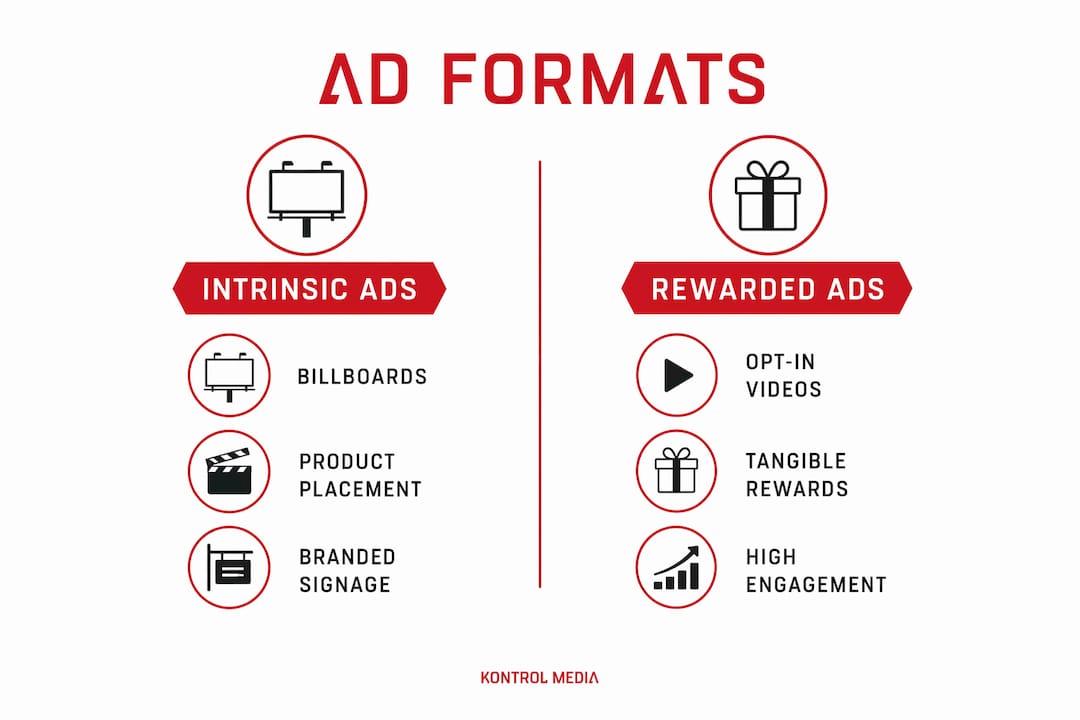
Intrinsic in-game ads
Intrinsic ads live inside the game world as branded signage, billboards on virtual stadiums, product placements on in-game vehicles, or ambient environmental details. They do not pause gameplay. They do not demand attention. They work the way outdoor advertising works in real life: the player absorbs them as part of the environment. This format performs best in sports titles, racing games, and open-world games where real-world brand presence feels authentic.

Rewarded video ads
Rewarded video ads are opt-in full-screen videos that give players a tangible in-game reward for watching. More than 60% of marketers find rewarded ads effective across all funnel stages, from awareness through loyalty. The opt-in mechanic is the key. Players choose to engage, which means attention is genuine rather than captured by force. Rewarded video eCPMs in tier-1 markets range from $15 to $40, making them the highest-earning mobile format by a significant margin.
Interstitial and adjacent ads
Interstitial ads appear between game levels or during loading screens. They are tolerated when timed correctly and resented when they appear mid-action. Adjacent ads sit outside the core gameplay area, in menus or lobby screens, and carry lower engagement but also lower disruption risk. These formats work for brands that need reach at lower CPMs, with in-game CPMs ranging from $5 to $40 depending on format, platform, and geography.
Platform-specific formats
Roblox Ads Manager offers programmatic self-serve bidding for immersive formats, including portal ads that teleport players directly into a branded game experience. Third-party brand safety and viewability verification are built in. This makes Roblox one of the few platforms where a brand can buy at scale with measurable accountability inside an immersive environment.
Why is advertising in video games a strategic opportunity?
The numbers tell a story that most media plans are still ignoring. Gaming reaches 3.4 billion players globally, and the US penetration rate of 59.2% puts gaming ahead of most traditional media channels in raw audience size. Yet the share of digital ad spend flowing into games remains at 2.3%. That gap is not a warning sign. It is an opening.
The engagement quality inside games is genuinely different from passive media. Players are active, focused, and emotionally invested. That state of mind creates stronger memory encoding for brands that appear naturally within the experience. The challenge is that the same emotional investment that makes gaming valuable also makes players intolerant of disruption. A poorly placed ad does not just get ignored. It generates active resentment toward the brand.
Brand safety and measurement have historically been the two objections that kept budgets out of gaming. Both are being addressed. Programmatic platforms now offer third-party verification, and standardization of ad units across console, PC, and connected TV is enabling scalable brand buys that were not possible three years ago. The brands entering now are building audience relationships before the channel gets crowded and CPMs rise.
The performance data supports the move. Rewarded formats drive purchase intent in 46% of players post-exposure. That figure rivals or exceeds most premium video benchmarks. The creative challenge is real, but the performance ceiling is high for brands willing to meet players on their terms.
How to create effective, non-disruptive ad strategies in games
The brands that fail in gaming treat game surfaces as billboards. The brands that succeed embed value through functional or aesthetic assets that make the game better, not just more commercial. That distinction is the spine of every effective in-game advertising strategy.
Here is how to build one:
Lead with value, not logos. Design brand integrations that give players something useful: a branded skin, a sponsored power-up, or an aesthetic element that fits the game world. A logo slapped on a wall is forgettable. A branded vehicle with unique handling characteristics becomes part of the player’s experience.
Time ads during natural lulls. Ads triggered during natural pauses, such as level transitions, loading screens, or post-match summaries, yield far higher acceptance than ads that interrupt active play. Map your ad placements to the game’s natural rhythm before you negotiate placement.
Follow IAB creative guidelines. The IAB’s in-game ad creative standards specify logo size, visual simplicity, and contextual relevance. Following them is not just compliance. It is the reason IAB-compliant intrinsic ads outperform generic display by 21% on brand recommendation.
Use dynamic, contextually relevant creative. Real-time data feeds allow brands to serve ads that match the player’s location, time of day, or in-game context. A sports drink brand showing a cold beverage ad during a post-match cooldown moment is relevant. The same ad during a tense final-round sequence is noise.
Test frequency and density before scaling. Start with conservative ad loads and measure retention alongside revenue. The relationship between ad frequency and player churn is nonlinear. A small increase in ad density can produce a disproportionate drop in session length.
Pro Tip: Run an A/B test on ad timing before committing to a full campaign. Compare player retention and session length between ad-free sessions and sessions with ads placed at natural lulls. The data will tell you exactly how much ad load your audience will accept before they leave.
How do programmatic platforms and brand partnerships scale campaigns?
Programmatic buying is the right starting point for any brand entering gaming advertising. It gives you targeting, third-party measurement, and the ability to establish baseline metrics before you commit budget to direct deals. Without that baseline, you are negotiating blind.
Once you have programmatic data, direct brand partnerships become a different conversation. You know your CPM floor, your viewability benchmarks, and your audience composition. That knowledge shifts the negotiation from guesswork to evidence. Direct deals in gaming typically take one of four structures:
- CPM-floor deals: A guaranteed minimum cost per thousand impressions, protecting publisher revenue while giving brands predictable pricing.
- Fixed-fee integrations: A flat fee for a defined placement, common in branded level design or sponsored in-game events.
- Revenue share models: The brand and publisher split revenue generated from a co-produced experience, aligning incentives on both sides.
- Value-exchange models: The brand funds in-game rewards in exchange for player engagement with brand content, common in rewarded video structures.
The most durable partnerships go beyond ad insertion. They are co-produced experiences where the brand contributes to the game’s creative direction. Brands that combine programmatic testing with prestige integrations and adapt based on data consistently outperform brands that treat gaming as a media buy rather than a creative collaboration.
Pro Tip: Before approaching a game developer for a direct partnership, run two to four weeks of programmatic ads on the platform. Use that data to show the developer your audience overlap and engagement rates. It turns a cold pitch into a data-backed conversation.
Tracking the performance of these campaigns requires the same rigor you apply to any channel. Measuring campaign ROI across brand lift, engagement, and conversion metrics is the only way to know whether the integration is working or just generating impressions. The difference between commerce media and traditional programmatic approaches matters here too, especially as gaming platforms develop their own first-party data capabilities.
Key Takeaways
Effective advertising in video games requires native integration, player-first timing, and programmatic measurement before direct partnerships to drive brand lift and purchase intent.
| Point | Details |
|---|---|
| Player experience comes first | Ads that disrupt gameplay generate resentment; native and rewarded formats earn attention instead. |
| The spend gap is an opportunity | Gaming reaches 59.2% of US adults but holds only 2.3% of digital ad spend, leaving room for early movers. |
| IAB standards drive performance | Intrinsic ads following IAB creative guidelines lift brand recommendation by 21% over generic placements. |
| Programmatic before direct | Establish CPM baselines and audience data through programmatic before negotiating direct brand partnerships. |
| Value-first creative wins | Branded skins, sponsored perks, and functional assets outperform logo placements in both recall and sentiment. |
The gamer ethos is not a barrier. It is the brief.
I have watched brands approach gaming advertising the same way they approached social media in 2010: with a media plan built for a passive audience dropped into an active one. The results were predictable. Players rejected the intrusion, developers pushed back on formats that hurt retention, and brands walked away convinced that gaming “doesn’t work” for advertising. That conclusion was wrong then, and it is wrong now.
What I have found, working with brands across entertainment and media, is that the gamer ethos is actually the clearest creative brief you will ever receive. Players want immersion, fairness, and reward. They will accept advertising that delivers on any one of those three. They will reject advertising that violates all three simultaneously, which is exactly what a mid-session interstitial does.
The emerging phygital integrations are where I see the most genuine excitement. Linking in-game actions to real-world rewards, or vice versa, creates a loop that traditional digital advertising cannot replicate. A player who earns a discount code by completing a branded in-game challenge has a fundamentally different relationship with that brand than someone who saw a pre-roll ad. That depth of engagement is what performance-oriented brands are actually looking for.
The standardization push across console, PC, and connected TV is making scale possible in ways it was not before. Brands that build their gaming playbook now, while CPMs are still relatively low and creative space is still relatively open, will have a structural advantage when the channel matures. The ones who wait for gaming to look like every other media channel will pay premium rates for a crowded environment. The time to learn the rules of this game is before everyone else figures out they need to play.
— Mark Kapczynski
How Kontrol Media approaches gaming brand partnerships
Building a brand presence inside a game is not a media buy. It is a relationship between your brand and a developer’s community, and it requires the same strategic thinking you would apply to any long-term partnership.

Kontrol Media works with brands and their agencies to build the kind of deep game integrations that produce performance results, not just impressions. The work starts with a clear business strategy that defines what success looks like before a single ad unit goes live. From there, Kontrol Media identifies the right game environments, structures the partnership terms, and builds the measurement framework that connects in-game activity to real business outcomes. If you are ready to move beyond standard ad placements and build something that actually resonates with players, that conversation starts here.
FAQ
What is intrinsic in-game advertising?
Intrinsic in-game advertising places branded content natively within the game world as signage, product placements, or environmental details, without interrupting gameplay. It is the format most associated with high brand recall and positive player sentiment.
How effective are rewarded video ads in mobile games?
Rewarded video ads are the most effective mobile gaming format, with 46% of players reporting purchase intent after exposure and eCPMs ranging from $15 to $40 in tier-1 markets.
Why does gaming receive so little ad spend relative to its audience size?
Gaming captures only 2.3% of digital ad spend despite reaching 59.2% of the US population, primarily because of historical concerns around brand safety, measurement, and creative complexity. Those barriers are shrinking as programmatic platforms add third-party verification.
What is the best way to start advertising in video games?
Start with programmatic ad buying to establish CPM baselines and audience data, then use that evidence to negotiate direct brand partnerships with developers for deeper, co-produced integrations.
How does gamification in advertising differ from in-game advertising?
Gamification in advertising applies game mechanics, such as points, challenges, and rewards, to brand experiences outside of games, while in-game advertising places brand content directly within existing game environments. Both approaches use player psychology, but they operate in different contexts and require different creative strategies.
Recommended
- Integrating Social Media into Your Advertising Strategy for Maximum Impact | Kontrol Media Consultancy
- Beyond Traditional Advertising: Exploring Guerrilla Marketing Tactics | Kontrol Media Consultancy
- Branding and Messaging Strategies for Marketers | Kontrol Media Consultancy
- Riding the AI Wave: Brand in the Age of Innovation | Kontrol Media Consultancy