


DTC customer acquisition is the process of attracting and converting customers directly to a brand, without retail intermediaries, using integrated paid, owned, and organic channels optimized for long-term profitability. Direct-to-consumer sales have never been more competitive. Average CAC rose 12–18% year over year in 2026, with median blended costs landing between $60 and $120 per new customer depending on category. That number demands a system, not a campaign. The brands winning right now treat acquisition as a unit economics problem first and a media-buying problem second.
What is driving DTC customer acquisition costs higher in 2026?
Three structural forces are pushing acquisition costs up, and none of them are going away. Privacy changes starting with iOS 14.5 and continuing through iOS 18 reduced ad targeting precision across Meta and other paid social platforms. AI-driven ad competition flooded auction environments with automated bidders, inflating CPMs even for brands with strong creative. Cookie deprecation added measurement noise that makes paid ROAS look better than it actually is, which leads to misallocated budgets.

The numbers tell a clear story. Paid social CAC is up 30–60% compared to 2020 levels. That is not a blip. It reflects a permanently more expensive environment where early-adopter audiences have been exhausted and cold prospecting requires more touches to convert.
Price inflation and supply chain pressure compound the problem. Thinner margins mean conversion rates must work harder to justify the same acquisition spend. A brand that could absorb a $90 CAC in 2022 may find that same number unprofitable today if average order value has not kept pace.
Attribution complexity is the hidden cost most teams underestimate. When a customer discovers a product on TikTok, researches it on Google, sees a Meta retargeting ad, and converts via an SMS link, no single channel gets full credit. Post-cookie measurement noise inflates reported ROAS and obscures which channels are actually driving new customers. Brands that do not account for this end up over-investing in retargeting and under-investing in prospecting.
What metrics actually measure acquisition efficiency?
The LTV-to-CAC ratio is the foundational metric for any DTC brand serious about sustainable growth. The minimum benchmark is 3:1, meaning for every dollar spent acquiring a customer, that customer must return at least three dollars in lifetime value. Anything below that ratio signals a structural problem with either acquisition cost, retention, or both.
Payback period matters just as much. The median payback period stretched from 6.2 months in 2025 to 7.8 months in 2026. That lengthening creates real cash flow risk, especially for brands without strong retention infrastructure to offset the acquisition lag.
Not all CAC numbers mean the same thing. Three distinct versions deserve separate tracking:
- Blended CAC includes all marketing spend divided by all new customers, giving a portfolio-level view.
- Paid CAC isolates spend on paid channels only, revealing true media efficiency.
- New customer acquisition cost (NCAC) strips out returning customer revenue from the denominator, showing what it actually costs to bring in net-new buyers.
Treating CAC purely as a marketing metric is a mistake. Viewing CAC as a margin metric constrained by profit floors at the order level prevents discount stacking and protects profitability beyond simple revenue-based KPIs. A brand that sets a CAC guardrail based on contribution margin per order will make better channel decisions than one chasing volume at any cost.
Pro Tip: Segment CAC by both acquisition channel and product line. A hero product with a $70 CAC and 4:1 LTV ratio may justify more spend than a secondary SKU with a $50 CAC and 2:1 ratio. The absolute number is less important than the margin it generates.
How to build a multi-channel DTC marketing strategy
Brands using three or more integrated channels see 190% higher revenue than single-channel brands. That statistic is not an argument for spreading budget thin. It is an argument for building a deliberate, sequenced system.
A proven channel allocation framework for 2026 looks like this:
- Paid social (60–75% of paid budget). Meta and TikTok remain the primary prospecting engines for most DTC categories. TikTok drives discovery. Meta drives conversion. Run them together, not as alternatives.
- Paid search (5–15% of paid budget). Google captures demand that already exists. Use it to close customers who discovered you through social, not to generate awareness from scratch.
- Influencer and UGC (5–10% of paid budget). User-generated content outperforms polished brand creative in paid social environments. Producing 5–10 creative concepts weekly with fast iteration cycles is a genuine competitive advantage when CPMs are high.
- Owned channels (remainder). Email and SMS are not acquisition channels in the traditional sense, but they reduce effective CAC by converting warm audiences at a fraction of the cost of cold paid media.
The sequencing matters as much as the allocation. Start with one paid channel, prove unit economics, then layer in a second. Brands that launch on Meta, TikTok, Google, and influencer simultaneously burn budget before they understand what works. Discipline in the foundation phase pays off at scale.
Pro Tip: Cap any single acquisition channel at 40% of total spend. Single-channel dependency creates catastrophic risk when platform algorithms shift or CPCs spike. Diversification is not inefficiency. It is resilience.
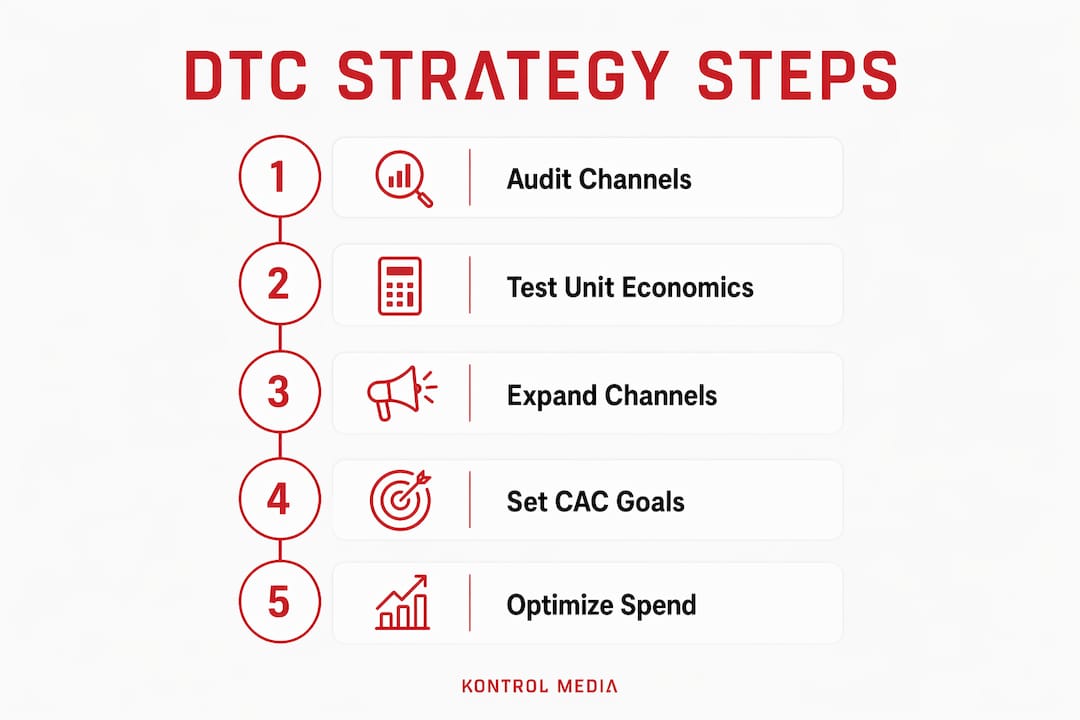
A stepwise build looks like this. In the foundation phase, audit existing channels, establish tracking, and set CAC guardrails based on unit economics. In the optimization phase, run creative testing at volume, build SMS capture flows, and measure NCAC separately from blended CAC. In the scale phase, layer in additional channels, run incrementality tests, and shift budget toward what the data confirms, not what the dashboards suggest.
Why retention is the other half of your acquisition equation
Retention is not separate from acquisition strategy. It is the mechanism that makes acquisition spend profitable over time. Mature DTC brands shift budget from an 80/20 acquisition-to-retention split toward roughly 50/50 as they grow, driving repeat purchase rates above 30%. That shift does not reduce growth. It makes growth sustainable.
Email generates 30–40% of revenue for mature DTC brands. SMS adds another 5–15%. These owned channels carry a CAC of $5–$15 per customer, compared to $60–$120 for paid acquisition. The math is not subtle.
The flows that drive retention results are specific:
- Welcome series sets brand expectations and drives the second purchase.
- Abandoned cart recovers high-intent buyers who did not convert on the first visit.
- Post-purchase builds loyalty and reduces return rates through education and cross-sell.
- Win-back reactivates lapsed customers before they churn permanently.
- Replenishment automates repeat purchase prompts for consumable products.
Subscription models and loyalty programs accelerate the repeat purchase rate further. A customer on a subscription has a predictable LTV that makes higher acquisition spend justifiable. That changes the entire unit economics calculation.
Early-stage brands see blended ROAS of 1.5–3x, while mature brands targeting retention achieve 3–5x because acquisition value includes future LTV. Measuring only first-order ROAS underestimates what a new customer is actually worth. That underestimation leads brands to underspend on acquisition precisely when they should be scaling.
How do you measure and optimize acquisition spend accurately?
Accurate measurement is the hardest problem in DTC marketing right now. Media mix modeling (MMM) and incrementality testing are the two frameworks that cut through attribution noise and validate true channel contribution.
MMM tools analyze historical spend and revenue patterns across channels to estimate each channel’s contribution independent of last-click attribution. Incrementality testing, run via geo-holdouts or audience holdouts, measures what would have happened without a specific channel’s spend. Together, they give a far more honest picture than any platform’s self-reported ROAS.
Three measurement principles that protect profitability:
- Use new customer revenue as your primary acquisition metric. Retargeting inflates ROAS by claiming credit for customers who would have converted anyway. Isolating new customer revenue removes that distortion.
- Set CAC budget guardrails from unit economics, not from channel benchmarks. What a competitor spends per customer is irrelevant if their margin structure differs from yours.
- Test one variable at a time. Channel fragmentation combined with simultaneous creative and audience changes makes it impossible to know what drove a result. Systematic testing requires discipline.
For teams building out their multi-touchpoint attribution capabilities, generative AI and authoritative content strategies are also becoming part of the organic acquisition funnel. AI-powered shopping assistants now surface brands that produce problem-solving content targeting commercial queries. Organic acquisition is no longer just an SEO play. It is a presence in the tools your customers use to make decisions.
Pro Tip: Do not let creative fatigue silently kill your paid performance. Rotate new creative concepts every two to three weeks in high-spend campaigns. Declining CTR is almost always a creative problem before it becomes a targeting problem.
Key Takeaways
Profitable DTC customer acquisition requires integrating paid, owned, and organic channels within a unit economics framework anchored by a 3:1 LTV-to-CAC ratio and a disciplined retention strategy.
| Point | Details |
|---|---|
| CAC is rising structurally | Median blended CAC ranges from $60 to $120; paid social costs are up 30–60% since 2020. |
| 3:1 LTV-to-CAC is the floor | Any ratio below 3:1 signals a retention or margin problem that paid spend cannot fix. |
| Multi-channel outperforms single-channel | Brands using three or more integrated channels generate 190% more revenue than single-channel brands. |
| Retention cuts effective CAC | Email and SMS carry a $5–$15 CAC versus $60–$120 for paid acquisition; owned channels are non-negotiable. |
| Incrementality testing beats last-click | MMM and geo-holdout testing reveal true channel contribution and prevent budget misallocation. |
The LTV-first mindset is the only one that survives rising CAC
I have watched a lot of DTC brands chase volume at the expense of margin, and the pattern is almost always the same. They scale paid spend, hit a CAC wall, and then scramble to fix retention after the fact. The brands that avoid that trap start with a different question. They do not ask “how do we get more customers?” They ask “what does a customer need to be worth for this acquisition spend to make sense?”
That reframe changes everything. It means you build your email and SMS flows before you scale Meta. It means you set a CAC guardrail before you hand budget to a media buyer. It means you run incrementality tests before you declare a channel a winner. The non-linear customer journey across TikTok, Google, Meta, and SMS is real, and it rewards brands that build systems, not brands that optimize individual channels in isolation.
The uncomfortable truth is that most DTC brands are over-indexed on acquisition and under-invested in the infrastructure that makes acquisition profitable. Retention is not a nice-to-have. It is the mechanism that turns a $90 CAC into a positive margin event. Without it, you are running a very expensive customer rental business.
The brands I respect most in this space are the ones that treat creative testing with the same rigor they apply to financial modeling. They produce volume, iterate fast, and let data kill bad ideas quickly. That combination of creative discipline and analytical honesty is what separates brands that scale from brands that stall.
The good news is that the fundamentals are not complicated. Build the retention infrastructure. Diversify your channel mix. Measure what actually matters. The brands that do those three things consistently will outperform the ones chasing the next platform trend every quarter.
— Mark Kapczynski
How Kontrol Media helps DTC brands build acquisition systems that last
Rising acquisition costs are a strategy problem before they are a media-buying problem. Kontrol Media works with DTC brands and marketing leaders to build integrated business and marketing strategies that connect acquisition spend to unit economics, retention infrastructure, and long-term brand value.
Kontrol Media’s work spans multi-channel media strategy, creative testing frameworks, and data-driven spend allocation, the exact disciplines that determine whether a DTC brand scales profitably or burns budget chasing volume. Clients like Experian, BuzzFeed, and RE/MAX have seen what happens when acquisition strategy is built on a real foundation rather than platform-reported metrics. If your CAC is rising and your retention infrastructure is not keeping pace, that gap is where Kontrol Media starts. Explore Kontrol Media’s services to see how the work gets done.
FAQ
What is DTC customer acquisition?
DTC customer acquisition is the process of attracting and converting customers directly to a brand without retail intermediaries, using paid, owned, and organic channels. The goal is to acquire customers at a cost that supports a profitable LTV-to-CAC ratio.
What is a good LTV-to-CAC ratio for DTC brands?
A 3:1 LTV-to-CAC ratio is the minimum benchmark for sustainable DTC growth. Ratios below 3:1 indicate that acquisition costs or churn are eroding profitability.
How much does it cost to acquire a DTC customer in 2026?
Median blended CAC for DTC brands ranges from $60 to $120 per new customer in 2026, with paid social CAC up 30–60% compared to 2020 levels.
Why is multi-channel marketing critical for direct-to-consumer sales?
Brands using three or more integrated channels generate 190% more revenue than single-channel brands. Customer journeys span TikTok, Google, Meta, and email, so no single channel captures the full conversion path.
How do email and SMS reduce overall acquisition costs?
Email and SMS carry a CAC of $5–$15 per customer compared to $60–$120 for paid acquisition. Email alone generates 30–40% of revenue for mature DTC brands, making owned channels the most cost-efficient part of any acquisition system.
Recommended
- Advertiser Acquisition Strategies for Media Networks in 2026 | Kontrol Media Consultancy
- Comprehensive Business & Marketing Services | Kontrol Media
- Ad Sales Strategies That Drive Real Revenue in 2026 | Kontrol Media Consultancy
- Emerging Trends Shaping the Future of eCommerce in 2025 | Kontrol Media Consultancy