


Strategic partnerships are formal collaborations where independent organizations pool resources, expertise, and capabilities to achieve shared business objectives without merging or surrendering autonomy. They are not optional extras for growth-minded executives. Collaborative innovation has become a strategic imperative in the modern economy, demanding that companies build real cross-organizational capabilities rather than rely on internal resources alone. The most effective business alliances combine aligned goals, clear governance, and operational discipline at every level. This guide breaks down how these partnerships work, what types exist, and what separates the ones that deliver from the ones that quietly fall apart.
What are strategic partnerships and how do they differ from other alliances?
Strategic partnerships are defined as ongoing collaborations between two or more independent organizations that share control over a joint activity without creating a new legal entity. That last point matters more than most executives realize. Alliances maintain organizational independence and do not produce a separate parent-owned business, which is precisely what distinguishes them from joint ventures.
A joint venture creates a new company owned by the founding parties. A strategic alliance does not. This distinction shapes everything from tax treatment to exit flexibility. Contractual agreements, by contrast, are transactional and time-limited. A strategic alliance is ongoing, relational, and built around shared capability rather than a single deliverable.

The legal frameworks used to govern these arrangements vary by complexity and risk. Many partnerships begin with a non-binding Memorandum of Understanding, or MoU. MoUs cover technology development, licensing, production, and procurement while preserving flexibility before formal contracts are signed. This staged approach lets both parties test alignment before committing to binding obligations.
Pro Tip: Start every new alliance with a structured MoU that defines scope, data sharing rules, and exit conditions. Skipping this step is the single fastest way to create a dispute that neither party anticipated.
Three characteristics define a genuine strategic alliance: the partners remain legally independent, they share decision-making authority over the collaboration, and the relationship is designed to produce outcomes neither could achieve alone. If any of those three conditions is missing, you are looking at a vendor relationship, not a true partnership.
What are the key types of strategic partnerships and their business applications?
Not all collaborative partnerships are built the same way. The type you choose should map directly to your business objective, your risk tolerance, and the resources you are willing to commit.
| Partnership Type | Primary Objective | Typical Application |
|---|---|---|
| Equity alliance | Shared ownership stake | Technology investment, R&D co-development |
| Co-marketing agreement | Shared audience reach | Joint campaigns, co-branded content |
| Technology partnership | Capability integration | Platform interoperability, API sharing |
| Distribution agreement | Market access | Channel expansion, geographic entry |
| Licensing arrangement | IP monetization | Brand extension, product localization |
Each type serves a distinct purpose. Equity alliances signal long-term commitment and align financial incentives, which is why they appear most often in capital-intensive sectors like energy, aerospace, and enterprise software. Co-marketing agreements are lower risk and faster to execute. They work best when both brands share a customer base but sell non-competing products.
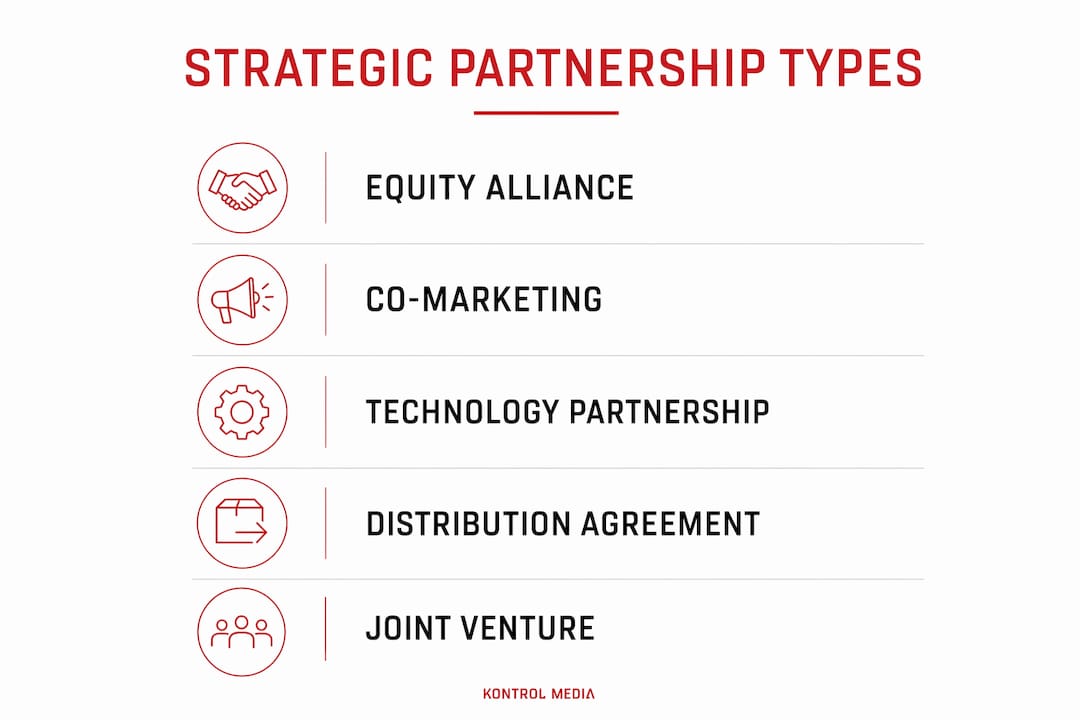
Technology partnerships have grown significantly in relevance as companies race to integrate AI and data capabilities they cannot build internally. Partnerships offer expanded market reach, reduced risk, and access to new technologies through shared R&D, which makes them especially attractive for mid-market companies competing against larger, better-resourced players.
Distribution agreements are the most underrated type. A well-structured distribution partnership can open a new geography or customer segment in months rather than years. The trade-off is dependency: if the distribution partner underperforms, your market entry stalls with them.
Selecting the right type starts with a clear-eyed answer to one question: what do you need that you cannot build or buy efficiently on your own? The answer points directly to the partnership structure that fits.
How do business leaders effectively establish and manage strategic partnerships?
Establishing a strong alliance requires more than a signed agreement and a press release. The real work begins after the ink dries. Here is how business leaders can build partnerships that hold up over time.
Define the value exchange clearly. Both parties must articulate what they contribute and what they expect in return. Vague value propositions create misaligned expectations that surface as conflict six months in.
Assign dedicated Partnership Leads. Operational-level management is critical to avoid fragmented and transactional outcomes. High-level vision fails without trained individuals managing day-to-day execution, partner engagement, and issue resolution.
Build a governance structure before you need it. Establish decision-making protocols, escalation paths, and review cadences at the outset. Partnerships without governance default to whoever shouts loudest.
Manage sensitive information with discipline. Failure to govern controlled information sharing undermines trust and alliance longevity. IP, financial models, and product roadmaps require secure, structured workflows, not email threads.
Use staged agreements to build trust progressively. Move from MoU to formal contract as the relationship matures and both parties demonstrate reliability. Rushing to a binding agreement before trust is established is a common and costly mistake.
Invest in cultural integration. Differences in organizational culture, decision-making speed, and communication style kill more partnerships than commercial disagreements do. Address these gaps explicitly and early.
Pro Tip: Executive sponsorship is not a formality. Assign a named senior leader on both sides who has authority to resolve disputes and the mandate to keep the partnership on track. Without that, operational teams fill the vacuum with competing priorities.
The role of executive coaching in partnership decisions is also worth considering. Leaders who have worked through partnership dynamics with a coach tend to navigate the interpersonal and political complexity of alliances more effectively than those who rely on instinct alone.
What are examples of successful strategic partnerships illustrating best practices?
Real-world examples cut through theory faster than any framework. Two recent alliances illustrate what high-functioning partnerships look like in practice.
Amazon and OpenAI: the anatomy of a large-scale commitment
Amazon’s partnership with OpenAI stands as one of the most significant business alliances of 2026. Amazon committed $50 billion overall, with a $15 billion initial payment and 2 gigawatts of Trainium capacity delivered over 8 years. The scale signals something important: this is not a pilot program or a co-marketing experiment. It is a structural bet on shared infrastructure.
What makes this alliance instructive is its architecture. Amazon contributes cloud infrastructure and compute capacity. OpenAI contributes model development and AI research capability. Neither party is trying to replicate what the other does. That clarity of role is the foundation of every partnership that actually delivers.
Stellantis, Wayve, and Uber: scaling autonomous mobility
The three-way alliance between Stellantis, Wayve, and Uber to scale robotaxi services globally demonstrates a different model. Each partner brings a distinct and non-overlapping capability. Stellantis provides vehicle manufacturing and fleet management. Wayve contributes autonomous driving software. Uber supplies the demand network and ride-hailing infrastructure.
The partnership was formalized through a non-binding MoU, which gave all three parties room to align on technology development, licensing terms, and production timelines before committing to binding obligations. That staged approach reflects mature partnering strategy.
The lessons from both examples are consistent:
- Aligned goals with no overlap in core capabilities reduce internal competition.
- Clear governance and defined contribution from each party prevent scope creep.
- Long-term commitment signals, whether financial or contractual, build the trust that sustains collaboration through setbacks.
- Cultural integration and communication protocols are treated as operational requirements, not soft skills.
Key takeaways
Effective strategic partnerships require aligned goals, dedicated operational management, and disciplined governance to convert shared ambition into durable business results.
| Point | Details |
|---|---|
| Define the structure early | Choose between equity alliances, co-marketing, technology, or distribution based on your specific business objective. |
| Use staged agreements | Start with a non-binding MoU to build trust before committing to formal contracts. |
| Invest in Partnership Leads | Dedicated operational managers are the difference between a functioning alliance and a fragmented one. |
| Govern sensitive information | Secure workflows for IP and financial data protect trust and long-term viability. |
| Study high-performing examples | Amazon’s $50 billion OpenAI commitment and the Stellantis-Wayve-Uber alliance both demonstrate the value of clear roles and long-term commitment. |
Why most partnerships fail before they ever really start
I have watched a lot of alliances get announced with genuine excitement and then quietly dissolve within 18 months. The press release goes out, the leadership teams shake hands, and then everyone goes back to their day jobs. That is the failure mode nobody talks about openly.
The truth I have come to after years of working on business strategy and execution is that most partnerships do not fail because the commercial logic was wrong. They fail because nobody invested in the operational infrastructure to make them work. Collaborative maturity, the internal capability to integrate work across organizational and cultural boundaries, is what separates partnerships that produce results from those that produce meeting notes.
Executives tend to overestimate the power of a signed agreement and underestimate the difficulty of sustained cross-organizational execution. A contract does not create alignment. It documents it. If the alignment was not real before the signing, the contract will not manufacture it afterward.
The organizations I have seen build genuinely durable alliances share one trait: they treat partnership capability as a core competency, not a project. They train their Partnership Leads. They build governance before they need it. They assign executive sponsors with real authority, not just titles. And they revisit the partnership’s value exchange regularly, because what made sense at launch may not make sense two years in.
My honest recommendation is this: before you pursue your next alliance, audit your own organization’s readiness. Do you have the people, the processes, and the cultural openness to sustain a real collaboration? If the answer is no, fix that first. A great partner cannot compensate for a weak internal foundation.
— Mark Kapczynski
How Kontrol Media helps you build partnerships that actually work
Building a partnership strategy that holds up under real-world pressure requires more than a framework. It requires hands-on execution support from people who have done it before.
Kontrol Media works with business leaders across private equity portfolio companies, mid-market firms, and large enterprises to design and execute comprehensive business strategies that include partnership development as a core growth driver. From identifying the right alliance structures to building the governance and operational systems that keep partnerships on track, Kontrol Media brings both the strategic thinking and the execution muscle. Clients like Experian, REMAX, and West Monroe have worked with Kontrol Media to move from partnership concept to measurable business results. If you are ready to build alliances that generate real growth, the conversation starts here.
FAQ
What is a strategic partnership in business?
A strategic partnership is a formal collaboration between two or more independent organizations that share resources, capabilities, or market access to achieve shared objectives without merging. Unlike joint ventures, these alliances do not create a new legal entity.
How do strategic partnerships differ from joint ventures?
Strategic alliances maintain organizational independence and do not form a separate business entity, while joint ventures create a new company owned by the founding parties. Alliances are more flexible and easier to exit.
What are the most common types of business alliances?
The most common types include equity alliances, co-marketing agreements, technology partnerships, distribution agreements, and licensing arrangements. Each type serves a different strategic objective and carries a different risk profile.
How do you build a strategic partnership that lasts?
Durable partnerships require clear value exchange, dedicated Partnership Leads, structured governance, and disciplined information sharing. Operational-level management is the most commonly overlooked factor in alliance longevity.
What is an MoU and why does it matter for partnerships?
A Memorandum of Understanding is a non-binding initial agreement that outlines the scope and intent of a partnership before formal contracts are signed. It covers areas like technology development, licensing, and procurement while preserving flexibility for both parties.
Recommended
- Strategic Partnerships: How to Form Win-Win Collaborations | Kontrol Media Consultancy
- Business Strategy Consulting: A Leader’s 2026 Guide | Kontrol Media Consultancy
- The Art of Building Strong Business Relationships: A Guide to Networking | Kontrol Media Consultancy
- Maximizing Business Growth: Strategies for Success | Kontrol Media Consultancy