


Most business owners and marketing professionals use the term “marketing strategy” to describe something closer to a campaign calendar or a channel mix. That confusion is expensive. A genuine marketing strategy is a documented, long-term blueprint that connects your big-picture business goals to the customers you serve, the position you hold in the market, and the metrics that prove it’s working. Without it, you’re not executing a plan. You’re running scattered experiments and hoping something sticks.
Table of Contents
- Key Takeaways
- What is a marketing strategy, really?
- The STP framework at the center of strategy
- Strategy vs. plan: the distinction that saves budgets
- Marketing strategy as an operating system
- How to create your marketing strategy
- My honest take on why most strategies don’t work
- How Kontrol Media helps you build strategy that actually executes
- FAQ
Key Takeaways
| Point | Details |
|---|---|
| Strategy is not tactics | A marketing strategy defines direction and positioning; tactics and timelines live in the marketing plan. |
| STP is the core framework | Segmentation, Targeting, and Positioning determine who you reach and why your message resonates. |
| Measurement is the hardest part | Linking KPIs directly to revenue outcomes is where most strategies break down. |
| AI is changing execution speed | Modern strategy functions as an operating system, collapsing the gap between insight and action. |
| Strategy must drive operations | A strategy that doesn’t translate into concrete initiatives is just an abstract document collecting dust. |
What is a marketing strategy, really?
The formal definition of marketing strategy is a company’s documented, longer-term plan for promoting a brand to the right audience, linking business goals to decisions about who you reach, how you position your offer, which channels you use, and how you measure success. The American Marketing Association and practitioners alike recognize this as distinct from a marketing plan, which gets into execution specifics.
Think of the strategy as the spine of your entire marketing operation. Everything else attaches to it. Without a spine, you have a pile of disconnected parts. The key elements of a strong marketing strategy include:
- Business objectives: What the company needs to achieve, expressed in terms marketing can actually influence, like market share, customer acquisition cost, or revenue from new segments.
- Target audience segmentation and personas: Detailed profiles of the customers whose problems you solve, built on behavioral and demographic data rather than assumptions.
- Competitive and market analysis: An honest look at where you sit relative to alternatives and what the market actually rewards.
- Positioning: The specific territory you claim in a customer’s mind, and why that position is both credible and differentiated.
- Channel selection: The platforms, formats, and touchpoints most likely to reach your audience at the right moment.
- KPIs and measurement logic: The metrics that signal whether your strategy is working, tied directly to business outcomes rather than vanity numbers.
A step-by-step strategy guide from Salesforce reinforces that these components are not a checklist. They’re interconnected decisions that should inform each other. Your channel choices, for example, should follow from your audience definition, not from what’s trendy.
The STP framework at the center of strategy
Segmentation, Targeting, and Positioning, commonly known as STP, is the analytical engine underneath every effective marketing strategy. It’s not branding work. It’s the decision-making process that determines whether your messaging is relevant or generic.
Here’s how the three phases work in practice:
- Segmentation divides the total market into distinct groups based on shared characteristics. These might be demographic (age, income, job title), psychographic (values, lifestyle), behavioral (purchase frequency, product usage), or geographic. The goal is to identify clusters of customers whose needs are meaningfully different from each other.
- Targeting evaluates those segments by size, growth potential, competitive intensity, and fit with your capabilities, then selects the ones you’ll focus on. Not every segment worth serving is a segment worth pursuing. Resource allocation follows this choice.
- Positioning articulates why your offer is the right solution for your chosen segment, relative to alternatives. This is where perceptual maps become useful. They plot your brand against competitors along two axes (price vs. quality, for example) to reveal white space or differentiation opportunities.
When STP is unclear, execution becomes generic. Teams don’t know whose problem they’re solving or why their solution is different, and the resulting marketing speaks to everyone, which means it connects with almost no one. Clear STP is what separates purposeful messaging from noise.
Pro Tip: Before writing a single word of positioning copy, complete your perceptual map first. If you can’t draw a clear line between where you sit and where your closest competitor sits, your positioning isn’t specific enough yet.
Strategy vs. plan: the distinction that saves budgets
The single most common failure mode in marketing is treating strategy and plan as interchangeable. They answer completely different questions.

Your marketing strategy answers why and what: Why are we entering this market? What position do we intend to own? What customer segment matters most? These are directional, longer-term decisions. Marketing strategy operates on a time horizon of one year or more, while the marketing plan lives in quarterly or monthly cycles.
Your marketing plan answers how and when: How will we execute a content campaign this quarter? When will we launch the paid social push? What’s the budget allocation by channel? These are operational decisions that should follow from the strategy, not replace it.
Here’s a concrete illustration. Imagine a B2B software company whose strategy defines mid-market financial services firms as their primary segment, with a positioning centered on compliance simplicity over feature breadth. That’s strategy. The marketing plan then specifies:
- Publish two compliance-focused case studies per month targeting CFOs at firms with 50 to 500 employees.
- Run LinkedIn Sponsored Content against a financial services job-title list for eight weeks starting in Q2.
- Host a quarterly webinar with a compliance attorney as co-presenter.
- Track marketing-sourced pipeline as the primary KPI, reviewed monthly.
Each tactical decision flows from the strategic choices already made. Without documented strategy, teams skip straight to tactics, producing scattered experiments that waste budget and time.
Pro Tip: When reviewing your marketing plan, ask yourself whether each tactic can be traced back to a specific strategic decision. If you can’t draw that line, the tactic probably doesn’t belong in the plan.
Marketing strategy as an operating system
Traditional marketing strategy documents have an execution gap. They get written, reviewed, filed, and partially forgotten. The quarterly plan diverges from the annual strategy, and by month six, the team is optimizing for clicks while the strategy called for brand authority. This gap is the rule, not the exception.
What’s changing that, fast, is AI. The collapse of distance between strategy and execution via AI-driven systems is one of the most significant structural shifts in modern marketing practice. When AI can generate content at scale, test messaging variations overnight, and analyze performance data in real time, the strategy stops being a document and starts functioning as an operating system.
The practical implication is a shift in how forward-looking teams structure their work:
- SPOT: Identify the market signal, customer behavior, or competitive shift that demands a response.
- BUILD: Develop the strategic response, including positioning update, audience refinement, or channel addition.
- TEST: Run rapid experiments against specific KPI thresholds before committing full resources.
- SCALE: Deploy the validated approach at full capacity with measurement infrastructure already in place.
This cycle compresses what used to take quarters into weeks. But it only works if the strategy itself is specific enough to guide each phase. Vague strategy produces vague prompts, which produce mediocre AI output. The quality of your knowledge base, your documented understanding of the customer, the competitive context, and the positioning rationale, matters far more than the prompts you write. A strategy built for AI-driven execution is more precise, more customer-specific, and more measurement-oriented than traditional versions.
How to create your marketing strategy
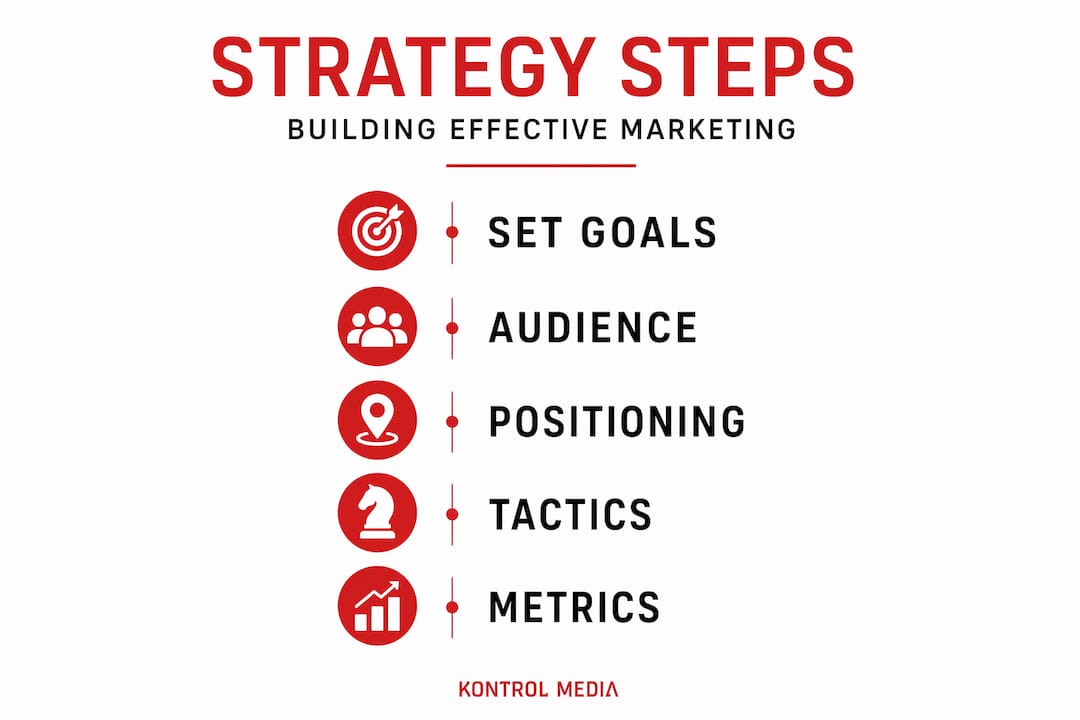
Building an effective marketing strategy doesn’t require a 40-slide deck. It requires honest answers to a sequence of connected questions, documented in a form your team can actually use. Here’s a practical comparison of what strong versus weak strategy development looks like at each stage:
| Stage | Weak approach | Strong approach |
|---|---|---|
| Business goals | “Grow revenue” | “Acquire 200 new mid-market accounts in Q3 at or below $1,200 CAC” |
| Customer insight | “Our audience is marketers aged 25-45” | Validated personas built from CRM data, interviews, and behavioral patterns |
| Competitive analysis | “We’re better than the competition” | Perceptual map showing specific differentiation across two relevant dimensions |
| Positioning | “We offer great value” | “The only platform that [does X] for [segment Y] without [pain point Z]” |
| Channel selection | “We should be everywhere” | Three channels chosen based on where the target segment consumes information |
| KPIs | “Impressions and engagement” | Marketing-sourced pipeline, conversion rate by segment, and ROI by channel |
The KPI and measurement logic section deserves special attention because it’s where most strategies lose their authority. Teams over-index on listing channels and under-specify how each strategic choice will be measured and tied to revenue. If your strategy document doesn’t include a clear line from marketing activity to business outcome, it won’t drive decisions when budget pressure hits. Revisit and adapt the strategy quarterly, not annually. Markets move. Customer behavior shifts. Your strategy should reflect those changes before your competitors act on them.
My honest take on why most strategies don’t work
I’ve reviewed more marketing strategies than I can count, across industries and company sizes, and the pattern that consistently separates the ones that work from the ones that don’t is almost never about creativity or channel sophistication. It’s about operational specificity.
Most organizations write strategies that read beautifully but function as abstract frameworks. They articulate aspirational positioning without defining what proof points make that positioning credible. They list target segments without specifying the decision-making criteria that went into selecting them over alternatives. The result is that the execution team inherits a document that doesn’t tell them what to actually do differently on Monday morning.
The most overlooked element, in my experience, is the direct link between strategic metrics and revenue outcomes. This is where I see even sophisticated marketing organizations fall short. They track impressions or MQLs and call it measurement, but those numbers don’t tell you whether the strategy is working. They tell you whether the tactics are running. What you need is a measurement architecture that connects channel activity to pipeline to closed revenue, with enough granularity to know which strategic choices are generating returns and which need rethinking.
The second thing I’d push back on is the tendency to blend STP with execution details inside the same document. When STP decisions are buried alongside content calendars and ad formats, teams lose the strategic thread. Keep the strategic choices in one place and the execution details in another. That separation isn’t bureaucratic. It’s what allows you to update tactics without accidentally rethinking your positioning every quarter. A strategy that doesn’t translate into concrete operational initiatives is just vocabulary. Useful vocabulary, perhaps, but vocabulary nonetheless.
— Mark Kapczynski
How Kontrol Media helps you build strategy that actually executes
At Kontrol Media, we’ve seen firsthand how the gap between strategy and execution costs companies real revenue. Our work with organizations ranging from private equity portfolio companies to large enterprises is grounded in exactly what this article describes: connecting positioning, segmentation, and measurement into a system that guides daily decisions, not just annual planning sessions. If you’re ready to move from a strategy document to a growth-oriented marketing system, we build and operate those systems. From research and positioning through to sales and business development execution, we handle the full cycle. Explore how our strategy and execution approach translates into measurable results for your business.
FAQ
What is a marketing strategy in simple terms?
A marketing strategy is a documented plan that defines who you’re trying to reach, what position your brand holds in the market, and how you’ll measure success. It connects business goals to customer decisions rather than listing tactics.
How does a marketing strategy differ from a marketing plan?
The strategy defines direction, goals, and positioning and typically covers a year or more. The marketing plan translates those strategic choices into specific tactics, timelines, and budgets, usually on a quarterly or monthly basis.
What are the key elements of a marketing strategy?
The core components are business objectives, target audience segmentation, competitive analysis, positioning, channel selection, and KPI measurement logic. Each element should inform the others rather than exist in isolation.
Why is the STP framework important in marketing strategy?
Segmentation, Targeting, and Positioning help you identify which customer groups to pursue and why your offer is the right fit for them. Without clear STP, messaging becomes generic and fails to connect with any audience meaningfully.
How often should a marketing strategy be updated?
A marketing strategy should be reviewed at least quarterly and updated whenever significant market shifts, competitive changes, or new customer data warrant a strategic adjustment. Annual-only reviews are too slow for most modern markets.
Recommended
- What Is Marketing-Led Growth? A Strategic Guide | Kontrol Media Consultancy
- Unlocking Business Potential: Strategic Marketing and Consulting for Growth | Kontrol Media Consultancy
- Crafting an Effective Marketing Strategy: From Research to Execution | Kontrol Media Consultancy
- The Importance of Crafting a Comprehensive Business Strategy | Kontrol Media Consultancy