


Outsourcing business development makes sense for companies that need pipeline fast and already have closers who lack the bandwidth to prospect. The upside is speed and access to tools you would otherwise have to buy yourself; the caution is that lead quality can swing hard if the scope is vague. The move: run a 60 to 90 day pilot with defined KPIs before you sign anything longer.
TL;DR:
- Outsourced business development can deliver faster pipeline results, typically reaching full output within 60 to 90 days, compared to an internal ramp of over three months.
- Cost estimates show in-house reps cost between $110,000 to $150,000 annually, while outsourced programs usually range from $42,000 to $96,000, including tools and management.
- A clear scope and KPIs, especially around lead qualification and activity reporting, are crucial to avoid misunderstandings and ensure program success during pilots.
- Starting with a 60 to 90 day pilot allows setting precise success criteria and offers a defined decision point for scaling or ending the engagement.
- Building internal teams makes sense for complex, long-term discovery needs, while outsourcing is ideal for urgent targets, testing new segments, or leadership transitions.
Table of Contents
- What Is Outsourced Business Development, Exactly?
- What Do You Gain, and What Do You Give Up?
- Which Delivery Model Fits Your Sales Motion?
- Should You Build In-House or Outsource First?
- How Do You Evaluate and Select a Provider?
- What Does Outsourcing Business Development Actually Cost?
- How Should a 12-Week Pilot Onboarding Actually Run?
- What Goes Wrong, and How Do You Prevent It?
- Why Kontrol Media’s Approach To Business Development Differs
- How Have Companies Actually Benefited From Outsourcing?
- How Long Does It Take To Get From Contract To Full Ramp?
- What Should Leaders Actually Do Next?
- Ready To Pilot Outsourced Business Development With Kontrol Media?
- Sources
What Is Outsourced Business Development, Exactly?
Outsourced business development covers the front half of the revenue motion: prospecting, qualification, and appointment setting, sometimes stretching into full-cycle deal management. It is not the same thing as sales outsourcing, which typically centers on closing and revenue delivery rather than pipeline generation. Confusing the two is how companies end up disappointed with a provider who was never scoped to close anything in the first place.
Output expectations shift depending on which slice you’re buying:
- Meetings booked — the most common unit in pure appointment-setting contracts
- Qualified pipeline value — used when the provider also scores and prioritizes leads
- Closed revenue — only realistic in full-cycle arrangements where the outsourced team owns the deal to signature
Getting this distinction straight before you write an RFP saves weeks of arguing about whose job it was to close the loop. A provider hired to book meetings should never be graded on revenue, and one hired for full-cycle work should never be let off the hook for pipeline quality.
What Do You Gain, and What Do You Give Up?
The biggest draw is speed. Building an in-house SDR function from scratch takes time to hire, train, and ramp, while outsourced BDR programs often reach full output 60 to 90 days faster than an internal build, according to industry benchmarks that put average in-house ramp time at roughly 3.2 months.
Statistic Callout: Cost comparisons show in-house fully loaded per-rep costs running $110,000 to $150,000 a year, against outsourced-equivalent ranges of roughly $42,000 to $96,000 once salaries, tools, and management overhead are counted.
Beyond cost, you inherit infrastructure you didn’t have to build. Strong providers bundle sales intelligence platforms, buyer intent data, and CRM integration into the engagement, which means you’re not separately buying a data subscription and a dialer just to get started.
The tradeoffs are real, though:
- Knowledge transfer risk — institutional context about your buyers can walk out the door if the relationship ends
- Reduced day-to-day control — you’re managing an outcome, not a headcount
- Lead quality variability — quality drifts if qualification rules aren’t written down and enforced
None of this makes outsourcing the wrong call. It just means the contract and the governance around it matter more than the sales pitch.
Which Delivery Model Fits Your Sales Motion?
Not every outsourced arrangement looks the same, and picking the wrong one is a common reason pilots underdeliver.
- Outsourced SDR/BDR — a dedicated rep or pod handles top-of-funnel prospecting and hands off qualified meetings to your closers. Best for companies with a working sales process and simple, well-understood offers.
- Appointment setting only — narrower than a full SDR function, focused purely on booking calls against a target list. Works well for high-volume, low-complexity outreach.
- Outbound calling programs — phone-first campaigns, often layered on top of email and social touches, suited to markets where cold call conversion is still strong.
- Full-cycle outsourcing — the provider owns everything from first touch to closed deal. This fits smaller ACV, transactional sales where a dedicated in-house closer isn’t yet justified.
- Hybrid: fractional executive plus outsourced execution — a part-time sales or growth leader sets strategy while an outsourced team executes day to day. This has become a common pattern for mid-market companies that need senior judgment without a full-time salary.
Enterprise buyers with complex discovery processes usually need more hands-on internal involvement than SMBs selling a simpler product.
Should You Build In-House or Outsource First?
The decision usually comes down to time horizon and internal capability, not just budget.
Outsourcing tends to win when you’re facing urgent quota targets, you don’t have anyone senior enough to run an SDR function well, or you want to test a new market segment without committing headcount. It also fits nicely into the hybrid model where a fractional leader directs strategy and the outsourced team runs the plays.
Building in-house makes more sense when your product requires deep, ongoing discovery that’s hard to hand off, or when you need institutional knowledge to compound over years rather than months.
Run through this checklist before deciding:
- How much runway do you have before results need to show up?
- Does anyone internally have the bandwidth to manage an outsourced relationship well?
- Are your account executives sitting idle for lack of qualified meetings?
- Is your average contract value high enough to justify a longer, more consultative motion?
- Is your CRM and contact data clean enough for a provider to work with on day one?
Pro Tip: If you answer “no” to the data-quality question, fix that first. No outsourced team, however good, can prospect well against a CRM full of stale contacts and duplicate accounts.
How Do You Evaluate and Select a Provider?
Choosing a provider is where most of the risk in outsourcing business development actually lives, and it’s also where the most preventable mistakes happen. Buyer guides consistently flag mis-scoped work and vague definitions of “qualified” as the top reasons outsourced programs stall in their first few months.
Start with KPIs, and get specific. “Qualified” needs a written definition covering firmographics (company size, industry, revenue band), the right role or title, and at least one intent signal, plus explicit disqualifiers so nobody argues later about what counts.
Reporting transparency should be non-negotiable. Ask for:
- A sample report before you sign, not after
- Weekly or biweekly cadence at minimum during a pilot
- Fields covering calls made, connects, meetings booked, meeting show rate, and pipeline value generated
- Raw activity data, not just a rolled-up dashboard
Contract essentials protect you if things go sideways:
- Service-level agreements tied to volume and quality metrics, not just activity counts
- Exit clauses that let you leave without punitive penalties if KPIs aren’t met
- IP and data ownership clauses confirming your contact lists and call recordings belong to you, not the vendor
- Remediation steps spelling out what happens before termination, not just after
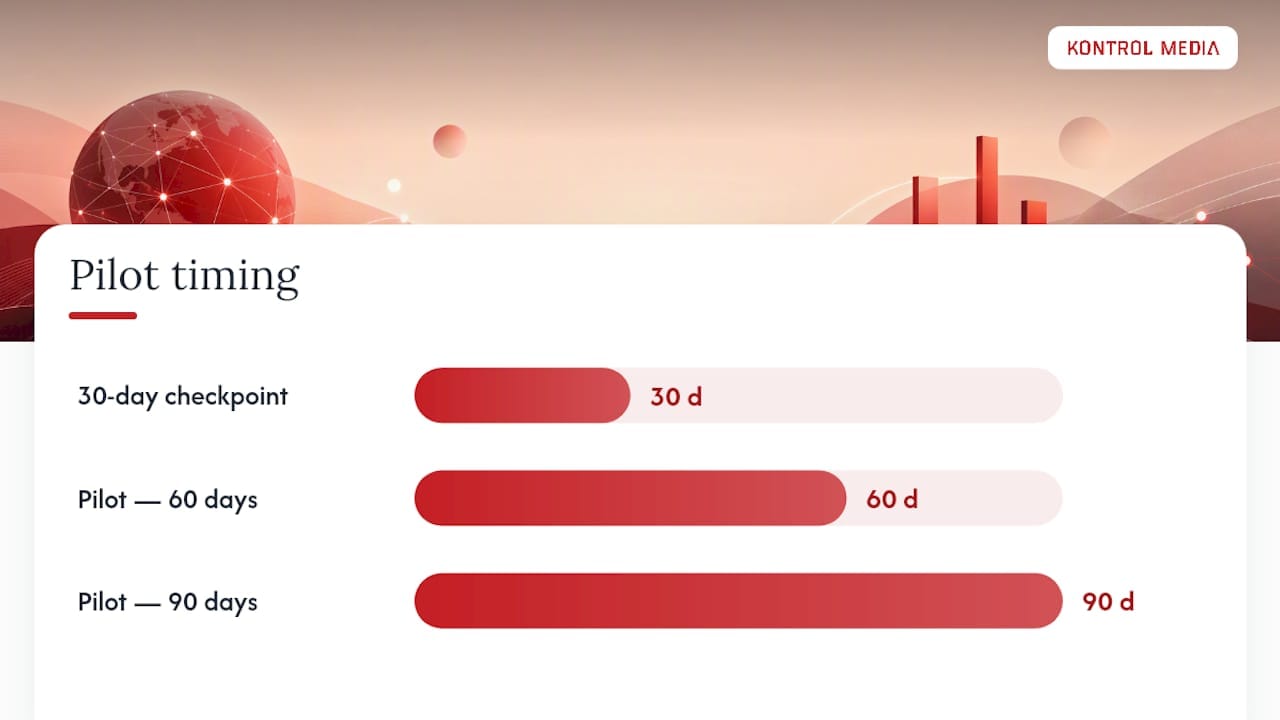
Pilot design ties it together. A 60 to 90 day pilot with agreed success metrics gives you a clean decision point instead of an open-ended commitment. Build in an escalation path, too. If meeting volume or quality falls short at the 30 day mark, you want a contractual mechanism to flag it and fix it before the pilot ends, not a shrug and a renewal invoice.
What Does Outsourcing Business Development Actually Cost?
Pricing structures vary more than most buyers expect, and comparing quotes without understanding the model behind each number leads to bad decisions.
The common structures:
- Monthly retainer — a flat fee for a defined level of activity, typically the most predictable option
- Per-meeting pricing — you pay for booked, qualified meetings, shifting more risk to the provider
- Hybrid retainer plus bonus — a base fee with performance incentives layered on top
- Dedicated-team retainer — you’re essentially renting a team, priced closer to headcount
Statistic Callout: Industry pricing summaries put small program retainers in the $2,500 to $15,000-plus monthly range, with per-meeting fees swinging widely based on how hard your ideal customer is to reach.
Cost drivers worth asking about directly: onshore versus nearshore staffing, how difficult your ICP is to target, and whether tooling like intent data and dialers is included or billed separately. A cheap quote that excludes data subscriptions often costs more once you add them back.
For a rough ROI check, work backward: cost per meeting, divided into expected close rate, gives you cost per closed deal. Compare that against your average contract value before you sign anything.
How Should a 12-Week Pilot Onboarding Actually Run?
A pilot only proves what it’s supposed to prove if onboarding is structured, not improvised.
- Pre-pilot (before week one): lock down your ideal customer profile, core messaging, written qualification rules, and CRM access for the provider’s team.
- Weeks 1 to 2: data handoff and list building, plus initial script and messaging testing against a small segment.
- Weeks 3 to 4: live outreach begins with close shadowing from your side, catching tone or targeting issues early.
- Weeks 5 to 8: ramp to full volume, with weekly QA reviews comparing booked meetings against your acceptance criteria.
- Weeks 9 to 12: stabilize cadence, tighten qualification based on what’s converting, and prepare a data-backed scale, iterate, or stop decision.
Governance matters as much as the calendar. Weekly standups between your account executives and the outsourced team close the feedback loop fast, and enforcing data hygiene rules from day one keeps the CRM from becoming a mess you have to clean up later.
What Goes Wrong, and How Do You Prevent It?
Most outsourcing failures trace back to a handful of preventable gaps.
- Mis-scoped work and unclear qualification rules — fix this with written acceptance criteria both sides sign off on before launch
- Poor contact data — agree in writing on data sources and how often lists get verified
- No feedback loop — schedule recurring QA reviews and set explicit acceptance metrics your account executives sign off on
- Treating outsourcing as a turnkey fix — retain strategic ownership of ICP, messaging, and qualification rules internally rather than handing over the entire motion
Pro Tip: Put the qualification definition in the contract itself, not just in a shared onboarding doc. Docs get out of date; contract language doesn’t.
Why Kontrol Media’s Approach To Business Development Differs
Kontrol Media Consultancy built its reputation as a growth catalyst focused on detailed business strategy paired with hands-on execution, working with private equity portfolio companies, middle market public companies, and large enterprises on measurable growth.
The client roster reflects that range: Experian, BuzzFeed, Huffpost, REMAX, Enthusiast Gaming, and West Monroe have all worked with the firm on visibility and customer acquisition challenges. Kontrol Media also runs specialized programs connecting brands and agencies with home buyers through real estate agent partnerships, and it builds and operates retail and commerce media networks for clients who need revenue-generating infrastructure, not just advice. That combination of strategy and execution is exactly what separates a genuine outsourced business development partner from a vendor that only hands you a spreadsheet of contacts.
How Have Companies Actually Benefited From Outsourcing?
Patterns show up again and again across companies that outsource business development well, even without naming every account publicly.
Mid-market SaaS companies facing a funding-driven growth mandate are a common case. A company with strong product-market fit but no internal SDR leadership brings in an outsourced team specifically to hit an aggressive pipeline target ahead of a fundraising round or board review. The provider’s existing playbooks and prospecting infrastructure mean the company skips months of hiring and tooling setup, and the pilot period gives the board a clean, measurable data point before the next raise conversation.
Retail and consumer brands entering new geographic or channel segments show a different pattern. Rather than hiring a full regional sales team speculatively, they outsource initial market testing, using booked meetings and early conversion data to decide whether a permanent build-out is justified. This lines up with how hybrid fractional leadership plus outsourced execution tends to work in practice: a part-time strategic lead directs the effort while the outsourced team absorbs the volume of outreach that would otherwise require several full-time hires.
Companies going through a leadership transition in sales, meanwhile, often use outsourcing as a bridge. Pipeline generation can’t pause just because a VP of sales is being replaced, and a temporary outsourced program keeps meetings flowing while the new hire gets oriented.
How Long Does It Take To Get From Contract To Full Ramp?
Most outsourced business development engagements follow a recognizable timeline, and knowing it in advance helps you set realistic expectations with your own leadership team.
Contract signing to first outreach typically takes one to three weeks, covering CRM access setup, initial data handoff, and messaging approval. Weeks one through four are early ramp: expect volume to be lower than target while scripts and targeting get tested and adjusted based on real responses.
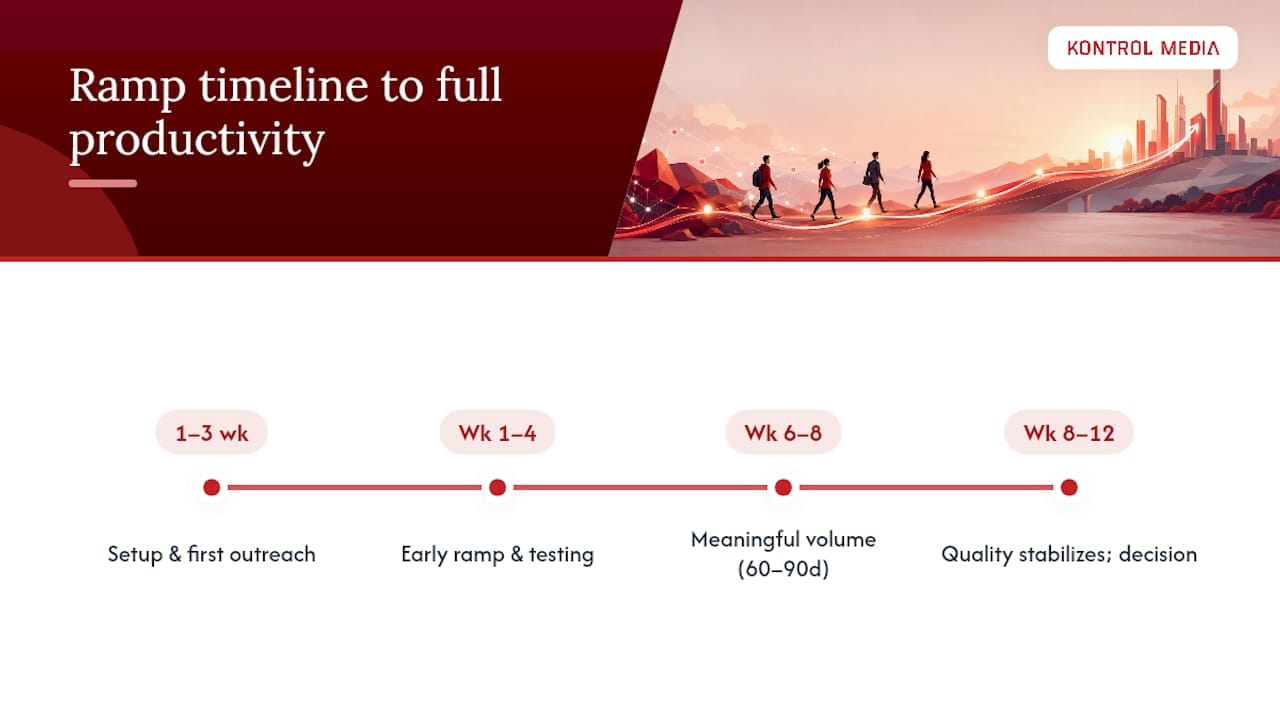
By week six to eight, most programs hit a meaningful inflection point, reaching something close to full planned outreach volume. This lines up with the 60 to 90 day benchmark commonly cited for outsourced teams to reach full productivity, well ahead of the roughly 3.2 months average for an internally hired SDR to do the same.
Weeks eight through twelve are where the real signal shows up: meeting quality should stabilize, and your account executives should be able to tell you clearly whether the leads they’re getting are worth the spend. That’s your natural decision point for scaling the engagement, adjusting scope, or walking away, and it’s exactly why the pilot structure matters more than any single feature on a provider’s pitch deck.
What Should Leaders Actually Do Next?
If you need meetings now, run a pilot. Keep strategy ownership, insist on transparent weekly reporting, and don’t let a provider define “qualified” for you. If you’re building for the long term instead, invest in an internal leader first and think about a hybrid model that pairs their judgment with outsourced execution for volume. Either way, expect your first 90 days to go mostly toward data cleanup, messaging calibration, and weekly QA, not toward closed revenue. That comes after the pilot proves the model works.
— Mark Kapczynski
Ready To Pilot Outsourced Business Development With Kontrol Media?
Kontrol Media is the alternative to a generic outsourcing vendor: instead of a rented SDR pod running someone else’s playbook, you get a consultancy that pairs business strategy with hands-on execution across sales, marketing, and business development.
A typical engagement starts with the same pilot structure covered above: a defined window, clear KPIs, and weekly reporting your team actually reads. Where Kontrol Media differs is scope. Because the firm also builds and operates retail and commerce media networks and runs real estate agent partnership programs for brands, its business development pilots come with playbooks already tested across fintech, ecommerce, B2B SaaS, media, and real estate verticals rather than a single narrow niche. Success is measured the same way it should be with any provider: booked meetings against defined qualification criteria, pipeline value, and a clean go or no-go decision at the pilot’s end.
If your account executives are sitting on capacity and your pipeline isn’t keeping up, reach out to Kontrol Media to scope a pilot built around your specific ICP and sales motion.
Sources
- Outsourced Business Development – Definition & B2B …
- Outsourced Business Development: 2026 Cost & ROI Guide