


A retail media clean room lets brands and retailers match and measure audiences privately, trading raw personal data for aggregated, privacy-safe results that prove campaign performance. It solves the core tension in retail media today: brands want granular insight into who bought what and why, while retailers and platforms need to protect shopper identity. We’ll walk through how these environments work, the types available, and the steps that turn a clean room from a technical curiosity into a working measurement engine, including the standards bodies that keep the whole system honest.
TL;DR:
- Google Ads Data Hub drops query rows representing fewer than 50 users, so narrow segments may return no result even when matching succeeds.
- Brands concentrated on one retailer can start in its walled garden; advertisers spanning retailers should consider neutral or managed rooms to avoid repeating setup.
- Before launch, align schemas and hashing salts, exclude shoppers who opted out at the source, and pilot one audience with one campaign lift question.
- A Kellanova case reported increases of 9% among price conscious shoppers and 36% among premium shoppers, showing why segment lift beats a campaign average.
- A practical cadence is quarterly tool recalibration with ongoing invalid traffic monitoring, while IAB and MRC guidelines call for regular validation.
Table of Contents
- What a data clean room is and why it matters for retail media
- How data clean rooms work: matching, PETs, and output thresholds
- Types of clean rooms and common platform models
- Retail media use cases: measurement, audience activation, and profile enrichment
- Implementation checklist: data prep, identity, privacy, and team skills
- Industry standards, protocols, and measurement accreditation to rely on
- Practical evidence and short case examples showing impact
- Kontrol Media’s hands-on experience with retail media and measurement
- Platform pilot or managed partner: a decision framework
- How we help brands put retail media clean rooms to work
- FAQ
- Sources
What a data clean room is and why it matters for retail media
A data clean room is a secure environment where two or more parties, typically a retailer and a brand, bring their own data sets together to run a shared analysis without either side viewing the other’s raw records. Neither party exports a customer list. Neither party sees a name, an email, or a loyalty ID that belongs to the other. What comes out the other end is an aggregated report: a lift percentage, a segment size, an overlap count.
This matters for retail media because the entire category runs on first-party data that retailers are, understandably, reluctant to hand over wholesale. Brands need to know whether their ads actually moved product. Retailers need to monetize their shopper data without becoming a liability. A clean room is the structure that lets both things happen at once, and IAB Tech Lab’s guidance has become a reference point for how the industry defines and operates these environments.
Clean rooms serve a short list of business goals that keep showing up across retail media programs:
- Addressability: finding and reaching the right shopper segments without exposing identity.
- Measurement: proving incrementality and sales lift tied to specific campaigns.
- Insights: enriching planning with purchase and basket data that sharpens targeting and creative decisions.
Those three goals thread through everything that follows, from the technical mechanics to the platforms built around them.
How data clean rooms work: matching, PETs, and output thresholds
The mechanics behind a clean room sound abstract until you see the workflow. A brand uploads a hashed customer list. A retailer holds its own hashed shopper data. The system matches the two sets using Private Set Intersection, a cryptographic method that finds overlapping records without decrypting or exposing either party’s underlying data. Neither side learns who, specifically, is in the overlap, only that an overlap exists and how large it is.
Several privacy-enhancing technologies make this possible. Hashing and salting scramble identifiers so a match can happen without a readable name or email ever entering the system. Differential privacy adds statistical noise to results so no single shopper can be reverse-engineered from an output. Trusted execution environments, or TEEs, isolate the computation itself inside hardware that even the clean room operator cannot inspect, which IAB Tech Lab’s ADMAP specification recommends pairing with PSI matching while keeping matching and aggregation services separate to protect keys.
Aggregation and minimum row thresholds are the last safeguard, and they’re the part marketers misunderstand most often. Outputs below a set group size simply don’t return. Google’s Ads Data Hub, for example, enforces a minimum aggregation threshold where rows representing fewer than 50 users get dropped before a query result is released. That’s not a bug. It’s the mechanism that prevents a tiny, identifiable segment from being reverse-engineered into an individual.
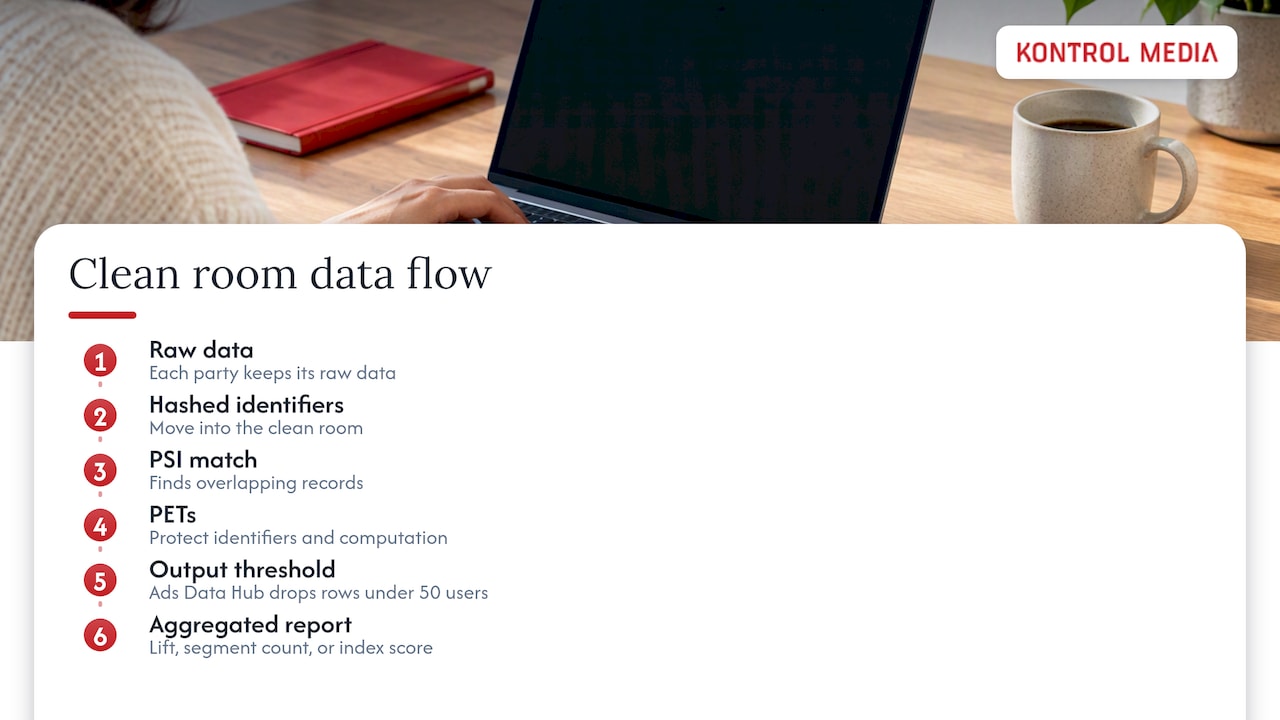
The resulting data flow looks like this: raw data stays put, hashed identifiers move into the clean room, PSI finds the overlap, PETs scramble and protect the computation, thresholds filter the output, and only an aggregated report (a lift number, a segment count, an index score) ever leaves the environment.
Types of clean rooms and common platform models
Not every clean room looks the same, and picking the wrong model wastes budget and months of setup time. Three structures dominate the market.
- Walled-garden platform rooms live inside a single retailer or platform’s ecosystem, like Amazon Marketing Cloud or Google’s Ads Data Hub. Access typically requires meeting a spend threshold or advertiser status, and the room only sees that platform’s own signals.
- Neutral cloud or third-party clean rooms sit outside any single retailer, built on infrastructure like AWS Clean Rooms, and can connect multiple retail partners into one workspace. They cost more to stand up but avoid locking a brand into one ecosystem.
- Clean-room-as-a-service offerings hand the technical lift, query writing, matching configuration, and reporting, to a managed provider, which suits brands without a dedicated data science team.
A rough buyer map: brands heavily concentrated in spend on one retailer usually start with that retailer’s walled-garden room. Multi-retailer advertisers or agencies managing several brands tend toward neutral or managed options, since repeating the same matching logic across five different platform rooms gets expensive fast.
Retail media use cases: measurement, audience activation, and profile enrichment
Three use cases account for nearly everything marketers actually do inside a clean room, and each produces a different kind of output worth knowing in advance.
- Incrementality and experimentation. Match-market tests and randomized controlled trials compare exposed versus unexposed shoppers to isolate the sales lift a campaign actually caused, rather than sales that would have happened anyway. This is the output most finance teams want to see before approving more budget.
- Audience activation. The clean room builds a segment, shoppers who bought a competitor’s product, lapsed buyers, high-value loyalty members, and returns it to an activation platform for targeting, without ever exposing the individual records that built it.
- Profile enrichment. Matching loyalty and purchase data against media exposure sharpens planning, letting teams understand which creative variants or placements resonate with specific basket behaviors rather than guessing from demographic proxies alone.
These outputs only matter once they feed back into decisions. A lift report that sits in a dashboard changes nothing; a lift report that triggers a budget shift from an underperforming placement to a proven one is the actual point. Our guide to key retail media metrics breaks down how to read these outputs against the KPIs that actually drive reallocation conversations.
Implementation checklist: data prep, identity, privacy, and team skills
Getting a clean room from contract signature to usable output takes more operational groundwork than most teams expect going in.
- Data inventory and schema alignment: map which fields exist on each side (loyalty ID, transaction timestamp, SKU, store ID) and standardize formats before a single query runs; mismatched date formats and inconsistent hashing salts are the most common early blockers.
- Identity strategy: decide how opted-out users get excluded from matching at the source, not filtered out after the fact, since post-hoc filtering can itself create privacy risk.
- Privacy controls: confirm aggregation thresholds, noise parameters, and access logging in writing, and make sure contract terms specify who can query, how often, and what output formats are permitted.
- Operational signals: budget for query cadence limits, the cost of each query run, and the SQL or BigQuery skill level your analysts actually need, since platforms like Ads Data Hub require a distinct query model rather than standard warehousing syntax.
Our breakdown of field-level data rules for audit-grade attribution covers the schema and governance pitfalls in more depth, and it’s worth reading before the first data pull, not after a failed one.
Pro Tip: Run your first clean room pilot on a single, well-defined audience segment and one measurement question, like incremental lift for one campaign, before expanding scope; a narrow pilot surfaces data and identity issues faster than a broad one.
Industry standards, protocols, and measurement accreditation to rely on
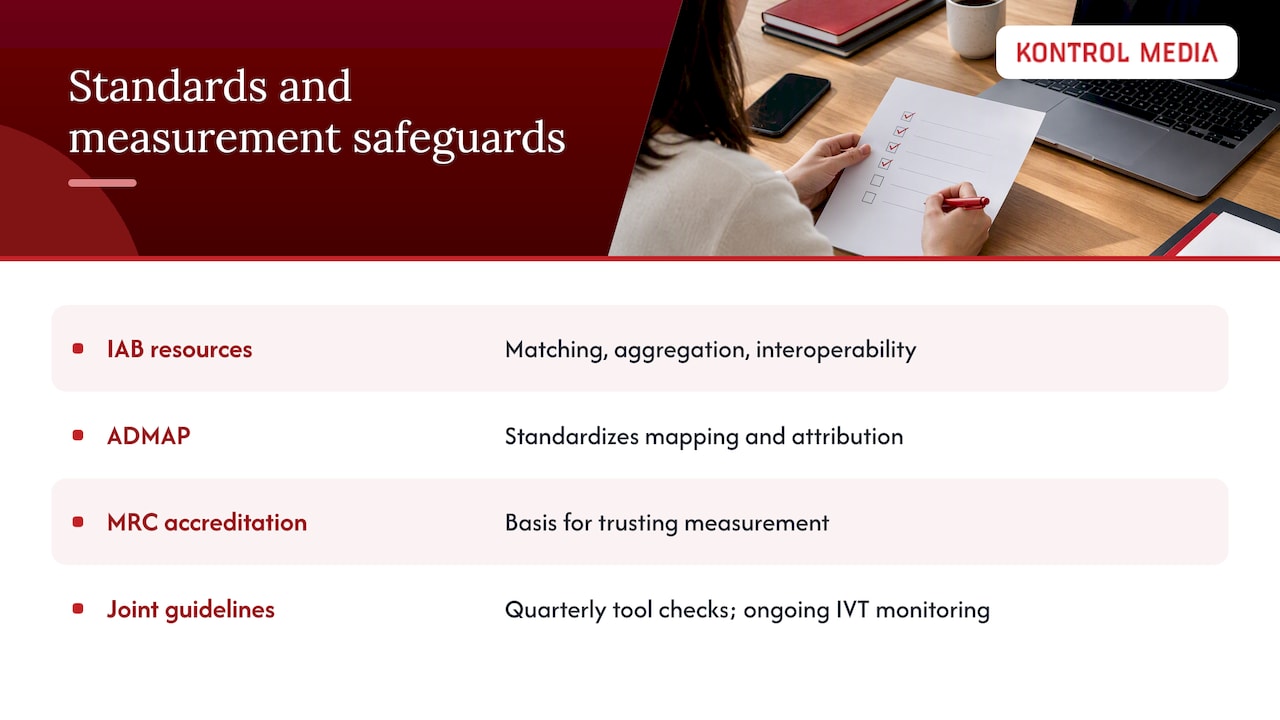
Clean rooms only earn marketer trust when they follow frameworks that hold up to outside scrutiny. IAB Tech Lab’s data clean room resources lay out recommended practices for matching, aggregation, and interoperability, and the organization’s ADMAP, or Attribution Data Matching Protocol, standardizes how mapping and attribution steps should work across providers so a brand isn’t reinventing matching logic for every retailer it works with.
Measurement accreditation from the Media Rating Council matters just as much. Ads Data Hub’s measurement approach has drawn MRC accreditation attention precisely because accredited measurement gives marketers and their finance partners a basis for trusting a number that didn’t come from the platform grading its own homework.
The IAB and MRC’s joint retail media measurement guidelines add a practical layer on top: regular validation of measurement tools and guardrails against invalid traffic. A reasonable cadence is quarterly recalibration of measurement tools paired with ongoing IVT monitoring, so a lift number from January and one from October were produced the same way.
Practical evidence and short case examples showing impact
The clearest way to set expectations for a clean room program is to look at what’s already been published. A Forbes case example involving Kellanova reported a 9% sales increase among price-conscious shoppers and a 36% increase among premium shoppers after using clean-room analysis to target campaigns more precisely, a reminder that the same campaign can produce very different lift depending on the segment being measured.
- Published brand cases show measurable, segment-specific sales lift rather than one blanket number across an entire campaign.
- Agencies increasingly treat clean-room incrementality data as a baseline for reallocating channel budget rather than a one-off report.
- Marketers should expect weeks, not days, for a first measurement cycle, and a scope limited to the segments and questions defined at pilot stage.
Set your first business case on the width of the segment split you can measure, not a single aggregate lift figure, since that’s where the real decisions get made.
Kontrol Media’s hands-on experience with retail media and measurement
We have experience standing up and operating retail and commerce media networks, so clean room projects integrate with work we handle rather than being a separate add-on. We assist with network setup, measurement design, and ongoing operations to help keep programs active after launch.
This experience includes supporting data inventory and schema alignment before partnerships go live, designing identity and governance considerations for clean room contracts, and managing query cadence and reporting after pilots. Clients across various industries have relied on this combination of strategy and execution rather than treating the two as separate engagements.
— Mark Kapczynski
Platform pilot or managed partner: a decision framework
If your team already has SQL-literate analysts and most of your spend concentrated on one retailer, start inside that retailer’s walled-garden room. The access barrier is lower and the learning curve, however steep, only has to be climbed once.
If spend is split across multiple retailers, or your team lacks dedicated data science bandwidth, a managed clean-room-as-a-service path reaches a usable measurement result faster than building internal query expertise from scratch. The fastest route to ROI is rarely the one with the most control. It’s the one that gets a validated lift number in front of finance before the next budget cycle closes.
How we help brands put retail media clean rooms to work
Standing up a clean room is one piece of a much larger retail media puzzle, and we’ve built our practice around the whole thing: setting up the network, negotiating the retailer relationships, designing the measurement framework, and running operations once it’s live. Rather than handing a brand a technical spec and walking away, we stay in the work long enough to turn aggregated lift reports into actual budget decisions.
If you’re weighing whether to pilot inside a platform room or bring in a neutral solution, our retail media network operations team can scope the right starting point for your data maturity and budget. For teams still deciding whether to build internal capability or bring in outside execution, our breakdown of the build versus buy decision is a useful next read. When you’re ready to talk specifics, our services overview is the fastest way to get a conversation started.
FAQ
What exactly is retail media?
Retail media is advertising sold by a retailer across its own owned channels, like its website, app, or in-store screens, using the retailer’s first-party shopper and purchase data to target and measure campaigns. It differs from traditional digital advertising because the retailer controls both the inventory and the data used to prove results.
What is a clean room in a pharmacy?
A pharmacy clean room is a physically controlled, sterile environment used to prepare medications safely, which is an entirely different concept from a data clean room and unrelated to retail media or advertising measurement.
What is a media clean room?
A media clean room is a secure data environment where advertisers and media owners, such as retailers or platforms, match and analyze their respective data sets without either party exposing raw customer records. Technologies like Private Set Intersection and aggregation thresholds, as used in Ads Data Hub, ensure only privacy-safe, aggregated results leave the environment.
What is another name for a cleanroom?
In the advertising and data context, a clean room is also referred to as a data clean room or data collaboration platform, with specific implementations branded by providers, such as Amazon Marketing Cloud or Ads Data Hub. The underlying function, privacy-safe data matching and measurement, stays consistent across these names.
Sources
- ADH for Marketers | Google for Developers
- IAB Tech Lab — Data clean rooms resources
- How data clean room technology can show marketing impact — Forbes
- IAB / MRC Retail Media Measurement Guidelines (January 2024)