


Onsite retail media puts ads on a retailer’s own properties (search results, product pages, homepage banners); offsite uses that retailer’s first-party data to reach shoppers on outside inventory like social, CTV, and display. The right sequence, not a side you pick forever, is what actually works: prove return onsite, where attribution is deterministic and margins are high, then extend offsite once conversion fundamentals are solid.
TL;DR:
- Focus on proving onsite return with deterministic attribution and high margins before expanding offsite efforts to ensure a solid conversion foundation.
- Proper campaign management requires balancing onsite supply limitations with creative optimization, and avoiding audience overlap to prevent wasted spend.
- Measure onsite performance with direct, session-based metrics, while offsite success depends on incremental lift and new customer acquisition through probabilistic methods.
- Allocate budget based on objective: onsite for conversion and margin, offsite for demand generation and reaching new audiences, with clear testing and control group strategies.
- Building a unified ownership and measurement standard prevents duplicated credit, and fixing digital shelf issues first is crucial before scaling retail media programs.
Table of Contents
- Onsite vs Offsite Retail Media: A Side-by-Side Comparison
- Onsite Retail Media: Formats, Conversion Power, and Optimization Levers
- Offsite Retail Media: Formats, Demand Creation, and How to Buy It
- How to Split Your Budget Between Onsite and Offsite
- How Do You Measure Onsite vs Offsite Retail Media Performance?
- Where Retail Media Growth Is Headed Next
- What Kontrol Media Sees Go Wrong in Retail Media Programs
- A Practitioner’s Take on Getting the Sequence Right
- Get Help Building or Running Your Retail Media Program
- Sources
Onsite vs Offsite Retail Media: A Side-by-Side Comparison
The two channels solve different problems, and treating them as competitors for the same budget line is how most programs go sideways. Onsite is the closer. Offsite is the opener. Here’s how they stack up across the decisions that actually matter to a budget owner:
| Dimension | Onsite | Offsite |
|---|---|---|
| Funnel stage | Bottom funnel, conversion | Upper to mid funnel, demand and penetration |
| Attribution | Deterministic, closed-loop | Probabilistic, clean-room or modeled |
| Margin/cost model | High margin, CPC/auction, floor pricing | Lower margin, pass-through CPM, media costs |
| Scale/reach | Finite, capped by site traffic | Broad, expands to new households |
| Targeting quality | Logged-in first-party signal | First-party data pushed to third-party inventory |
| Expected ROAS vs incrementality | High reported ROAS, easy to overcredit | Lower headline ROAS, meaningful incremental lift |
Onsite fits a retailer or brand trying to win the sale at the shelf. Offsite fits a brand trying to build a new customer base or launch into a category where it has no history. One risk both channels share: overlapping audiences. If your onsite retargeting and your offsite audience extension both hit the same loyalty-card household, you’re paying twice to convince someone who was already coming back. Suppression lists and frequency caps across both channels aren’t optional once you’re running both at scale.
Onsite Retail Media: Formats, Conversion Power, and Optimization Levers
Onsite inventory includes sponsored product listings, search placements, onsite display banners, loyalty app messages, and increasingly in-store screens tied to the same retailer network. What makes onsite convert so reliably isn’t creative quality. It’s context: a logged-in shopper, already holding a credit card, standing three clicks from checkout. That proximity, paired with closed-loop attribution, is why onsite carries the highest margins in retail media and why retailers protect that inventory with auction floors and CPC pricing that rarely discounts.
The catch is supply. Onsite inventory is finite. A retailer only has so many search result pages and so much homepage real estate, which means demand for prime placements routinely outstrips availability, especially during promotional windows.
Before spending more onsite, run through this checklist:
- Product titles, images, and bullet copy match what shoppers actually search for.
- Inventory is in stock and buy box ownership is stable.
- Star ratings and review counts meet the category’s competitive threshold.
- Creative and promotional timing align with actual purchase cycles, not campaign calendars.
Sites like Babylove Growth’s product page guide go deep on the digital shelf fixes that move conversion before a single ad dollar gets spent.
Pro Tip: Fix the digital shelf before you scale onsite spend. A sponsored placement pointing to a product page with three reviews and a blurry photo just burns budget faster.
Offsite Retail Media: Formats, Demand Creation, and How to Buy It
Offsite retail media takes a retailer’s first-party purchase data and uses it to target audiences on programmatic display, social platforms, connected TV, audio, digital out-of-home, and other publisher inventory the retailer doesn’t own. The job here isn’t closing a sale. It’s finding the household that hasn’t shopped this retailer yet and putting the right product in front of them before they’ve searched for it.
That reach comes with real trade-offs. Once retailer data leaves the walled garden, match rates degrade, third-party cookies and device graphs introduce noise, and attribution shifts from deterministic to modeled. Recent platform-level ad changes on major social networks add another layer of complexity for teams trying to keep offsite measurement consistent quarter over quarter.
Budgeting for offsite works differently than onsite:
- Start with a small test budget, not a full rollout.
- Build a holdout or control group before launch, not after.
- Expect a lower headline ROAS than onsite. That’s not a failure signal.
- Judge success on incremental lift and new-to-file customer counts, not last-click credit.
Pro Tip: Don’t treat offsite as a standalone channel. Use it to warm up audiences that later show up in your high-intent onsite search and retargeting placements. That handoff is where offsite earns its budget.
How to Split Your Budget Between Onsite and Offsite
Allocation isn’t a fixed ratio. It’s a decision tied to what the business actually needs this quarter.
- Map the objective to the channel. Conversion and margin protection lean onsite. Category penetration, new-customer acquisition, and product launches lean offsite.
- Run the pre-flight check. Confirm product content, inventory depth, search visibility, and ratings are solid before offsite dollars start driving new traffic to a weak page.
- Design the experiment. Build geo-based holdouts or matched control groups so incrementality, not attributed ROAS, drives the scale decision.
- Set the scale rule in advance. Decide the lift threshold that justifies doubling offsite spend before the test starts, not after you see the number you want.
Governance matters as much as strategy here. Someone needs to own the combined budget, one measurement standard needs to apply across both channels, and retail media, shopper marketing, and any outside agency need to agree on the same KPI before the first dollar moves. Programs that skip this step tend to have two teams claiming credit for the same sale.
How Do You Measure Onsite vs Offsite Retail Media Performance?
Onsite measurement is deterministic. A logged-in shopper clicks a sponsored listing and buys inside the same session, so the retailer can tie spend to revenue with near-total confidence. Offsite measurement is probabilistic, relying on clean-room matching, modeled attribution, or multi-touch frameworks to connect an impression on a third-party app to a purchase that happens somewhere else entirely, sometimes days later.
The IAB’s Retail Media Buyers Guide draws this line explicitly, and it’s why the two channels need different KPI expectations rather than one shared ROAS target. The tools that close the gap:
- Control-group and geo-based incrementality tests, run before scaling any offsite line item.
- Clean-room data matching between retailer and publisher, rather than raw pixel tracking.
- Multi-touch attribution models used as a directional guide, not a final answer.
A 2026 framework from Osmos puts it plainly: onsite wins on measurement and margin, offsite wins on scale and incremental reach, and the right move is to extend offsite spend based on incrementality rather than attributed ROAS.
Where Retail Media Growth Is Headed Next
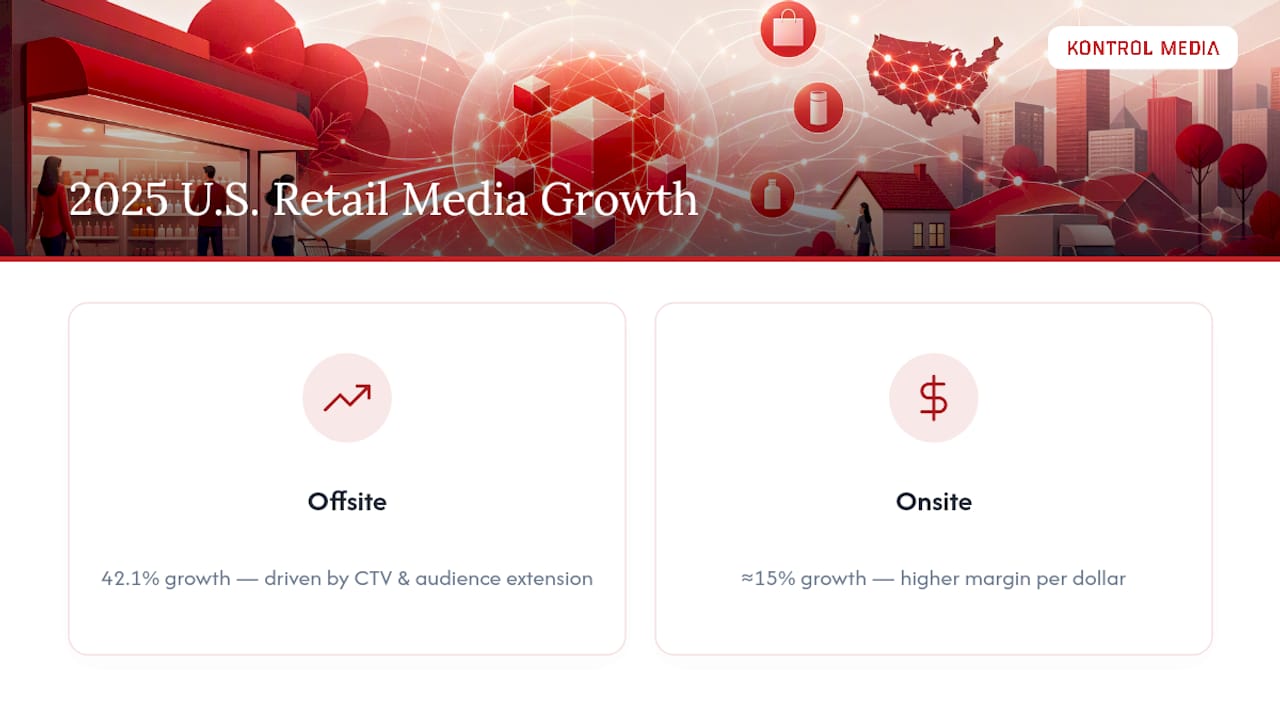
Offsite is growing far faster than onsite. eMarketer’s 2025 forecast put U.S. offsite retail media spend growth near 42.1%, compared to roughly 15% for onsite, driven largely by CTV and audience extension deals. Onsite still generates the higher margin per dollar, which is exactly why retailers keep investing in it even as offsite scales faster.
Expect more self-serve buying tools, machine-learning-driven targeting, and data clean-room partnerships to open up over the next few years. Plan budgets with flexibility built in, and require an incrementality read on any new format before committing real spend to it.
What Kontrol Media Sees Go Wrong in Retail Media Programs
Three failure patterns show up again and again. Nobody owns the combined onsite/offsite budget, so credit gets duplicated and nobody trims the losing channel. Product content ships broken, so offsite dollars drive traffic to pages that can’t convert it. KPIs get set per channel instead of per objective, so onsite and offsite end up competing instead of cooperating.
The fix in each case is the same: assign single ownership, fix the digital shelf before scaling spend, and set one incrementality standard both teams report against. Bring in outside help when measurement gets genuinely complex, when you’re standing up a network across multiple retailers, or when cross-retailer activation requires coordination your internal team hasn’t built yet.
A Practitioner’s Take on Getting the Sequence Right
Most retail media conversations start with a channel argument: onsite or offsite, which one deserves the bigger check. That’s the wrong question, and it’s the one that gets budgets wasted.
The better question is sequencing. I’ve watched brands pour offsite spend into audience extension campaigns while their product pages sat with outdated images and a two-star rating average, then wonder why the traffic that showed up never converted. Offsite doesn’t fix a broken conversion path. It just drives more people toward it faster, which means it amplifies whatever is already true onsite, good or bad.
What gets underestimated is how much offsite’s real value gets buried by ROAS thinking. Judge offsite by incrementality and new-customer count, not by the metric it was never built to win.
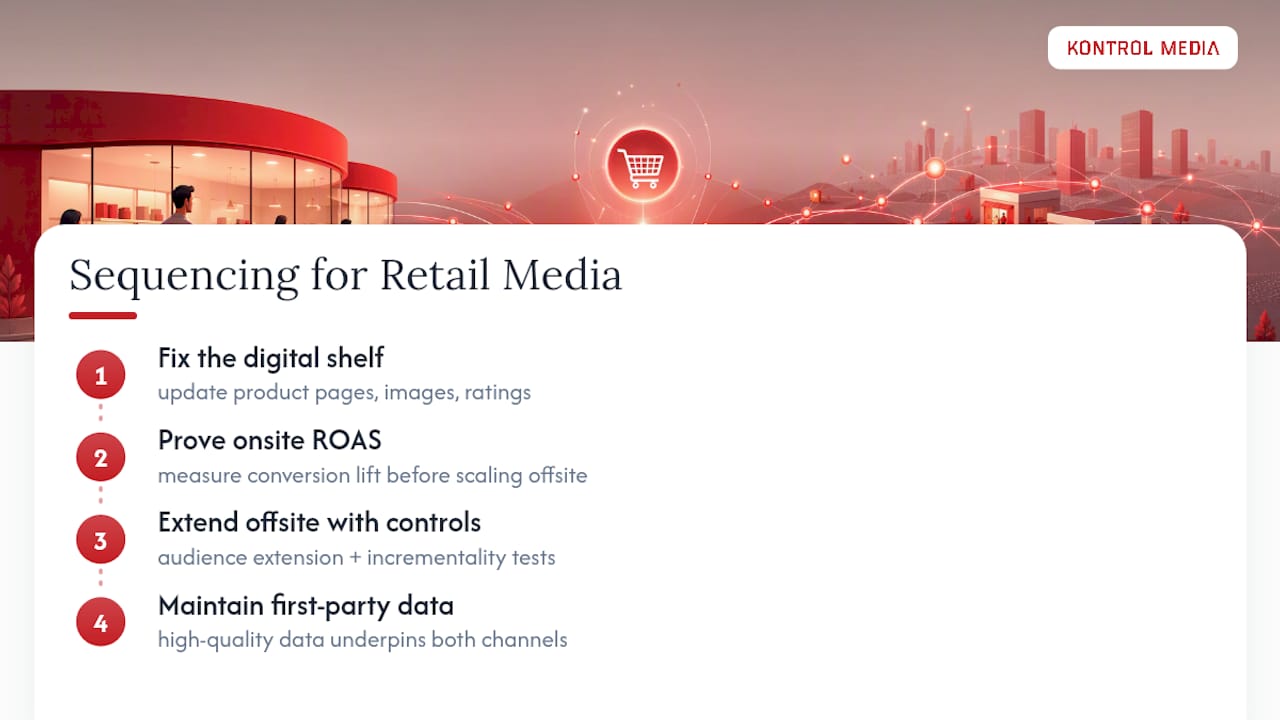
The practical order is simple, even if it’s not glamorous: fix the digital shelf, prove onsite ROAS, then extend offsite with a control group already built. Skip step one and step two doesn’t matter. First-party data quality underpins both channels, so weak data discipline shows up as poor performance everywhere, not just where you’re spending the least.
— Mark Kapczynski
Get Help Building or Running Your Retail Media Program
Some agencies run the operational side of retail media that most in-house teams don’t have bandwidth to staff: network setup, advertiser acquisition, and the measurement governance that keeps onsite and offsite numbers honest instead of duplicated.
If you’re deciding whether to build a network internally or bring in operational support, the calculation usually comes down to speed and measurement maturity. In-house pilots work fine for testing a single format, but once you’re running onsite and offsite simultaneously across multiple advertisers, the governance and reporting workload grows fast. Some consultancies’ retail media network setup guide walk through the build versus buy decision directly, and network operations playbooks cover the ad sales and measurement structure that keeps a program from drifting into duplicated credit and unclear KPIs. Book a discovery call to walk through where your program stands today and what the next ninety days should look like.
Sources
The IAB Retail Media Buyers Guide sets the measurement definitions this article relies on. Forrester’s global retail media forecast covers where investment is headed. The Osmos 2026 framework and CO Consulting’s retail media statistics round out the growth and allocation data.
- On-Site vs. Off-Site Advertising: The Retail Media Balancing Act
- IAB Retail Media Buyers Guide (July 2023)
- Onsite vs Offsite retail media ad formats framework (Osmos, 2026)