


Retail media operations are the workflows, SLAs, and integrations that turn a sold ad campaign into a delivered, measurable one. The whole discipline lives or dies on the sold to trafficked to invoiced flow, and most networks lose money not from weak sales but from breakage inside that flow. Fix the handoffs with defined SLAs and integrated data, and revenue scales without your headcount scaling alongside it. Everything below, models, team design, cadence, tooling, and measurement, exists to serve that one priority.
TL;DR:
- Prioritizing the sold-to-invoiced workflow fixes internal breakages, allowing revenue to scale without proportional headcount increases.
- Building a team with clearly defined roles and aligned incentives, especially for sales, account management, ad ops, and analytics, minimizes trust and handoff issues.
- Automating routine tasks such as inventory checks, campaign build, and QA through integrated systems reduces errors and manual workload.
- Establishing strict SLAs for each campaign stage and proactive monitoring prevents delays, inventory shortfalls, and reconciliation errors.
- Focusing measurement on proven incrementality and delivering trustworthy, transparent results sustains advertiser confidence and network growth.
Table of Contents
- What Does Retail Media Operations Actually Cover?
- Should You Build, Buy, or Go Hybrid for Your Retail Media Network?
- How Should You Structure a Retail Media Operations Team?
- What Are the Right SLAs for Retail Media Workflows?
- Which Tools and Integrations Actually Unlock Scale?
- How Do You Build Measurement Advertisers Actually Trust?
- What Are the Warning Signs Your Retail Media Ops Are Breaking?
- A 90-Day Roadmap for Fixing Retail Media Operations
- Why Change Management Determines Whether the New Workflow Sticks
- What Compliance and Privacy Rules Apply to Retail Media Data?
- How Should You Budget for Retail Media Operations?
- How Do You Plan for Crises in Retail Media Campaigns?
- What I’ve Learned Watching RMN Operations Scale (and Stall)
- How Kontrol Media Helps You Fix Retail Media Operations
- Sources
What Does Retail Media Operations Actually Cover?
Retail media operations sits at the intersection of ad sales, merchandising, e-commerce, and finance, and that’s precisely why it breaks so often. The scope runs wider than most people assume when they hear “ad ops.”
You’re managing on-site formats like sponsored product placements and display units, off-site activation that extends the retailer’s first-party data into programmatic channels, and increasingly, in-store media tied to point-of-sale and connected screens. Each format carries different creative specs, different inventory logic, and different measurement paths. Advertising Week’s breakdown of retail media formats makes the point clearly: first-party shopper data is the thread connecting all of them, but the operational demands per format diverge sharply.
The stakeholder map is where things get complicated. Ops sits between sales (who sold the campaign and promised delivery dates), the merchant team (who controls product assortment and pricing), the e-commerce platform team (who controls where ads render), analytics (who has to prove the campaign worked), and finance (who needs clean data to invoice correctly). A change in any one of those groups ripples through the others, often without anyone flagging it to ops first.
Commerce adds constraints that generic ad ops never has to deal with:
- Inventory volatility: a sponsored product going out of stock mid-campaign forces a pause or reallocation, often without warning.
- Pricing and margin sensitivity: bids and payouts have to respect margin floors the merchant team sets, not just a media budget.
- Product detail readiness: incomplete or inconsistent product pages tank click-through and conversion, regardless of how well the ad is targeted.
- Loyalty and first-party data governance: targeting logic depends on data that legal, privacy, and merchant teams all have a say in.
Should You Build, Buy, or Go Hybrid for Your Retail Media Network?
The build versus buy decision determines your ops workload for years, and most retailers underestimate how much. Building in-house gives you full control over data and monetization but demands a real engineering and ad ops bench from day one. Buying a managed platform gets you to market fast but limits how deeply you can customize targeting, reporting, and monetization logic. Hybrid models, where you own the ad server relationship and data layer but license specialized tooling for programmatic or measurement, tend to be the pragmatic middle ground for mid-market retailers.
The archetype you’re building toward shapes which model makes sense. OC&C Strategy Consultants’ framework on retail media archetypes lays out why: a marketplace RMN with thousands of third-party sellers has fundamentally different data depth and campaign volume than a vertical specialist retailer with a tighter catalog. Your archetype sets the commercial ceiling, and ops design should follow from it, not the other way around.
Here’s how the tradeoffs typically break down by archetype:
- Marketplace RMNs (high SKU count, many sellers): prioritize self-serve tooling and automated QA, because manual review doesn’t scale to seller volume.
- Omnichannel grocers (in-store plus digital, loyalty-rich): prioritize data integration between loyalty systems and the ad server before expanding format variety.
- Vertical specialists (narrower catalog, higher-margin categories): prioritize white-glove account management and custom reporting, since campaign volume is lower but deal size is higher.
On sequencing, resist the urge to launch every format at once. Start with a minimum viable on-site sponsored product offering, prove the sold to invoiced flow works cleanly, then expand into a self-serve or API layer once demand outpaces manual sales capacity. Programmatic and off-site activation should come last. Both require data infrastructure and measurement maturity that most networks don’t have in month one. Kontrol Media’s build versus buy framework walks through this sequencing in more depth for teams weighing their first infrastructure decision.
How Should You Structure a Retail Media Operations Team?
Team design either enables scale or quietly caps it, and the org chart mistake I see most often is treating ops as an afterthought bolted onto sales. A retail media network needs five functions working in coordination: sales, account management, ad ops, analytics, and revenue or yield management. Sales and account management typically report up through a commercial lead, while ad ops and analytics often sit closer to the platform or technology side, with a yield function bridging the two.

The handoff between sales and ad ops is where most networks bleed time and trust. Sales closes a deal with a launch date the ad ops team never confirmed capacity for. Ad ops builds the campaign against specs that account management never validated with the advertiser. Analytics gets asked for a performance readout on a campaign it didn’t know had launched. Each of these is a preventable failure, and each traces back to a missing handoff checkpoint, not a skills gap.
Core responsibilities break down roughly like this:
- Sales: owns the advertiser relationship and revenue target, not campaign execution.
- Account management: owns the brief accuracy and advertiser communication after the sale closes.
- Ad ops: owns campaign build, trafficking, and delivery against the confirmed brief.
- Analytics: owns measurement design and reporting, independent of sales pressure to show favorable numbers.
- Revenue/yield: owns inventory allocation and pricing logic across all campaigns competing for the same placements.
Comp structure matters more than most leadership teams realize. Alexander Group’s research on RMN operating models makes a sharp point here: retailers that only formalize sales compensation while leaving ad ops and account management on generic performance metrics end up with structural conflict. Sales gets rewarded for booking revenue; ops gets no corresponding incentive for delivering it cleanly. Align incentives so ops and account management have skin in renewal rates and delivery accuracy, not just sales has skin in bookings.
Pro Tip: Give account management a renewal-rate target, not just a satisfaction score. Renewal rate forces accountability for whether the campaign actually delivered, which is the metric advertisers care about most.
What Are the Right SLAs for Retail Media Workflows?
The lifecycle every campaign moves through is booked, briefed, trafficked, reported, invoiced, and each stage needs a named owner and a time commitment attached to it. Without that, “someone will get to it” becomes the default SLA, and advertisers notice.
A workable lifecycle with ownership looks like this:
- Booked: sales closes the deal and logs it in the CRM within 24 hours, including budget, dates, and placement type.
- Briefed: account management confirms creative specs and targeting parameters with the advertiser within 2 business days of booking.
- Trafficked: ad ops builds and QAs the campaign in the ad server, with a target of 48 hours from brief confirmation to launch-ready status.
- Live confirmation: ad ops sends a launch confirmation to the advertiser and sales within 4 hours of the campaign going live.
- Reported: analytics delivers a mid-campaign check-in and a final performance report, typically 7 days after launch and within 5 business days of campaign end.
- Invoiced: finance issues the invoice within 10 business days of campaign end, reconciled against actual delivery, not booked spend.
Internal and external SLAs need to be distinct but linked. Internally, ad ops might commit to a 48-hour brief-to-live cycle time. Externally, the advertiser-facing SLA might promise “campaigns launch within 5 business days of signed brief,” giving your team buffer for the inevitable QA catch or creative revision. When delivery falls short, whether from an out-of-stock SKU or a missed launch date, a defined make-good process (extended flight dates, bonus impressions, or partial credit) needs to exist before the conversation happens with an upset advertiser, not during it.
Cadence discipline is what makes this sustainable:
- Daily: monitor in-flight campaign delivery and inventory availability; flag pacing issues before an advertiser has to ask.
- Weekly: review the brief-to-live pipeline for bottlenecks and reconcile any invoice discrepancies from the prior week.
- Monthly: audit SLA adherence across the team and report cycle-time trends to leadership.
- Quarterly: revisit SLA targets themselves as volume grows; a 48-hour trafficking SLA that worked at 50 campaigns a month may not hold at 500.
Which Tools and Integrations Actually Unlock Scale?
If you fix one thing this year, fix the connection between your CRM and your ad server. ProOps Consulting’s research on RMN operations identifies this integration as the single highest-leverage technical project most networks can undertake, because manual re-keying between a sales CRM and a trafficking system is where handoff failures multiply as volume grows. Every campaign detail typed twice is a chance for something to not match.
That integration only works if the data underneath it is clean. Product feed hygiene, meaning consistent GTIN or SKU mapping, accurate pricing, and reliable inventory flags, determines whether automated campaign builds actually reflect reality or quietly serve ads against products that no longer exist at that price. Designing the exact fields that move between systems, who owns each field, and what validation rules apply is itself an operations design project, not just an engineering ticket.
Once that foundation exists, a handful of automation wins pay for themselves fast:
- Out-of-stock auto-pause: campaigns pause automatically when a SKU drops below an inventory threshold, rather than waiting for a human to notice.
- Margin-aware bidding rules: bids automatically respect the margin floors the merchant team sets, removing a manual check from every campaign build.
- Templated campaign builds: standardized naming and setup templates cut build time and reduce QA errors on repeat advertisers.
- Preflight QA checklists: an automated check before launch catches broken links, missing creative specs, or mismatched targeting before an advertiser ever sees them.
Inforsome’s 90-day automation playbook frames this well: targeting the highest-hour, most repetitive tasks first, feed hygiene, OOS pausing, templated builds, can cut routine ops work substantially, freeing your team to focus on exceptions and the advertisers who need genuine strategic attention rather than a rubber stamp.
Pro Tip: Start automation with a rule library, not a full platform overhaul. A short list of inventory thresholds, margin guards, and naming conventions, paired with a human review gate, gets you most of the benefit without the risk of a black-box system nobody trusts.
How Do You Build Measurement Advertisers Actually Trust?
Retail media only keeps growing if advertisers believe the numbers, and that trust gets built in operations, not in the sales deck. A layered measurement stack works better than betting everything on one method: delivery reporting confirms the campaign ran as promised, experiments prove it caused incremental sales, and modeled approaches like marketing mix modeling or multi-touch attribution fill in the gaps where clean experiments aren’t feasible.
Forrester’s forecast on retail media growth points directly at measurement and platform investment as the deciding factor in which networks keep scaling and which stall out. That’s not a coincidence. Advertisers are getting more sophisticated about demanding proof, not just impressions delivered.
Practical experiment design matters more than the theory behind it. Geo holdouts or store-level holdouts, where a subset of markets or locations doesn’t see the campaign, give you a clean incrementality read without needing individual-level tracking. A typical holdout window runs two to four weeks, long enough to smooth out day-to-day noise but short enough to keep the test commercially viable. Readouts should follow a set cadence, not an ad hoc one:
- Mid-flight check: directional delivery and early signal, shared internally only.
- End-of-campaign report: full delivery numbers and iROAS estimate, shared with the advertiser.
- Quarterly incrementality review: aggregated experiment results across campaigns, validating whether reported iROAS tracks with true incremental lift.
The retail media advertising market has grown enough that Statista’s tracked data shows it as one of the fastest-expanding digital ad categories, which means the operational bar for proving results is rising just as fast as the dollars flowing in.
Clean-room analyses, where advertiser and retailer data get matched without either party seeing the other’s raw data, need their own SLA. Build a defined turnaround time for clean-room requests into your measurement calendar, and treat third-party validation as a scheduled checkpoint rather than something you scramble to produce when a big advertiser asks. Kontrol Media’s guide to incrementality testing walks through experiment design in more depth if you’re setting this up for the first time.
What Are the Warning Signs Your Retail Media Ops Are Breaking?
Three symptoms show up before a network hits a real crisis, and none of them look dramatic at first. Headcount grows in lockstep with every revenue tranche, meaning you’re hiring your way through a process problem instead of fixing the process. Invoice reconciliation starts throwing errors between what was booked, what was delivered, and what got billed. And brief-to-live cycle times creep upward month over month, even though nobody changed the process on paper.
The fix isn’t more people. It’s three specific interventions, in this order:
- Explicit workflow design: map every handoff with a named owner and a time commitment, the way outlined in the SLA section above, before you touch tooling.
- CRM to ad server integration: eliminate the manual re-keying that’s the root cause of most reconciliation errors.
- Proactive monitoring with alerting: set thresholds that flag pacing issues, SLA breaches, and inventory conflicts before an advertiser notices them first.
Watch brief-to-live time, percentage of spend running against in-stock inventory, and invoice-to-delivery match rate monthly. Kontrol Media’s guide to retail media KPIs breaks down how to benchmark these against your own historical baseline, which matters more than comparing against industry averages that don’t reflect your catalog or format mix.
A 90-Day Roadmap for Fixing Retail Media Operations
Weeks 1 and 2 are for auditing, not building. Map your current sold to invoiced workflow, baseline your brief-to-live cycle time and reconciliation error rate, and pick the two or three automations with the biggest time payoff.
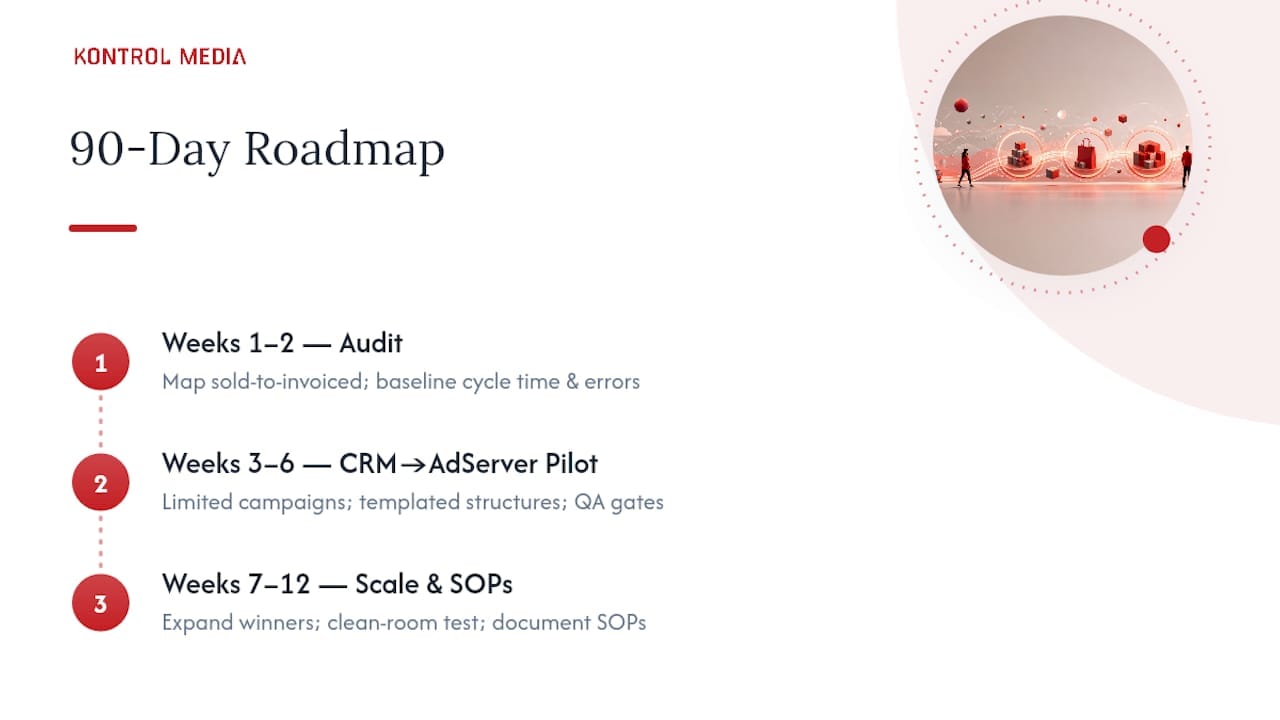
Weeks 3 through 6 focus on the CRM to ad server pilot. Run it on a limited set of campaigns, build your first templated campaign structures, and set QA gates before anything launches broadly.
Weeks 7 through 12 expand what worked, launch a first clean-room measurement test with a willing advertiser partner, and document standard operating procedures so the workflow survives beyond whoever built it. Kontrol Media’s execution-first playbook covers this exact sequencing in more procedural detail for teams running the pilot themselves.
Why Change Management Determines Whether the New Workflow Sticks
A better workflow on paper means nothing if the ad ops analyst still emails the sales rep instead of using the new intake form. Change management in retail media operations comes down to sequencing and buy-in, not just documentation.
Roll out changes to one team or one campaign type first, not the whole organization simultaneously. A pilot group that sees the new SLA structure actually reduce their weekend fire drills becomes your best internal advocate when you expand it. Trying to flip every process for every team in the same week guarantees confusion and a quiet reversion to old habits within a month.
Training has to be role-specific, not a single all-hands deck. Sales needs to understand why they can’t promise a launch date without checking ad ops capacity first. Account management needs a clear script for setting advertiser expectations around SLA windows. Ad ops needs hands-on practice with the new tooling before it goes live, not a screenshot walkthrough the week of launch.
Document the “why” behind each change, not just the “how.” Teams that understand a new QA gate exists because it caught three billing errors last quarter follow it more consistently than teams told to follow it because leadership said so. Build a short feedback loop, even informal, where the people running the workflow daily can flag friction within the first thirty days, before workarounds calcify into a shadow process nobody documented.
What Compliance and Privacy Rules Apply to Retail Media Data?
Retail media runs on first-party shopper data, and that dependency is exactly why privacy governance has to live inside operations, not just legal’s inbox. Loyalty purchase history, browsing behavior, and household-level identifiers all feed targeting and measurement, and each carries different consent requirements depending on how it was collected and what the shopper agreed to.
Data-sharing agreements with advertisers need explicit field-level clarity: what data crosses into a clean room, what stays retailer-side only, and what gets aggregated before it ever reaches a report. This is where the operations design work described earlier in the tooling section pays off again. A clear data contract that names owners and validation rules prevents an advertiser from receiving individually identifiable information they were never entitled to see.
Consent management needs a defined owner inside the ops org, someone accountable for confirming that targeting logic respects opt-outs and that data retention windows match what the retailer’s privacy policy actually promises shoppers. This isn’t a one-time legal review. Retention rules and consent scopes shift as regulations evolve, and campaigns built against last year’s data governance assumptions can quietly drift out of compliance without anyone noticing until an audit.
Build a quarterly compliance checkpoint into your existing cadence rhythm rather than treating it as a separate fire drill. Pair it with the same monitoring discipline you apply to SLA adherence: flag anomalies early, document what changed, and keep a clear audit trail of which advertiser had access to which data set and when.
How Should You Budget for Retail Media Operations?
Most retail media budgets get built around media revenue targets and forget to fund the operations layer that actually delivers them. That’s backwards. Ops headcount, tooling licenses, and integration work need their own line item tied to campaign volume, not treated as overhead absorbed wherever there’s spare margin.
A useful budgeting anchor is cost per campaign managed, tracked separately from cost per dollar of media revenue. As automation from the tooling section takes hold, cost per campaign should decline even as total campaign volume rises. If it’s flat or climbing, that’s an early signal you’re scaling headcount to cover process gaps instead of fixing them, the same warning sign covered in the scaling section above.
Tooling costs deserve their own scrutiny cycle, ideally annual, since ad server licensing, clean-room access fees, and analytics platform costs tend to creep as vendors add tiers and usage-based charges. Build a light build-versus-renew review into that cycle: a tool that made sense at 50 campaigns a month may not be the most cost-efficient choice at 500.
Reserve a portion of the ops budget, even a modest one, for make-good inventory and reconciliation buffers. Delivery shortfalls happen, whether from stockouts or creative delays, and having budgeted flexibility to honor make-goods without a finance escalation keeps advertiser trust intact. Treat this line item as a cost of doing business reliably, not a failure to plan for.
How Do You Plan for Crises in Retail Media Campaigns?
A major stockout, a platform outage during a high-spend campaign, or a data breach affecting targeting data. None of these are hypothetical for a network running enough volume, and the difference between a manageable incident and a lost advertiser often comes down to whether a response plan existed before the crisis, rather than during it.
Build scenario playbooks for the failure modes most likely to hit your specific network. A grocery RMN should have a defined response for a widespread inventory disruption affecting multiple advertisers simultaneously. A marketplace RMN should have one for a seller-side data quality failure that breaks targeting across hundreds of small advertisers at once. Generic crisis plans borrowed from other industries rarely map cleanly onto retail media’s specific dependencies.
Every playbook needs three things: a communication protocol (who tells the advertiser, how fast, and with what level of detail), a make-good or compensation framework decided in advance rather than negotiated case by case under pressure, and a named incident owner who isn’t also trying to manage the daily campaign queue during the crisis. Ambiguity about who’s in charge during an incident is often what turns a contained problem into a advertiser relationship crisis.
Run a tabletop exercise at least twice a year: walk through a plausible failure scenario with the ops, sales, and analytics leads in the room, and test whether the SLA and make-good structures from the workflow section actually hold up under pressure. The gaps you find in a calm rehearsal are far cheaper than the ones you find during an actual outage with an advertiser on the phone.
What I’ve Learned Watching RMN Operations Scale (and Stall)
Two patterns show up repeatedly across networks trying to scale. The ones that succeed treat ops design as the fix, not headcount. The ones that stall keep hiring coordinators to patch a broken handoff instead of fixing the handoff itself.
The second lesson is subtler: SLAs aren’t bureaucracy, they’re what preserves advertiser trust when something inevitably goes wrong. A network with a clear make-good process recovers from a stockout gracefully. One without it loses the advertiser’s confidence permanently, over something that should have been a minor hiccup.
The most common mistake I see is treating measurement as a reporting afterthought instead of an operations requirement built in from the start. Fix that early, and everything downstream gets easier.
— Mark Kapczynski
How Kontrol Media Helps You Fix Retail Media Operations
If the breakage described above sounds familiar, the fix usually isn’t more headcount. It’s operations design done right the first time, and that’s exactly where some consultancies work with retail and commerce media teams: mapping the sold to invoiced workflow, building the CRM to ad server integration that eliminates manual re-keying, and setting up the measurement structure advertisers actually trust.
A typical engagement starts with the same audit outlined in the 90-day roadmap above: baseline your cycle times, identify the highest-leverage automation targets, and pressure-test your current SLA structure against real advertiser expectations. From there, Consultants work alongside your ad ops and analytics leads to implement the fixes, not just hand over a slide deck and leave. Retailers weighing whether to build this capability in-house, license a platform, or land somewhere in between can start with Kontrol Media’s retail media network setup framework, which walks through the build versus buy decision in the context of your specific archetype and volume. If you’re ready to talk through where your operations are breaking, reach out to Kontrol Media and start with an audit of your current workflow.