


A private equity commercial and marketing due diligence strategy has one job: give the investment committee model-ready numbers, three risk-scoped scenarios, and a prioritized Day-1 value-creation plan it can defend under questioning. Anything short of that is a research report, not diligence.
Deal teams that get this right walk into IC with more than a market overview. They walk in with a validated total addressable market, cohort-level retention math, a pricing headroom estimate backed by real customer data, and a short list of red flags that either got resolved or got priced into the offer. Deal teams that get it wrong find those same red flags eighteen months into the hold period, usually right when the original underwriting case stops working.
The required output set looks like this:
- A validated TAM/SAM built bottom-up and reconciled against top-down market reports
- Cohort-level retention and unit economics broken out by customer segment, not blended into a single average
- A competitive pressure map naming direct competitors and adjacent substitutes
- A pricing headroom estimate grounded in win/loss data, not management’s aspirational deck
- A CAC/LTV breakdown by channel and cohort
- A short, prioritized list of material red flags with a recommended structural response for each
On scope and sequencing: run a light, thesis-focused primary research pass before the letter of intent when the deal is sensitive to a specific assumption, then commit to a full post-LOI sprint once you have exclusivity. For most mid-market deals, that full sprint means 15 to 30 operator and customer interviews plus 30 to 100 or more survey responses, depending on the customer base size and how concentrated the revenue is.
Key Takeaways
A private equity commercial and marketing due diligence strategy succeeds when it produces traceable evidence, cohort-level economics, and a named, owner-assigned Day-1 plan rather than a generic market overview.
| Point | Details |
|---|---|
| Demand traceable evidence | Every claim in the IC memo should link to a named interview, extract, or report, not a summary statement. |
| Prioritize customer quality and pricing | When time is short, run interviews on retention and pricing before spending budget on market sizing. |
| Require cohort-level metrics | Insist on CAC, LTV, and retention broken out by cohort, never a single blended figure. |
| Convert findings into owned actions | Every material red flag should become a price adjustment, a structural protection, or a named 100-day initiative. |
| Partner with specialists who bridge to execution | Kontrol Media pairs marketing due diligence with hands-on Day-1 execution support, not just a delivered report. |
Table of Contents
- What Is Commercial Due Diligence in Private Equity, and Where Does Marketing Fit?
- What Are the Core Workstreams a PE Deal Team Must Demand?
- How Should Marketing Due Diligence Test Channel Health and Growth Potential?
- What Methods and Data Sources Do Specialists Actually Use?
- What Deliverables Should Investors Expect From a Diligence Engagement?
- What Red Flags Should Trigger a Second Look at the Deal?
- How Long Should a Commercial and Marketing Due Diligence Engagement Take?
- How Should PE Teams Work With External Specialists for Maximum Value?
- How Kontrol Media Runs Marketing Due Diligence and Supports Execution After Close
- How Kontrol Media Can Support Your Next Deal
- Frequently Asked Questions
- Sources
What Is Commercial Due Diligence in Private Equity, and Where Does Marketing Fit?
Commercial due diligence tests whether a target’s growth story holds up outside of management’s PowerPoint. It answers whether the market is as large as claimed, whether customers actually stay and expand, whether pricing has room to move, and whether the go-to-market engine can scale without breaking. Marketing due diligence is not a separate discipline bolted onto the side. It sits inside commercial due diligence as the workstream that interrogates how the company acquires and keeps customers: the channels it uses, the martech stack running underneath, and the unit economics that determine whether growth is profitable or just loud.
Treating marketing DD as an afterthought is one of the more common mistakes deal teams make. A target can have a real market and a defensible product and still be a bad investment if its customer acquisition cost has crept up faster than its lifetime value, a pattern that shows up constantly in businesses that scaled through paid channels without disciplined measurement.
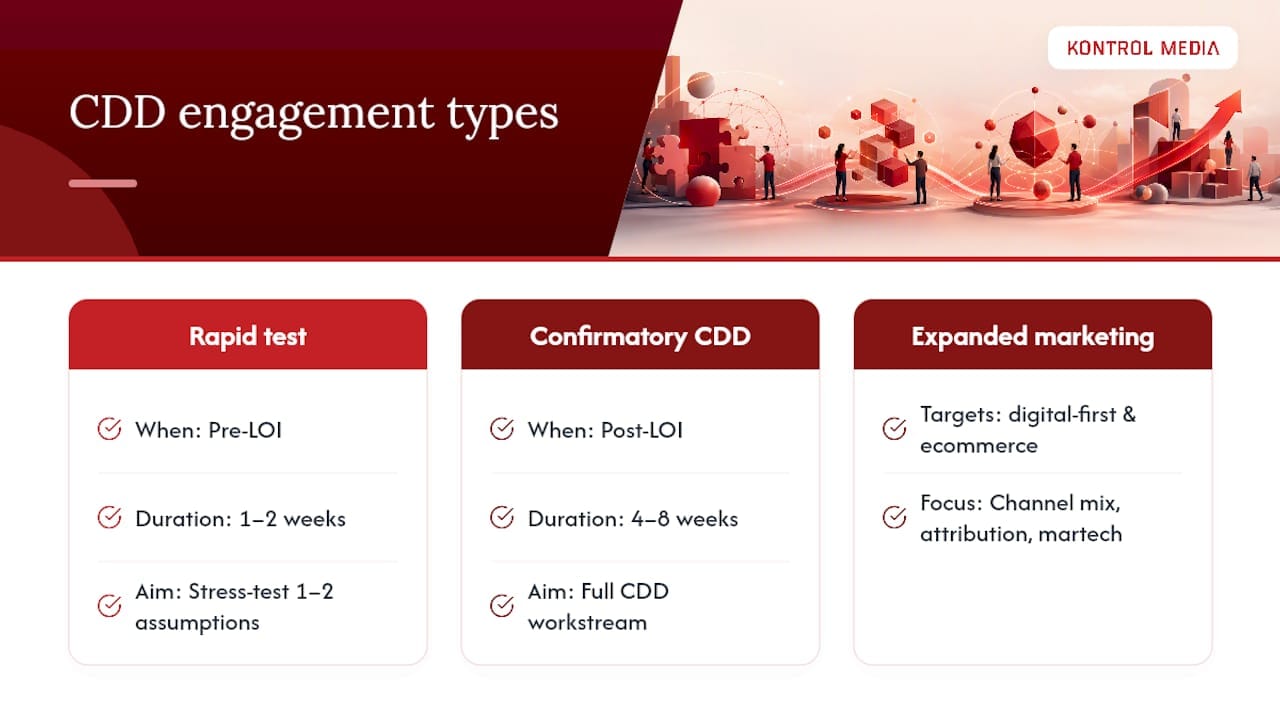
In practice, engagements come in three shapes. A rapid thesis test runs pre-LOI, usually in a week or two, and exists to stress-test one or two assumptions the deal hinges on, like whether a niche market is really as large as the CIM claims. A confirmatory CDD runs post-LOI over four to eight weeks and covers the full workstream set with enough rigor to support IC materials and financing conversations. An expanded marketing DD goes deeper on digital-first or ecommerce-heavy targets, where channel mix, attribution, and martech maturity carry more weight in the thesis than they would for a traditional B2B services business.
The canonical workstreams that make up full-scope CDD are market sizing, competitive mapping, customer quality and concentration, pricing and unit economics, go-to-market effectiveness, and product depth. A well-run engagement sequences these so early findings shape later interview questions rather than running all six in parallel and hoping they converge.
What Are the Core Workstreams a PE Deal Team Must Demand?
Six workstreams do the heavy lifting in any commercial due diligence process, and each one should map to a specific line in the financial model. A structured framework that ties market sizing to TAM assumptions, customer quality to retention ceilings, and go-to-market effectiveness to CAC and payback timelines keeps diligence from turning into a pile of interesting facts with nowhere to go.
Market sizing and growth validation starts bottom-up: count the addressable buyers, multiply by realistic spend per buyer, and reconcile against a top-down industry estimate. When those two numbers disagree by more than 20 or 30 percent, something in the model needs to change before the deal team relies on it.
Competitive landscape mapping should name six to twelve direct competitors and substitutes, not just the two or three logos management mentions in the pitch. Ask for win/loss records against each named competitor, not a generic statement about market position.
Customer quality and concentration looks at retention by cohort, not blended churn. A company with 95% logo retention can still be fragile if its top five accounts generate 40% of revenue and none of them have signed multi-year contracts.
Pricing architecture and expansion levers require the actual pricing history: list price changes over the last three years, discount rates by deal size, and any evidence that price increases stuck without triggering churn.
Go-to-market effectiveness and unit economics demand CAC and LTV broken out by channel and cohort, not a single blended figure that hides which channels are actually working.
Product depth and technical moat covers release velocity, technical debt, and whether the product roadmap matches what customers say they need in reference calls.
| Workstream | Must-have metrics | Acceptable evidence source |
|---|---|---|
| Market sizing | Bottom-up TAM/SAM, top-down reconciliation | Industry reports, buyer counts, spend benchmarks |
| Competitive mapping | 6–12 named competitors, win/loss rate | CRM win/loss records, sales team interviews |
| Customer quality | Retention by cohort, revenue concentration | CRM extracts, cohort retention tables |
| Pricing | Price history, discount rates by segment | Contract database, pricing change log |
| GTM effectiveness | CAC/LTV by channel and cohort | CRM/analytics platform exports |
| Product depth | Release velocity, roadmap alignment | Engineering logs, customer reference calls |
Pro Tip: When the timeline is compressed, spend your limited interview budget on customer quality and pricing first. Market sizing errors get caught by outside benchmarks eventually, but a fragile customer base or unrealistic pricing assumption can sink the entire thesis and rarely shows up in secondary data.
How Should Marketing Due Diligence Test Channel Health and Growth Potential?
Marketing due diligence earns its keep by finding out whether growth is durable or borrowed against future spend. That means testing channel-level ROI, not just accepting a blended CAC figure from the data room. Ask for CAC and incremental lift by channel, the paid versus organic mix over the last two years, and how much confidence the attribution model actually deserves given the platforms in use.
Martech and data maturity matter more than most deal teams expect going in. Tag hygiene issues, weak consent management, and broken identity resolution across devices all point to a company that has been flying partly blind on its own growth engine. A target that cannot tell you with confidence which channel drove a given customer is a target whose reported CAC numbers deserve real skepticism.

The metrics worth demanding: CAC by channel and cohort, LTV by cohort (not a single lifetime average), funnel conversion rates at each stage, and any incrementality test results the company has actually run, even informal ones. Few mid-market companies run rigorous incrementality testing, and that gap itself is useful information about how disciplined the marketing function really is.
| Signal to test | What good looks like | What a red flag looks like |
|---|---|---|
| CAC by channel | Clear attribution, stable or declining trend | Blended CAC only, rising trend with no explanation |
| LTV by cohort | Cohorts tracked and improving over time | Single blended LTV figure, no cohort view |
| Attribution fidelity | Multi-touch model, clean tagging | Last-click only, broken tags, no consent management |
| Funnel conversion | Documented rates at each stage | No funnel instrumentation |
| Incrementality testing | Holdout tests run on at least top channels | No testing culture, spend allocated by habit |
Quick wins worth flagging in the Day-1 plan usually surface during this workstream: restructuring spend away from underperforming channels, fixing reactivation flows for lapsed customers, or correcting a pricing packaging issue that is leaving revenue on the table.
Pro Tip: Short diligence windows rarely allow for a proper incrementality test, but you can get a reasonable proxy by comparing performance in markets or segments where a channel was paused against ones where it kept running. It is not a controlled experiment, but it beats trusting a platform’s self-reported attribution.
What Methods and Data Sources Do Specialists Actually Use?
Rigorous commercial due diligence rests on a hierarchy of evidence, and deal teams should know that hierarchy well enough to push back on a thin proposal. Primary research sits at the top: expert and operator interviews, customer reference calls, B2B surveys, and channel checks generate evidence that cannot be gamed by a well-produced management deck. This kind of thesis-driven primary research is increasingly standard practice for high-conviction deals, and it is the piece that most often changes a valuation assumption rather than just confirming what management already claimed.
Secondary sources and alternative data fill in the picture between interviews. Industry reports, web traffic signals, hiring trend data, and marketplace transaction data all offer independent commercial momentum signals that do not depend on the target’s own narrative. AI-powered contract intelligence tools can now automate a meaningful chunk of contract review, freeing up analyst time for the harder work of synthesis and interview design.
Validation matters as much as collection. When two independent signals converge, like a customer interview theme matching a pattern in the CRM data, confidence goes up. When they conflict, the right move is not to average them together. It is to escalate: run another interview batch, pull a different data cut, or flag the discrepancy explicitly in the IC memo rather than smoothing it over.
- Interview transcripts with named respondent roles (not just “customer A”)
- A documented survey codebook showing question logic and response rates
- Raw CRM and analytics extracts, not summary dashboards
- A written data reconciliation note when top-down and bottom-up figures diverge
Standardized documentation practices, the kind audit and assurance bodies have long emphasized for defensible evidence trails, apply just as well here. A deal team should be able to trace every number in the IC memo back to a specific interview, extract, or report.
What Deliverables Should Investors Expect From a Diligence Engagement?
A finished commercial and marketing due diligence engagement produces a defined set of artifacts, each mapping directly into either the financial model or the 100-day plan. Vague summary decks without traceable evidence are a common quality issue in vendor work.
| Deliverable | Expected contents | Where it maps |
|---|---|---|
| IC memo | Thesis validation, key findings, risk register | Investment committee decision |
| Three-case sensitivity model | Base, upside, downside scenarios with named drivers | Valuation and financing model |
| Customer cohort exhibits | Retention curves, concentration analysis by segment | Revenue quality assumptions |
| Pricing analysis appendix | Price history, elasticity signals, packaging options | Revenue growth line items |
| GTM staffing and 100-day plan | Named initiatives, owners, timelines | Post-close value-creation plan |
The full-scope engagement typically produces a report in the neighborhood of 20 to 30 pages for the core CDD workstreams, plus appendices. Anything dramatically shorter usually means shallow primary research; anything dramatically longer often means padding.
When reading a deliverable, scrutinize whether every claim traces back to a named source. A statement like “customers report high satisfaction” without a linked interview count or survey result is a placeholder, not evidence. Push consultants to show the reconciliation between top-down market data and their bottom-up estimate rather than presenting a single unchallenged number.
What Red Flags Should Trigger a Second Look at the Deal?
Some patterns show up again and again in flawed deals, and a deal team that knows them going in can ask sharper questions during management meetings rather than discovering the problem in the data room three weeks later.
- Rising CAC alongside flat or declining retention, a combination that usually means the growth engine is running on paid acquisition rather than product-market fit
- Blended ARPU that hides a shrinking core segment behind a growing but lower-value one
- Heavy customer concentration where the top five or ten accounts generate a disproportionate share of revenue with no long-term contracts
- Missing or incomplete win/loss data, which often signals a sales organization that does not track why it loses deals
- Declining product release velocity paired with a roadmap that promises acceleration
Each of these should change either the price or the deal structure, not just get noted and forgotten. Customer concentration often justifies an earn-out tied to retaining named accounts through a transition period. Unverified ARPU claims justify a holdback pending a post-close audit. Weak win/loss data is a signal to build stronger reps and warranties around revenue representations.
| Red flag | Why it matters | Follow-up evidence to demand |
|---|---|---|
| Rising CAC, flat retention | Growth may be unprofitable at scale | Channel-level CAC trend, cohort retention curves |
| Customer concentration | Revenue at risk from a handful of relationships | Contract terms, tenure, and renewal history for top accounts |
| Missing win/loss data | Sales process lacks discipline and self-awareness | Direct interviews with sales reps and recently lost prospects |
| Declining release velocity | Product moat may be eroding | Engineering roadmap history, customer product-gap complaints |
Sample questions worth asking management directly: “Walk me through why you lost your last three competitive deals.” Asking customer references: “What would make you switch providers?” Asking channel partners: “Has your commission structure or priority changed in the last year?” Each question targets a specific red flag category rather than fishing for generalities.
How Long Should a Commercial and Marketing Due Diligence Engagement Take?
A confirmatory, post-LOI engagement typically runs four to eight weeks for a mid-market target, with pre-LOI thesis tests compressed into a week or two when speed matters more than depth. Sequencing usually starts with secondary research and data room review initially, moves into primary interviews and surveys in the subsequent weeks, and closes with synthesis, model integration, and report drafting in the final phase.
A properly staffed team includes a deal lead who owns the thesis and final go/no-go recommendation, a CDD lead who runs the workstream sequencing, a marketing specialist who owns the channel and martech deep dive, a data analyst who handles CRM extracts and cohort math, and a research coordinator who schedules and manages the interview and survey program. External consulting partners typically slot into the CDD lead and marketing specialist roles, working alongside the deal team’s own analyst.
Budget scales with deal size and depth. A rapid pre-LOI test costs a fraction of a full confirmatory sprint, while an expanded marketing DD for a digital-first asset with complex channel attribution runs higher than a straightforward B2B services target. Scope, not deal size alone, moves the price: more interviews, more survey markets, and deeper martech audits all add cost.
| Weeks | Core activities | Sample outputs |
|---|---|---|
| 1 | Data room review, secondary research, interview guide design | Initial hypothesis map, data gap list |
| two or three | Primary interviews, survey fielding, channel checks | Interview transcripts, preliminary survey results |
| 4–5 | CRM/analytics extraction, cohort analysis, pricing review | Cohort tables, pricing exhibit draft |
| four to eight | Synthesis, sensitivity modeling, report drafting | IC memo draft, three-case model, 100-day plan |
How Should PE Teams Work With External Specialists for Maximum Value?
Getting real value from an outside CDD and marketing DD provider starts before the kickoff call, with a scope of work that names exactly what evidence you expect and how it will be delivered. A vague SOW that just lists workstream names invites a vague deliverable.
The engagement process should run through defined stages: RFP and SOW design, a structured kickoff that aligns on the thesis and the two or three assumptions the deal actually hinges on, interim evidence handoffs as interviews and data extracts come in, a draft deliverable review with time built in for pushback, and a final handover that feeds directly into 100-day plan development.
A sound SOW checklist includes:
- Named deliverables with page-count or exhibit-count expectations
- Evidence traceability requirements, meaning every claim ties to a transcript, extract, or report
- Primary research quotas, stated as interview counts and survey response targets
- Clear IP and usage rights over transcripts and data extracts
- Confidentiality limits, especially around what can be shared with lenders or co-investors
- Named escalation points if signals conflict or timelines slip
Weekly check-ins keep sprint velocity honest, and a short “so what” page circulated after each week’s fieldwork forces the consultant to connect raw findings to model implications rather than just reporting activity. If a week of interviews produced interesting color but no answer to “does this change our valuation assumption,” that is worth flagging immediately, not at the final readout.
| SOW element | Why it matters | What to ask for |
|---|---|---|
| Evidence traceability | Prevents unverifiable claims in the IC memo | Every finding linked to a named source |
| Primary research quotas | Ensures the report reflects real customer voice, not desk research | Interview and survey counts by segment |
| Escalation points | Keeps conflicting signals from being smoothed over | Named contact for mid-sprint disputes |
| IP and usage rights | Protects future use of transcripts and data | Written terms before kickoff |
The final step, and the one most engagements skip, is converting each material finding into an owner-assigned, time-bound initiative before the consultant walks away. A pricing headroom finding without a named owner and a 90-day deadline is a fact, not a plan.
How Kontrol Media Runs Marketing Due Diligence and Supports Execution After Close
Kontrol Media approaches marketing due diligence as the bridge between what a target claims about its growth engine and what a portfolio company actually needs to do differently on day one. That means primary research with real customers and channel partners, a full martech and attribution audit, and, where the timeline allows, small commercial experiments that test a pricing or channel hypothesis before the deal even closes rather than after.
For PE deal teams, the relevant service lines include commercial due diligence support built around named workstreams and traceable evidence, marketing-specific audits covering channel ROI and martech maturity, growth playbooks that translate findings into a prioritized 100-day plan, and outsourced go-to-market execution for portfolio companies that need hands-on help implementing what diligence uncovered.
Kontrol Media has run this kind of work with organizations including Experian, BuzzFeed, HuffPost, RE/MAX, Enthusiast Gaming, and West Monroe, spanning ecommerce, media, real estate, and B2B categories where channel mix and customer acquisition economics vary widely.
In one representative engagement pattern, a marketing due diligence sprint uncovered that a target’s blended CAC figure was hiding a paid channel with negative unit economics offset by a high-performing organic channel investors had assumed was minor. Reallocating spend away from the underperforming channel became a named Day-1 initiative, and the pricing analysis run in parallel identified an untapped upsell tier that shaped both the final offer price and the first-quarter revenue plan.
- Commercial due diligence support with named workstreams and traceable evidence
- Marketing due diligence covering channel ROI, attribution, and martech audits
- Growth playbooks translating findings into a prioritized, owner-assigned 100-day plan
- Outsourced go-to-market execution for portfolio companies post-close
What Frameworks Help Assess Market Entry Risk and Competitive Threats?
Assessing market entry risk starts with mapping barriers to entry against the target’s actual moat, not its claimed one. A useful lens borrows from Porter’s Five Forces, adapted for diligence purposes: how easily could a well-funded competitor replicate the target’s distribution advantage, and how much would it cost them in time and capital to do so? If the answer is “eighteen months and a modest ad budget,” the competitive threat section of the IC memo needs a harder edge than management’s deck suggests.
Layer that against a switching-cost analysis: interview customers specifically about what it would take for them to leave. Vague answers about “relationships” are weaker evidence than a documented integration cost or a multi-year contract with real penalty clauses. Competitive threats that matter most tend to come from adjacent categories rather than direct competitors, since a business rarely gets disrupted by the company it has been benchmarking against for years.
How Should Digital Marketing Effectiveness Be Evaluated Beyond Surface Metrics?
Impressions, click-through rates, and even blended ROAS tell you almost nothing about whether a marketing function can scale profitably. The deeper test is whether the team can explain incrementality: what happens to revenue when a channel is paused, not just what a platform’s dashboard attributes to it. A target that has never run a holdout test is a target whose reported marketing efficiency numbers deserve a discount.
Innovation potential shows up less in the tools a marketing team uses and more in how it tests. Ask how the last three experiments were structured, what the control group looked like, and what changed as a result. A comparison of brand versus performance marketing investment mix also matters here: a company overweighted toward performance channels may show strong near-term efficiency while quietly eroding the brand equity that protects long-term pricing power.
What Risk Mitigation and Contingency Planning Should Follow Diligence?
Every material finding from diligence should produce one of three outcomes: a price adjustment, a structural protection, or a Day-1 action item. Findings that just get noted and filed away defeat the purpose of the exercise.
Structural protections worth considering include earn-outs tied to retention of concentrated customer accounts, holdbacks pending resolution of unverified pricing claims, and specific reps and warranties around data quality when a target’s CRM hygiene raised concerns during diligence. Contingency planning should also cover a downside scenario explicitly: if the identified pricing headroom does not materialize within the first two quarters, what is the fallback plan for hitting the underwritten growth rate? Building that fallback into the 100-day plan before close, rather than improvising it mid-hold, is what separates teams that convert diligence into returns from teams that just check a compliance box.
Balancing marketing risk against opportunity in the underwriting model
Deal teams tend to make one of two mistakes with marketing signals: treating every channel weakness as a dealbreaker, or waving away real red flags because the growth story is otherwise compelling. Neither instinct holds up well over a five-year hold.
My view, after seeing how these findings actually play out post-close, is that early channel signals deserve real weight when they touch the primary growth engine, and much less weight when they touch a secondary or experimental channel. A target burning cash on an underperforming paid social campaign that represents 8% of total spend is a fixable Day-1 problem, not a reason to walk. A target whose entire growth story depends on a channel with unverifiable attribution and no incrementality testing is a different conversation entirely, because you are underwriting a number you cannot actually trust.
The rule of thumb worth adopting: if a marketing finding could move the valuation by more than a few percentage points on its own, it belongs in the model as an explicit adjustment or in the deal structure as a covenant, not buried in a risk register nobody rereads after closing. Anything smaller belongs on the 100-day plan as an operating fix. Convert findings into covenants sparingly. Overusing structural protections signals distrust that can sour the relationship with management before the deal even closes, and the management team you inherit is the same one that has to execute the plan you just built.
How Kontrol Media Can Support Your Next Deal
Traditional diligence vendors often stop at the report. Kontrol Media stays through the part that actually moves returns: turning marketing due diligence findings into a working 30/60/90-day execution plan and, when portfolio companies need it, hands-on support running that plan.
For deal teams evaluating an acquisition, Kontrol Media offers a pilot diligence sprint scoped around your specific thesis risks, a full marketing audit paired with a prioritized execution roadmap, and retained support for portfolio companies that need outside hands to implement Day-1 pricing, channel, or go-to-market changes once the deal closes. That last piece is where a lot of value gets left on the table industry-wide: diligence identifies the opportunity, but nobody owns turning it into revenue in the first two quarters.
If your team is heading into a confirmatory diligence sprint or already sitting on a diligence report that needs to become an execution plan, start a conversation about crafting a business strategy built around what your findings actually showed.
Frequently Asked Questions
What is the difference between commercial due diligence and marketing due diligence in private equity?
Commercial due diligence covers the full growth thesis, including market size, competitive position, and customer quality. Marketing due diligence is the workstream inside CDD that focuses specifically on acquisition channels, martech maturity, CAC/LTV economics, and go-to-market effectiveness.
How many customer interviews should a PE due diligence engagement include?
Most full-scope engagements for mid-market targets run 15 to 30 operator and customer interviews, supplemented by 30 to 100 or more survey responses depending on customer base size.
When should PE firms bring in an external commercial due diligence specialist?
Bring in specialists as soon as a deal reaches exclusivity, or earlier for a light pre-LOI thesis test when the deal hinges on one or two assumptions that a quick round of primary research can validate or kill before you commit resources to a full bid.
What should a PE deal team do if diligence findings conflict with management’s projections?
Escalate rather than average. Run an additional interview batch or pull a different data cut to resolve the discrepancy, and if it remains unresolved, flag it explicitly in the IC memo along with a recommended price adjustment or structural protection.
How does marketing due diligence affect the Day-1 value-creation plan?
Marketing due diligence often surfaces the fastest wins available post-close, such as reallocating spend away from underperforming channels or fixing a pricing packaging gap, both of which can become named, owner-assigned initiatives in the first 90 days.
This article is general information, not a substitute for advice from a qualified financial advisor. Consult a qualified financial professional about your own circumstances before acting on anything here.
Sources
- Private Equity Due Diligence Framework: Commercial Analysis in 6 Steps – SuiteCompete Blog
- Commercial Due Diligence: A Practical Guide for PE, VC and Corporate Buyers | FieldSignal
- PitchBook 2024 annual US PE breakdown
Recommended
- Private Equity Marketing Due Diligence: 2026 Guide | Kontrol Media Consultancy
- Private Equity Commercial Due Diligence: 2026 Guide | Kontrol Media Consultancy
- Marketing for Private Equity Portfolio Companies: 2026 Guide | Kontrol Media Consultancy
- Top 5 Commercial Due Diligence Agencies 2026 | Kontrol Media Consultancy