


Using licensed real estate agents as distributed influencer partners is one of the most direct ways for brands to reach qualified homebuyers in specific local markets — and the fastest path to proving it is a tightly scoped pilot. Run a 3-month test in two contiguous ZIP codes with 6–10 vetted agents and a single product offer, whether that is a mortgage product, a home services subscription, or a retail brand targeting new movers. Set your objective, define your KPI set (referral clicks, qualified leads, cost per acquisition), build a simple incentive model, establish a content cadence of two to four posts per agent per month, and track everything through unique referral links plus UTM-tagged landing pages. That is the pilot brief. Everything below is the playbook to execute it well.
Key Takeaways
Agent-driven influencer programs deliver superior homebuyer conversion when built on hyper-local audience selection, lifestyle-first content, clean attribution, and compliance infrastructure from day one.
| Point | Details |
|---|---|
| Pilot structure | Run a 3-month test in two ZIP codes with 6–10 vetted agents and one product offer before scaling. |
| Agent selection | Require platform analytics showing 35–50%+ of followers in the target market; geo-fit beats follower count. |
| Payment model | Hybrid flat fee plus affiliate payout attracts the most motivated partners and aligns incentives with conversion. |
| Compliance | FTC disclosures, RESPA compliance for lenders, and data consent must be built into every activation, not added later. |
| Kontrol Media | Designs and operates agent-driven channels end-to-end, from pilot design and agent sourcing to attribution and scale playbooks. |
Table of Contents
- Why real estate agents outperform broad influencer buys for homebuyer reach
- What program model fits your objective?
- How to recruit and qualify the right agent partners
- Your activation playbook: content types and physical-to-digital tactics
- How to pay agents, track outcomes, and measure success
- Operational design: onboarding, governance, and scale
- What does a pilot actually cost, and when do you see results?
- Legal, compliance, and brand-safety checklist
- Case examples that show the mechanics in action
- When should you build in-house versus hire a partner?
- Kontrol Media builds and operates agent-driven channels for brands
- Sources
Why real estate agents outperform broad influencer buys for homebuyer reach
Agents beat generic influencer buys for homebuyer conversion because local credibility converts at rates that dispersed macro-influencer reach simply cannot match. A lifestyle blogger with 400,000 followers spread across 40 states is structurally the wrong vehicle for a mortgage lender or a home services brand trying to activate in Phoenix or Charlotte. An agent with 4,000 highly concentrated local followers, a weekly neighborhood market update, and a coffee-shop partnership down the street is a different proposition entirely.
The mechanism is what practitioners call trust osmosis: when a brand partners with an agent who is already a trusted community figure, it inherits that trust rather than having to build it from scratch. The agent’s audience has already decided this person knows the neighborhood. A product recommendation from that person carries weight a banner ad never will.
This is the “digital mayor” effect. Agents who consistently feature local businesses in lifestyle content rather than pushing property listings build an identity as the neighborhood’s go-to connector. That identity is the distribution asset brands are actually buying. The Philadelphia Inquirer reported that social content is now the initial trust signal for many buyers discovering agents, which means the audience relationship is already primed before a brand message ever enters the feed.
The distribution mix compounds the effect. Owned followers are just one layer. Add the partner business’s audience, event attendees, and physical touchpoints like QR codes linking to a micro-site, and you get a surround-sound signal across digital and physical channels simultaneously.
- Prioritize agents with audience geography concentrated in your target ZIP codes, not raw follower counts.
- Nano and micro creators with 2,000–8,000 highly local followers often outperform larger, dispersed accounts for real-estate-targeted campaigns, per InfluencerFee’s local creator guidance.
- Agents who already spotlight local businesses are pre-qualified for lifestyle-first brand partnerships.
- High-influence agents like Kris Lindahl, whose Activision partnership generated significant impressions, filter partnership proposals carefully — your pitch must align with their brand identity, not just their audience size.
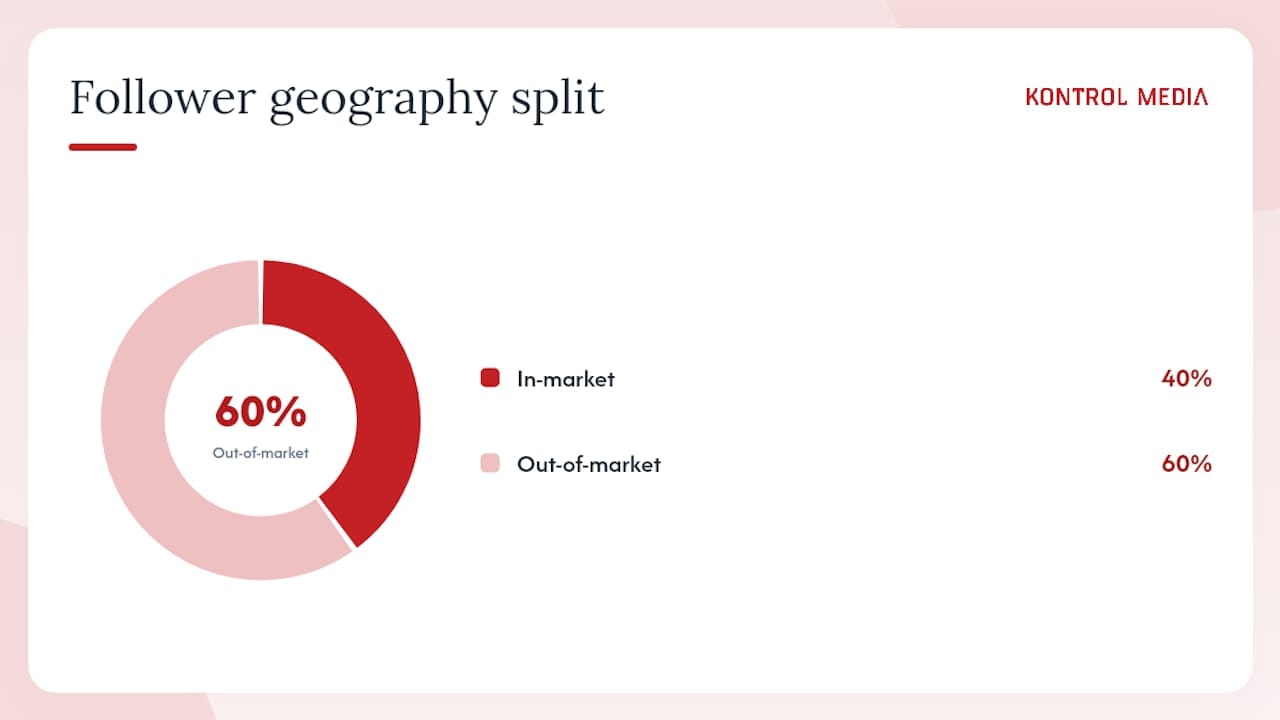
Pro Tip: Require Instagram Insights or TikTok Analytics screenshots showing follower geography before any contract conversation. An agent whose audience is 60% out-of-market is a content creator, not a local distribution partner.
What program model fits your objective?
Choose the model that maps to your primary objective. Awareness calls for sponsored lifestyle content. Lead generation calls for affiliate or referral links. Commerce integration calls for retail media tie-ins. Relationship-building at scale calls for co-branded events.
| Campaign Model | Reach Type | Measurement Complexity | Cost Model | Time to First Conversion | Scalability |
|---|---|---|---|---|---|
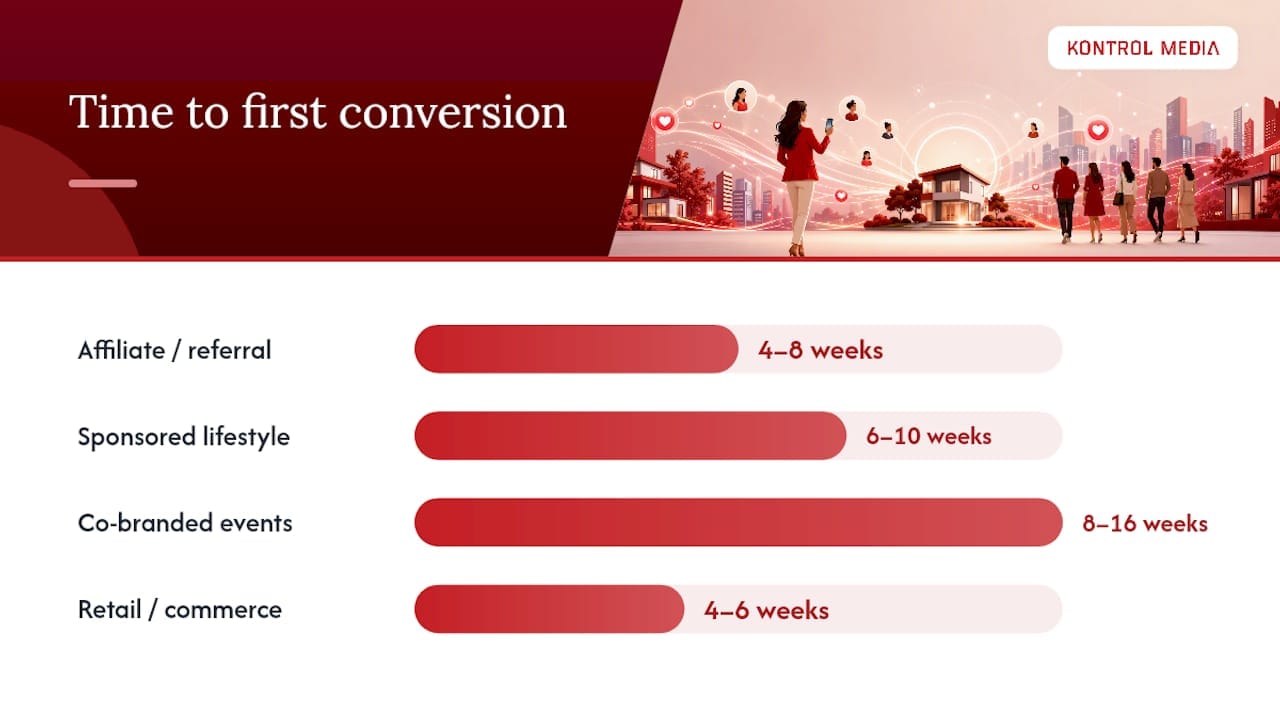
| Affiliate / referral links | Owned followers + partner audiences | Low | Revenue share or affiliate payout | 4–8 weeks | High — repeatable across markets |
| Sponsored lifestyle content | Owned followers | Medium | Flat fee per post or retainer | 6–10 weeks | High with content templates |
| Co-branded events | Event attendees + local press | High | Event cost + agent fee | 8–16 weeks | Moderate — market-by-market |
| Retail / commerce media tie-ins | Partner business audiences | Medium | Revenue share or placement fee | 4–6 weeks | High with platform integration |
For lenders, the affiliate model is the clearest fit. Beeline’s Realtor and Content Creator Partner Program gives each affiliate a unique referral link to drive DSCR mortgage applications directly on Beeline’s platform — a clean, trackable model that any lender can adapt. For home services and retail brands, sponsored content paired with a QR-to-micro-site flow produces the surround-sound effect described above. For large CPG sponsors, co-branded events offer the deepest community integration, though they carry the highest operational cost and the longest lead time to measurable conversion.
Co-branded builder and agent campaigns can also share production costs and amplify reach across both parties’ audiences, per Realtor — a cost-sharing mechanic worth building into your program structure from day one.
How to recruit and qualify the right agent partners
Prioritize agents with concentrated local audiences, a consistent content cadence, and demonstrated partnership experience. Follower count is a secondary signal. Audience geography and content tone fit are primary.
Qualification checklist before contracting:
- Active license in the target state, verified through the relevant state real estate commission
- 35–50%+ of followers located in the target market (verified via platform analytics screenshots)
- Consistent posting cadence — at least two to four posts per week over the prior 90 days
- Content tone that fits your brand (lifestyle, community-first, not purely transactional)
- Prior partnership or sponsorship experience with appropriate FTC disclosures visible in past posts
- Engagement rate above 3% on recent posts
| Tier | Profile | Suggested Incentive |
|---|---|---|
| Tier 1 — Market leaders | 10K+ local followers, proven brand deals, high engagement | Flat fee + performance bonus + co-branded event budget |
| Tier 2 — Growth creators | 2K–10K local followers, consistent cadence, strong geo-fit | Affiliate payout + flat content fee |
| Tier 3 — Opportunistic partners | Under 2K followers, high geo-concentration, active community ties | Affiliate payout only or event participation fee |
Require audience geo-verification before any contract is signed. An agent who looks strong on follower count but whose audience is dispersed across multiple states delivers awareness, not local conversion.
Your activation playbook: content types and physical-to-digital tactics
Lifestyle-first, local-story content outperforms property-centric posts for brand partnerships. The agent’s feed should feel like a neighborhood guide, not a listing sheet, and your brand should appear as a natural part of that neighborhood story.
Content brief template fields:
| Field | What to specify |
|---|---|
| Campaign objective | Lead generation, awareness, or event attendance |
| Target audience | Local homebuyers, new movers, or investors in target ZIPs |
| Local hook | Specific neighborhood, business, or community event to anchor the story |
| Required disclosures | FTC-compliant language, placement in caption and on-video overlay |
| KPIs | Referral clicks, qualified leads, engagement rate |
| Assets | Brand logo, product one-pager, QR code, micro-site URL |
| Approval window | 48-hour brand review before posting |
| CTA and tracking | Unique referral link + UTM parameters |
Physical-to-digital tactics extend the content’s reach beyond the feed. Branded coasters or table tents at partner coffee shops with a QR code linking to a co-branded micro-site create a touchpoint that works while the agent is not actively posting. Event tie-ins — open houses, neighborhood festivals, local charity events — give the brand a physical presence that feeds back into digital content. Partner-perk DMs to engaged followers sustain the relationship between posting cycles.
Pro Tip: Build a 60-second micro-interview format that agents can shoot on a phone and repurpose across TikTok and Instagram Reels with minimal editing. Feature the partner business or community story first, the product second. Agents who are comfortable on camera will produce this consistently; those who are not will stall. Screen for camera comfort during recruitment. For visual consistency, lifestyle headshot standards applied to agent creative assets signal professionalism and reinforce brand trust across every piece of content.
How to pay agents, track outcomes, and measure success
Choose a payment model that aligns agent motivation with the outcome you actually want. Flat fees produce content. Affiliate payouts produce referrals. Hybrid models produce both, and they tend to attract the most motivated partners.
Payment model comparison:
| Model | Best for | Upside | Watch out for |
|---|---|---|---|
| Flat fee | Content volume and awareness | Predictable cost | No performance incentive |
| Affiliate / revenue share | Lead generation and conversions | Aligns incentives | Requires clean attribution |
| Hybrid (flat + affiliate) | Balanced content and conversion | Motivates quality and quantity | Higher admin complexity |
| Event cost reimbursement | Community and sponsorship plays | Low cash outlay | Hard to attribute directly |
Tracking checklist:
- Unique referral links per agent, generated through a referral platform or UTM builder
- UTM taxonomy covering source, medium, campaign, and agent ID
- Dedicated landing pages or co-branded micro-sites per campaign
- Partner dashboard with real-time click and lead data
- CRM integration with a defined lead attribution window (typically 30–90 days)
KPI definitions for your pilot scorecard: Impressions (total content views), engaged local reach (impressions from target ZIP codes), referral clicks (unique clicks on agent referral links), qualified leads (leads meeting your ICP criteria), lead-to-appointment conversion rate, cost per acquisition, lifetime value of referred customers, and referral velocity (leads generated per agent per week).
Operational design: onboarding, governance, and scale
Scale safely by standardizing onboarding and brand guardrails before expanding beyond the pilot. Programs that skip this step accumulate compliance risk and brand inconsistency at the same rate they add agents.
Onboarding assets every partner receives: a signed contract with indemnity clauses, a creative brief, FTC disclosure guidance with platform-specific language, a tracking snippet or referral link, a partner welcome kit with brand assets, and a short training module covering messaging, disclosure requirements, and content approval workflow.
Governance roles for a scaled program:
| Role | Responsibility |
|---|---|
| Program manager | Partner recruitment, onboarding, and day-to-day operations |
| Creative lead | Brief development, asset creation, and content review |
| Legal / compliance reviewer | Contract sign-off, disclosure audits, and claims review |
| Regional operations | Market-level agent management and event coordination |
| Analytics lead | Dashboard management, KPI reporting, and attribution |
Partner scorecard fields: engagement rate, geo-fit score, content quality rating, lead volume, lead-to-conversion rate, and brand safety incidents (target: zero).
Lower’s national marketing agreement with HomeSmart demonstrates how co-branded resources and agent enablement can be operationalized across a large network — the governance infrastructure that made that agreement functional is the same infrastructure a brand needs to run a multi-market agent program.
What does a pilot actually cost, and when do you see results?
A low-risk pilot typically starts at a $25K–$75K blended budget covering creative fees, agent incentives, activation costs, tracking technology, and any event spend.
| Program Stage | Agents | Budget Range | Cost Buckets |
|---|---|---|---|
| Micro-pilot | 6 agents | $25K–$40K | Creative, incentives, tracking, setup |
| Market pilot | 20 agents | $25K–$75K | Creative, incentives, activation, events, tech |
| Multi-market scale | 6–10 agents | $200K+ | All above plus regional ops and compliance |
Timeline to first results:
- Weeks 1–4: Onboarding — contracts signed, assets delivered, tracking live, training complete.
- Weeks 2–6: Content rollout — agents posting on cadence, QR and micro-site live, partner businesses activated.
- Weeks 4–8: First qualified leads — referral links generating clicks, CRM capturing attributed leads.
- Weeks 8–16: First closes — conversion timeline depends on product category; mortgage products typically close in 30–60 days from lead; home services can close in days.
Legal, compliance, and brand-safety checklist
Treat compliance as an operational requirement, not a legal afterthought. FTC disclosure rules, mortgage and lending referral regulations, and privacy consent requirements must be built into every activation from day one.
| Compliance Area | Requirement | Mitigation |
|---|---|---|
| FTC influencer disclosure | Clear “#ad” or “#sponsored” in caption and on-video overlay | Pre-approved disclosure language in creative brief |
| Lender referral rules | RESPA compliance for mortgage referral compensation | Legal review of all lender-agent incentive structures |
| Compensation transparency | Disclosed in content and contract | Indemnity clause in partner agreement |
| Data handling | CCPA / state privacy consent for lead capture | Privacy policy on micro-site, consent checkbox on forms |
| Recordkeeping | Retain content and disclosures for minimum 3 years | Automated content archiving in partner dashboard |
Pro Tip: Build a 48-hour legal sign-off SLA into your content approval workflow. Pre-approved messaging templates reduce review time to near zero for standard posts; the SLA only activates for custom or off-template content. Periodic content audits — quarterly at minimum — catch drift before it becomes a compliance incident.
Case examples that show the mechanics in action
Short vignettes reveal repeatable mechanics across sponsorship, affiliate, and co-branded models.
- Century 21 BHJ Realty + YMCA soccer festival: This local sponsorship drew 350+ participating children, generated community goodwill, and created a lead-capture list for follow-up. The lesson: events produce a physical audience that digital content alone cannot replicate, and the follow-up sequence is where conversion happens.
- Beeline Realtor and Content Creator Partner Program: Beeline built an affiliate network targeting licensed real estate professionals and creators, giving each a unique referral link to drive DSCR mortgage applications. The lesson: a clean referral link structure removes attribution ambiguity and makes the program auditable from day one.
- Lower + HomeSmart marketing agreement: Lower Mortgage’s national agreement with HomeSmart provided co-branded resources and mortgage product access across HomeSmart’s agent network. The lesson: national-to-local activation works when the brand provides the infrastructure and the brokerage provides the distribution — neither party has to build the other’s capability from scratch.
Each of these programs succeeded because the mechanics were simple, the incentives were clear, and the attribution was built in before launch, not retrofitted after.
When should you build in-house versus hire a partner?
Build in-house when you have repeatable processes, internal ops bandwidth, and a technology stack already capable of handling attribution and partner management. Hire a partner when you need speed-to-market, proven deployment templates, or regulatory expertise you do not have internally.
The honest decision checklist: Do you have a dedicated program manager? Do you have a referral platform or can you build one in under 30 days? Do you have legal resources familiar with RESPA and FTC influencer rules? Do you have creative capacity to brief and review agent content at volume? If the answer to two or more of those is no, a managed partner engagement is the faster and lower-risk path.
The pilot-plus-retainer model is the most practical entry point. Run a time-boxed pilot with pre-agreed KPIs and simple compensation terms, use it to build internal knowledge and validate the channel, then transition to in-house operations once the playbook is proven. That transition is cleaner when the pilot was designed with documentation in mind from the start.
Kontrol Media builds and operates agent-driven channels for brands
Brands that want to reach homebuyers through agent partnerships without spending 18 months building the infrastructure themselves have a direct path: Kontrol Media designs and operates these programs end-to-end. The work covers pilot design, agent sourcing and qualification, campaign execution, partner dashboards and attribution, compliance templates, and scale playbooks — the full stack from strategy to revenue operations.
Kontrol Media’s client list includes Experian, RE/MAX, BuzzFeed, and West Monroe, which reflects the range of enterprise and mid-market programs the firm has built and operated. For brands entering the real estate channel for the first time, the pilot design service is the lowest-risk starting point: a scoped engagement that produces a working program, a validated KPI set, and a documented playbook your team can own going forward. For brands ready to move faster, the strategic partnership framework covers multi-market deployment with governance and compliance built in. Reach out to Kontrol Media to scope a pilot for your brand.
Sources
- The Coffee Shop Strategy: Digital & Physical Partnerships – Agentree Blog
- How to Feature Local Businesses in Hyperlocal Content (Without It Feeling Awkward) – BAM
- Call of Duty’s ‘The Replacer’ Gets Kris Lindahl Playing Games, Scoring Marketing Points — RISMedia
- Beeline’s New Affiliate Network to Target 200,000 Realtors and Creators, Accelerate Real-Estate-Investor Lending — GlobeNewswire
- Lower partners with HomeSmart to empower agents nationwide — PR Newswire
- Active Advertising: How Local Sponsorships Bring A Brand To Life | Inman Real Estate News
- Influencer Marketing for Real Estate Agents: Local Creator Strategy and Rates — InfluencerFee
- How social-media content creators are changing real-estate agent discovery — The Philadelphia Inquirer
Recommended
- Advertising to Home Buyers Through Real Estate Agents | Kontrol Media Consultancy
- Agent Influencers | Kontrol Media Consultancy
- Best Real Estate Marketing Channel for Agents in 2026 | Kontrol Media Consultancy
- Integrating Social Media into Your Advertising Strategy for Maximum Impact | Kontrol Media Consultancy