


Everyone Sells is a practical playbook by Kontrol Media CEO Mark Kapczynski that teaches every employee, not just the sales team, how to influence with authenticity through story-driven connection. The book is available in multiple formats and is especially relevant for corporate employees and marketing professionals who influence decisions every day but have never been handed a framework for doing it well.
Table of Contents
- What does the Everyone Sells book actually teach?
- Who is Mark Kapczynski and why does Kontrol Media matter here?
- The core frameworks: story arc, trust signals, and the internal ask
- How marketing teams and non-sales roles apply this day-to-day
- Running a 60–90 minute internal-sales workshop
- What the approach looks like in practice
- How to measure impact after applying these methods
- Where to buy Everyone Sells and which edition to get
- Who should read this book?
- Key Takeaways
- The gap nobody talks about
- Put the Everyone Sells framework to work with Kontrol Media
- Useful sources and further reading
What does the Everyone Sells book actually teach?
The central thesis is disarmingly simple: selling is not a department, it is a human skill. Every time you pitch a budget request, present a campaign idea, or ask a cross-functional team to prioritize your project, you are selling. The book argues that influence rooted in trust and emotional intelligence outperforms any scripted close, and that storytelling is the mechanism that makes that influence repeatable.
The book is structured around three broad movements: understanding why everyone already sells (whether they admit it or not), learning the story-driven frameworks that make influence feel natural rather than manipulative, and applying those frameworks inside real organizations. Marketing teams get particular attention because they sit at the intersection of internal persuasion and external messaging, yet they are often the last group to receive any formal selling-skills training.
Core skills the book promises to build:
- Constructing a story arc that moves an audience from awareness to belief
- Reading and responding to empathy signals in real conversations
- Framing an internal pitch so stakeholders see their own goals reflected in your ask
- Separating authentic influence from manipulation, a distinction the book treats as non-negotiable
- Writing a one-sentence value statement that travels without you in the room
Who is Mark Kapczynski and why does Kontrol Media matter here?
Mark Kapczynski is the Managing Director and CEO of Kontrol Media, a growth consultancy whose client roster includes Experian, BuzzFeed, HuffPost, RE/MAX, Enthusiast Gaming, and West Monroe. That list matters because the book’s frameworks were not written in a vacuum. They were stress-tested across private equity portfolio companies, middle-market public companies, and large enterprises where misaligned messaging costs real revenue.
Kontrol Media’s execution-first model, blending business strategy with hands-on activation across sales, marketing, and business development, gives the book a grounding that most selling-techniques books lack. The ideas have been operationalized with real clients, not just theorized on a whiteboard.
The core frameworks: story arc, trust signals, and the internal ask
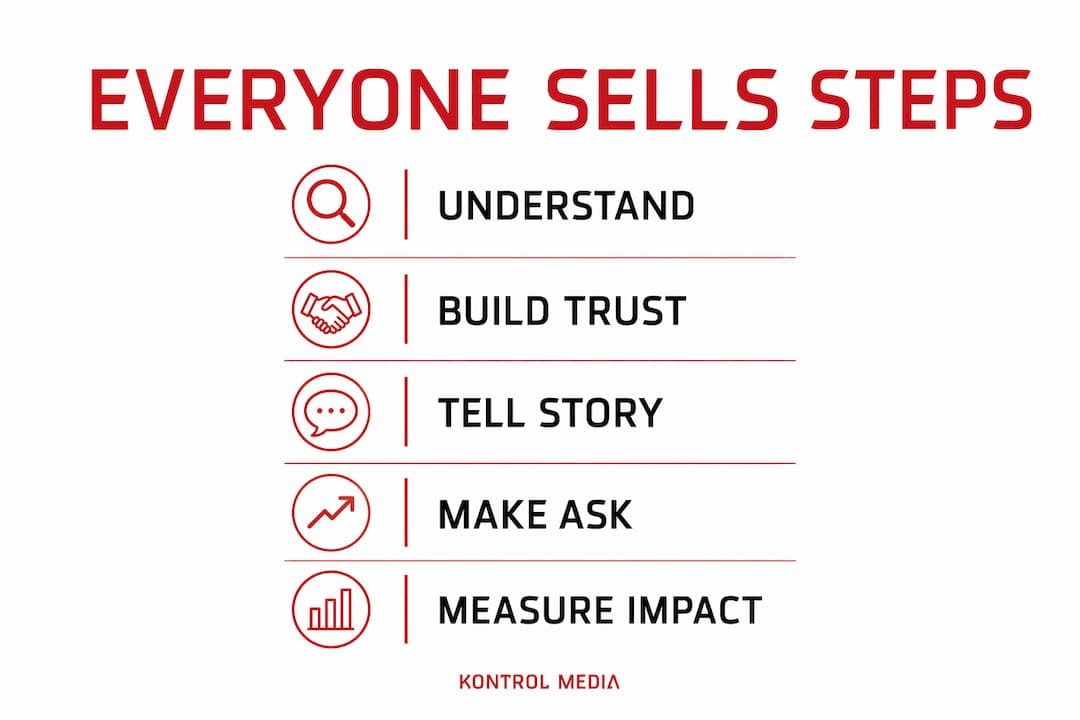
The book organizes influence into a four-part sequence: story arc → empathy → proof → ask. Each stage has a specific job. The story arc establishes context and stakes. The empathy layer signals that you understand the audience’s world before you ask them to enter yours. Proof grounds the narrative in something concrete. The ask, when it finally arrives, feels like a logical conclusion rather than a demand.
Trust signals the book emphasizes include:
- Naming the audience’s problem before naming your solution
- Using specific, observable language rather than abstract claims
- Acknowledging trade-offs honestly instead of overselling
- Mirroring the vocabulary the audience already uses internally
Reusable templates the book provides:
- The 90-second story pitch: situation → complication → resolution → ask
- The one-sentence value statement: “We help [audience] achieve [outcome] by [mechanism]”
- The internal ask format: context + stakes + specific request + success metric
These are not scripts to memorize. They are modular blocks you assemble differently for a budget meeting, a campaign brief, or a cross-functional kickoff.
How marketing teams and non-sales roles apply this day-to-day
The gap between knowing a framework and using it under pressure is where most training fails. Consider a before-and-after for a common marketing scenario.

Before: “We’re recommending a Q3 content push to increase brand awareness and support the sales pipeline.”
After: “Last quarter, the sales team told us prospects arrived at demos already skeptical about our pricing. A targeted content series addressing that objection directly could shorten the sales cycle. We’re asking for six weeks and a modest production budget to run a pilot.”
The second version opens with the audience’s problem (skeptical prospects), grounds the ask in a specific outcome (shorter sales cycle), and names a measurable scope. That is the story-arc framework in a single paragraph.
Pro Tip: Place your empathy signal in the first sentence, not the third. Audiences decide whether to keep listening within the first 10 seconds. If your opening line is about you or your team, you have already lost the room.
The same logic applies to HR professionals requesting headcount, product managers pitching a roadmap shift, or project managers asking for deadline extensions. The framework is role-agnostic.
Running a 60–90 minute internal-sales workshop
The workshop structure Kontrol Media recommends follows a tight pitch-write-feedback loop that produces a usable deliverable before the session ends.
Workshop agenda:
- Minutes 0–10: Framing — Why everyone sells; the stigma problem; what this session will produce
- Minutes 10–25: Teach the story arc — Walk through situation → complication → resolution → ask with two real examples from your industry
- Minutes 25–45: Script writing — Each participant writes a 90-second pitch for a real internal challenge they are currently facing
- Minutes 45–65: Paired delivery and feedback — Partners deliver pitches, listeners note where empathy signals landed and where they did not
- Minutes 65–80: Revision round — Participants rewrite the weakest section of their pitch based on feedback
- Minutes 80–90: Commit — Each participant names one owner, one metric, and one deadline for their pitch
Deliverables participants leave with:
- A written 90-second story pitch for a real, current challenge
- A one-sentence value statement for their role or team
- A personal measurement commit (metric + owner + 30-day deadline)
For governance, shared messaging frameworks and a single source-of-truth story library reduce drift between teams after the workshop ends. This is especially relevant when AI tools are generating content at scale, where prompt standards and a shared knowledge base keep story-driven messaging consistent.
What the approach looks like in practice
Kontrol Media has applied these principles across client engagements where marketing and sales were operating with fundamentally different narratives. In one scenario, a brand’s marketing team was producing content optimized for awareness while the sales team was fielding objections the content never addressed. The fix was not a new campaign. It was a shared story architecture, built in a half-day workshop, that gave both teams the same vocabulary for the customer’s core problem.
The advertising inventory work Kontrol Media does for retail media and commerce media networks follows the same logic: embed the story into the system so the message stays consistent whether a sales rep, a content team, or an automated placement delivers it. Consistency at that level is what makes influence scalable.
A template derived from that kind of engagement: map the customer’s stated objection → write a one-paragraph story that acknowledges it → attach a proof point → close with a specific next step. That four-part block can be dropped into a sales deck, a nurture email, or an internal brief with minimal adaptation.
How to measure impact after applying these methods
Tracking the right signals early keeps the program alive past the first workshop.
Core metrics to track:
- Internal approvals won per quarter (behavioral)
- Speed to decision on cross-functional requests (behavioral)
- Campaign conversion lift on story-led creative vs. control (external)
- Meeting-to-next-step conversion rate for internal pitches (behavioral)
| Metric | Frequency | Owner |
|---|---|---|
| Internal approvals won | Monthly | Team lead |
| Speed to decision | Monthly | Project manager |
| Campaign conversion lift | Per campaign | Marketing analytics |
| Meeting-to-next-step rate | Bi-weekly | Individual contributor |
Timeline for realistic expectations:
- 30 days: Behavioral shifts visible, participants using story arc in meetings, anecdotal feedback from stakeholders
- 90 days: Measurable improvement in internal approval rates and meeting-to-next-step conversion; first campaign data available
- 6–12 months: Sustained conversion lift on story-led campaigns; reduced sales cycle length where marketing and sales share a common narrative
Tie behavioral and external metrics together in a single dashboard so leadership sees both the cultural shift and the revenue signal.
Where to buy Everyone Sells and which edition to get
- Paperback and ebook: Available through major North American retailers including Amazon and Barnes & Noble
- Author and extended resources page: kontrolmedia.com/everyonesellsbook includes applied tactics, AI-aware guidance, and workshop templates
- Bulk orders: Contact Kontrol Media directly for corporate training bundles; bulk pricing is available for teams of 10 or more
- Recommended edition for workshops: The extended resources version on the Kontrol Media site pairs best with the 60–90 minute workshop format, as it includes downloadable templates
Who should read this book?
Everyone Sells delivers the most immediate value to people who influence decisions without a formal sales title. Marketing managers who present campaign strategies to skeptical executives, product leaders who pitch roadmap priorities to finance, HR professionals who sell culture change to a resistant workforce, and project managers who need cross-functional buy-in will all find frameworks they can use within a week of reading.
The book is not for someone looking for closing tactics or negotiation scripts. It is for the person who already knows their idea is good and cannot figure out why it keeps getting deprioritized.
Key Takeaways
Everyone Sells is the most practical guide available for corporate employees and marketing professionals who need to build trust and influence without a sales title or sales training.
| Point | Details |
|---|---|
| Story arc drives influence | Use situation → complication → resolution → ask to structure every internal pitch. |
| Empathy signals come first | Open with the audience’s problem before naming your solution or your team’s need. |
| Workshops produce real deliverables | A 60–90 minute session yields a written pitch, a value statement, and a measurable commit. |
| Measure both behavior and revenue | Track internal approvals and campaign conversion lift together to prove value to leadership. |
| Kontrol Media operationalizes the book | Kontrol Media offers workshops, playbook customization, and measurement support to embed these methods across your organization. |
The gap nobody talks about
The most honest thing about Everyone Sells is what it admits upfront: the stigma around sales is real, and it is doing serious damage inside organizations. Marketing teams spend enormous energy distancing themselves from the word “sales,” even as they write copy designed to persuade, run campaigns designed to convert, and present strategies designed to win budget. That cognitive dissonance is expensive.
What the book gets right is refusing to resolve that tension by rebranding sales as something softer. It does not call it “storytelling” as a euphemism. It says plainly that selling is a human skill, that it is rooted in connection and trust, and that withholding that skill from non-sales roles is a structural failure, not a cultural preference. The leaders I have seen resist this idea the longest are usually the ones whose teams are losing internal budget battles they should be winning. The frameworks in this book are not complicated. The harder part is giving people permission to use them.
Put the Everyone Sells framework to work with Kontrol Media
Reading the book is step one. The teams that see the fastest results are the ones that run a facilitated workshop within 30 days of finishing it, before the ideas fade into good intentions.
Kontrol Media offers three engagement levels built around the book’s frameworks: a standalone workshop for teams ready to run the 60–90 minute session with expert facilitation, a pilot program that includes playbook customization and a 90-day measurement plan, and an enterprise roll-out that embeds story-driven selling across sales, marketing, and business development functions. Clients like Experian and West Monroe have used this approach to align messaging across teams that were previously operating with entirely different narratives. If you are ready to move from reading to results, explore Kontrol Media’s services or reach out directly to discuss the right engagement for your team.
Useful sources and further reading
- Everyone Sells: How Every Role Drives Trust and Revenue — Kontrol Media’s overview of the book’s thesis and applications
- Extended book resources and AI-aware tactics — Workshop templates, applied guidance, and purchase information
- Building a High-Performing Sales Team — Kontrol Media’s operational playbook for internal seller alignment
- The Human Algorithm: Why Influence Is the New Strategic Asset — BriefGlance coverage of the book’s core argument on trust and automation
- The Marketing-Sales Alignment Problem Is a Data Problem — VEN Studio on shared metrics and governance
- David Nour on executive influence and relationship mapping — Partner resource for leadership-focused workshop design
Recommended
- Everyone Sells: How Every Role Drives Trust and Revenue | Kontrol Media Consultancy
- Everyone Sells (Including Ai): How to Influence Anyone, Anywhere, Anytime | Kontrol Media Consultancy
- The Art of Building Strong Business Relationships: A Guide to Networking | Kontrol Media Consultancy
- Building a High-Performing Sales Team: Strategies and Best Practices | Kontrol Media Consultancy