


HuffPost.com is one of the most visited news and lifestyle destinations in the United States, drawing over 39 million unique visitors every month, including a disproportionately high share of affluent, purchase-ready consumers. That scale is not just impressive. It is a direct opportunity for brands that want to reach high-net-worth individuals in a context where they are already engaged, curious, and leaning into content they trust. Kontrol Media has worked directly with HuffPost as a client and understands how its audience, content architecture, and ad technology come together to create real campaign results. This guide breaks down exactly how marketing professionals and brand managers can put that audience to work.
What is the audience profile of HuffPost.com?
HuffPost.com attracts a monthly audience that most premium publishers would envy. The site pulls 39 million-plus unique visitors each month, and the demographic composition skews toward educated, higher-income readers who are active buyers across luxury goods, travel, technology, and lifestyle categories. That is the kind of reader who does not just browse. They research, compare, and purchase.
The audience’s passion for the products and services they use is a defining characteristic. HuffPost readers engage deeply with HuffPost lifestyle section content, HuffPost opinion pieces, and HuffPost celebrity news, which means they arrive with strong category interest already formed. A reader in the Wellness vertical is not casually scrolling. They are actively building a point of view on health products, fitness services, and personal care brands.
High-net-worth consumers on HuffPost also show strong cross-category behavior. A reader who follows HuffPost latest trends in fashion may also engage with financial services content, home improvement features, and travel editorial. That behavioral breadth gives advertisers multiple contextual entry points to reach the same valuable individual across a single visit.
From a planning standpoint, this audience profile creates a compelling case for brands in categories like:
- Luxury goods and accessories seeking aspirational context
- Financial services and wealth management targeting income-qualified readers
- Premium travel and hospitality reaching frequent, high-spend travelers
- Consumer technology engaging early adopters with purchasing authority
- Health, wellness, and personal care connecting with lifestyle-driven buyers
The combination of scale and income profile is rare. Most publishers offer one or the other. HuffPost delivers both.
How do brands advertise on HuffPost.com?
Brands across a wide range of industries run active campaigns on HuffPost.com, using display, video, and sponsored content formats to reach its affluent readership. The ad inventory spans standard IAB display units, high-impact takeovers, pre-roll and mid-roll video, and native sponsored articles that sit within editorial flows. Each format serves a different campaign objective, from awareness to direct response.

The categories most active on HuffPost reflect the site’s audience composition. Luxury automotive brands run awareness campaigns timed to model launches. Financial services firms place display and video ads within Politics and Business sections, where financially engaged readers concentrate. Consumer electronics brands activate around seasonal editorial features like Back to School and the annual Buyers Guide, where purchase intent is at its peak. Fashion and beauty labels align with the HuffPost lifestyle section, where style-forward readers spend significant time.
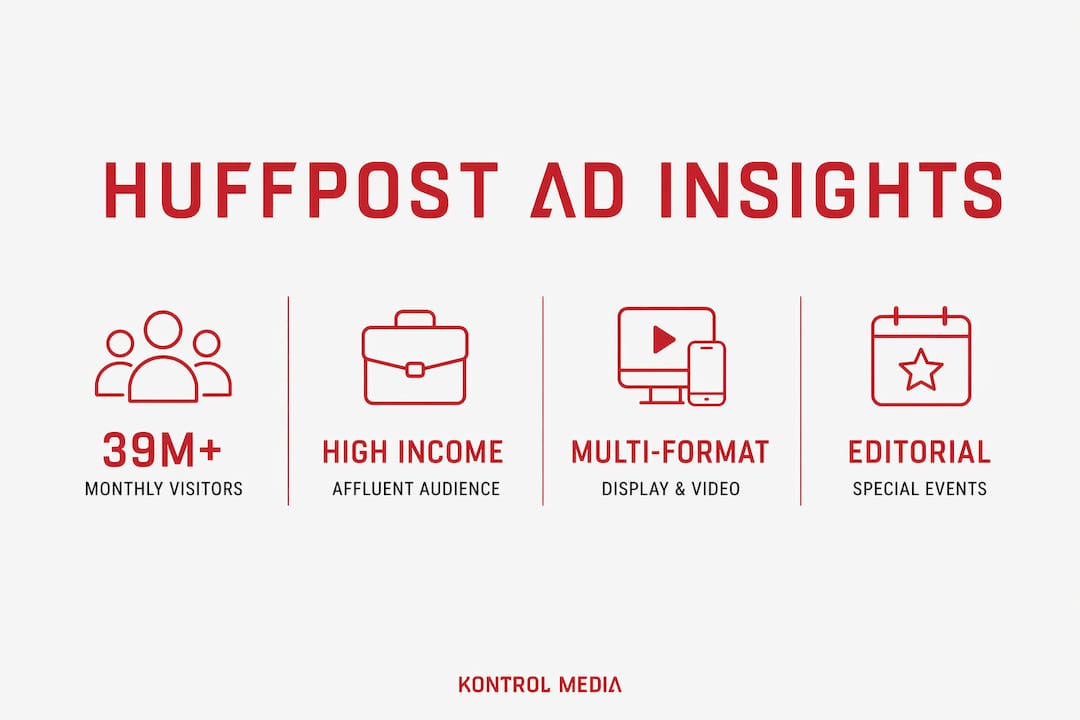
Special editorial events are among the most underused opportunities on the platform. HuffPost builds dedicated content hubs around moments like the FIFA World Cup, Back to School, and seasonal Buyers Guides. These hubs concentrate highly motivated readers in one place, and brands that sponsor or advertise within them benefit from the editorial credibility of the surrounding content.
Pro Tip: Time your HuffPost campaign launches to coincide with special editorial events. A luxury travel brand running ads inside a FIFA World Cup hub reaches sports-passionate, high-income readers at a moment of peak cultural engagement, which is a combination that generic run-of-site placements rarely replicate.
Sponsored content is particularly effective for brands that need to explain a product or service rather than simply display it. HuffPost news articles and opinion pieces set a high editorial standard, and sponsored content that matches that tone performs measurably better than content that reads like a press release.
How can marketers use HuffPost’s content verticals for targeting?
HuffPost organizes its editorial output into distinct content verticals that function as natural targeting frames for advertisers. Each vertical attracts a specific reader mindset, and aligning your creative to that mindset is the difference between an ad that feels relevant and one that feels intrusive.
| Content Vertical | Primary Audience Intent | Best-Fit Brand Categories |
|---|---|---|
| Politics | Civic engagement, current events | Financial services, advocacy, media |
| Entertainment | Pop culture, celebrity news | Consumer goods, streaming, fashion |
| Lifestyle | Wellness, home, relationships | Health brands, home goods, travel |
| HuffPost Personal | Identity, lived experience | Nonprofits, wellness, education |
| Business | Career, economy, finance | B2B services, fintech, professional tools |
| Technology | Product news, digital trends | Consumer tech, software, telecom |
The practical implication is straightforward. A wealth management firm placing ads in the Business vertical reaches readers who are already thinking about money, careers, and financial decisions. That same ad in the Entertainment vertical would land in a completely different mental state. Context is not a soft consideration. It is a measurable performance variable.
Seasonal content features amplify this targeting logic. The Back to School hub draws parents with purchasing authority and a defined shopping timeline. The Buyers Guide concentrates readers who are actively evaluating products and ready to make decisions. The FIFA World Cup hub brings together sports fans, travel planners, and entertainment seekers in a single high-engagement environment. Brands that plan creative specifically for these moments, rather than repurposing generic assets, consistently see stronger engagement.
Campaigns targeting affluent HuffPost audiences perform best when matched precisely to editorial section themes and seasonal content features. The editorial context is not just background. It is an active signal of reader intent that your creative should answer directly.
What ad technologies enable high-net-worth targeting on HuffPost.com?
Effective targeting on HuffPost.com depends on understanding both the tools available and the constraints that shape them. HuffPost’s privacy policy describes cookie-matching and personalized advertising as the mechanism that funds free content, but it also grants users opt-out rights under California law. That opt-out reality means a portion of your target audience will not be reachable through third-party cookie-based personalization.
This is not a reason to avoid the platform. It is a reason to plan smarter. Advertisers should build KPI models that account for two distinct audience segments: opted-in users where full personalization applies, and opted-out users where contextual targeting carries the full weight. Understanding privacy segmentation and measurement challenges is now a baseline competency for any brand running campaigns on premium publishers.
On the technology side, HuffPost UK has adopted Taboola’s DeeperDive AI answer engine, an AI-driven Q&A tool that presents ads aligned with the specific questions users ask on-site. That shift matters because it moves ad placement from broad contextual matching to intent-level matching. A reader asking “what is the best carry-on luggage for business travel” is signaling purchase intent with precision that a page-level contextual tag cannot capture.
Advertising effectiveness improves when creative messaging aligns with the exact questions users ask in on-site AI discovery tools, rather than generic awareness ads. That means your creative strategy needs to anticipate natural language question variations, not just broad category themes. This demands more agile creative production but delivers meaningfully better engagement.
Multi-platform coordination is the third major lever. Advertising revenues from HuffPost campaigns can be extended across third-party platforms including YouTube and Apple News, creating consistent frequency and message reinforcement with the same high-value audience. Coordinated campaigns increase purchase consideration lift among premium consumers. A reader who sees your brand in a HuffPost Lifestyle article and then encounters the same campaign on YouTube is far more likely to convert than a reader who sees a single isolated impression.
Here is a practical framework for structuring a multi-platform HuffPost campaign:
- Anchor on HuffPost.com with contextually aligned display or sponsored content in the most relevant vertical for your category.
- Activate special editorial features such as Back to School, Buyers Guide, or FIFA World Cup to capture peak-intent audiences.
- Extend reach to YouTube and Apple News using consistent creative to build frequency with the same audience segment.
- Segment measurement by consent state, tracking opted-in users with full attribution models and opted-out users with contextual performance proxies.
- Test AI-aligned creative that anticipates the specific questions your target audience asks within on-site discovery tools.
Pro Tip: When planning multi-platform ad campaigns, treat HuffPost.com as the contextual anchor and third-party platforms as frequency builders. The editorial credibility of HuffPost primes the audience. The extended platforms close the gap to conversion.
HuffPost also plans expansion into free-streaming video, audio, and user-generated content channels, which will broaden the available ad inventory and campaign formats considerably. Brands that build HuffPost into their media mix now will be positioned to scale into those emerging formats as they come online.
Understanding commerce media versus traditional programmatic approaches is also worth your time as HuffPost’s inventory evolves. The distinction between intent-driven commerce placements and broad awareness buys will become more pronounced as AI-driven tools like DeeperDive mature.
Key Takeaways
Advertising on HuffPost.com delivers access to a high-net-worth audience at scale, but campaign performance depends on contextual alignment, privacy-aware measurement, and coordinated multi-platform execution.
| Point | Details |
|---|---|
| Audience scale and quality | HuffPost.com draws 39 million-plus unique monthly visitors with a strong high-net-worth demographic. |
| Vertical targeting precision | Aligning ads to specific content verticals like Lifestyle or Business improves relevance and reader response. |
| Special editorial features | Hubs like Back to School and Buyers Guide concentrate purchase-intent audiences at defined moments. |
| Privacy-aware measurement | Build KPI models that account for opted-in and opted-out audience segments separately. |
| Multi-platform coordination | Extending campaigns to YouTube and Apple News builds frequency and lifts purchase consideration. |
What I’ve learned from working inside HuffPost’s ad ecosystem
I have spent enough time working with HuffPost as a client at Kontrol Media to know that the biggest mistake brands make on this platform is treating it like a generic programmatic buy. They upload a standard creative set, select broad run-of-site targeting, and then wonder why the results feel flat. The audience is there. The intent signals are there. The editorial context is doing its job. The creative is just not meeting the moment.
The brands that win on HuffPost are the ones that do the work upstream. They study which verticals their best customers actually read. They plan creative that speaks to the specific mindset of a reader in that vertical, not a generic awareness message. And they time their campaigns to the editorial calendar, treating Back to School or the Buyers Guide the way a smart retailer treats a seasonal window display.
The privacy dimension is the part I find most underappreciated. Marketers hear “opt-out” and assume it means lost reach. What it actually means is that your measurement model needs to be more sophisticated. You need to know what a successful campaign looks like for a fully attributed user and what it looks like for a contextually targeted user, and you need to hold both to appropriate standards. Brands that collapse those two groups into a single KPI are making decisions on incomplete data.
The AI-driven tools coming into the HuffPost ecosystem, like Taboola’s DeeperDive, represent a genuine shift in how intent gets surfaced. The brands that will benefit most are the ones already thinking about generative AI in advertising and building creative processes agile enough to respond to natural language question patterns. That is not a future consideration. It is a present one.
HuffPost’s audience is genuinely exceptional. Treating it with the strategic seriousness it deserves is how you get results that justify the investment.
— Mark Kapczynski
How Kontrol Media helps brands reach HuffPost’s audience
Kontrol Media has worked directly with HuffPost and brings firsthand knowledge of how its ad ecosystem, audience segments, and editorial features translate into campaign results for brands targeting affluent consumers.
Whether you are planning a first campaign on HuffPost.com or looking to improve the performance of an existing one, Kontrol Media provides the campaign planning, audience targeting strategy, and multi-platform execution that premium advertisers need. From aligning creative to content verticals to building privacy-aware measurement frameworks, the work is hands-on and results-focused. For brands ready to put HuffPost’s high-net-worth audience to work, Kontrol Media’s consulting services provide the strategic foundation and execution support to make it happen.
FAQ
What is HuffPost.com’s monthly audience size?
HuffPost.com attracts over 39 million unique visitors per month, with a significant share of high-net-worth, purchase-active consumers across news, lifestyle, and entertainment content.
Which ad formats are available on HuffPost.com?
HuffPost supports display, video, and sponsored content formats, including high-impact takeovers and native articles that integrate within editorial flows for contextual relevance.
How does HuffPost’s privacy policy affect ad targeting?
HuffPost uses third-party cookie-matching for personalized advertising, but California opt-out rights mean a portion of the audience is only reachable through contextual targeting. Advertisers should segment their measurement accordingly.
What are HuffPost’s special editorial advertising opportunities?
HuffPost builds dedicated content hubs around events like the FIFA World Cup, Back to School, and seasonal Buyers Guides, concentrating high-intent audiences that brands can reach with contextually aligned campaigns.
How does Taboola’s DeeperDive tool affect HuffPost advertising?
HuffPost UK has adopted Taboola’s DeeperDive AI answer engine, which serves ads aligned with the specific questions users ask on-site, shifting placement from broad contextual matching to precise intent-level targeting.
Recommended
- Advertising on Huffpost.com: A Brand Safety Guide | Kontrol Media Consultancy
- Consumer Brand Media Network Best Practices in 2026 | Kontrol Media Consultancy
- 5 Things Brands Should Prioritize in 2025 | Kontrol Media Consultancy
- Integrating Social Media into Your Advertising Strategy for Maximum Impact | Kontrol Media Consultancy