


Most marketing professionals know branding and messaging matter. Far fewer can articulate where one ends and the other begins, and that confusion is expensive. Weak branding and messaging creates disconnected campaigns, confused customers, and marketing spend that simply doesn’t stick. This article cuts through the fog. You’ll find a clear framework for understanding how brand strategy, brand identity development, and effective messaging work together, along with practical steps to audit what you have, fix what’s broken, and build something that actually moves the needle for your business.
Table of Contents
- Key takeaways
- What branding and messaging really mean
- The components of effective brand messaging
- Integrating brand strategy with marketing execution
- Common pitfalls in branding and messaging
- A practical framework for improving your messaging
- My take on what actually moves the needle
- How Kontrol Media can sharpen your brand strategy
- FAQ
Key takeaways
| Point | Details |
|---|---|
| Brand strategy precedes everything | Define your identity and core pillars before designing visuals or launching campaigns. |
| Messaging needs architecture | A structured framework with proof points and tone guidelines prevents fragmentation across channels. |
| Word choice shapes persuasion | Using reversible, specific language measurably increases message acceptance among skeptical audiences. |
| Consistency builds brand equity | Repeated, coherent experiences across all touchpoints drive long-term recognition and trust. |
| Measure and iterate | Track messaging performance with clear metrics and adjust based on what the data tells you. |
What branding and messaging really mean
Here’s a distinction worth writing down. Brand strategy, design strategy, and marketing strategy are three separate disciplines, each with a distinct function. Conflating them is one of the most common and most costly mistakes in marketing.
Brand strategy defines who you are internally. It answers the foundational questions: What do you stand for? Who do you serve? What makes you different? It is the spine of everything that follows. Design strategy then translates that essence into visual and experiential form, through logos, color systems, typography, and UX. Marketing strategy amplifies the brand externally, deciding which channels, audiences, and tactics will carry your message into the market.
Messaging sits at the intersection of brand strategy and marketing strategy. It is the verbal expression of your brand, shaped by your values and positioning, and delivered through your marketing efforts. Think of it this way:
Brand strategy answers who you are.
Brand messaging answers what you say and how you say it.
Marketing strategy answers where and when you say it.
A common misconception worth addressing: many teams treat their logo or visual system as their brand. That’s understandable, because visuals are tangible. But visual identity without brand strategy leads to disconnected messaging and genuine market confusion as companies grow. The logo is the face. Strategy is the mind behind it.
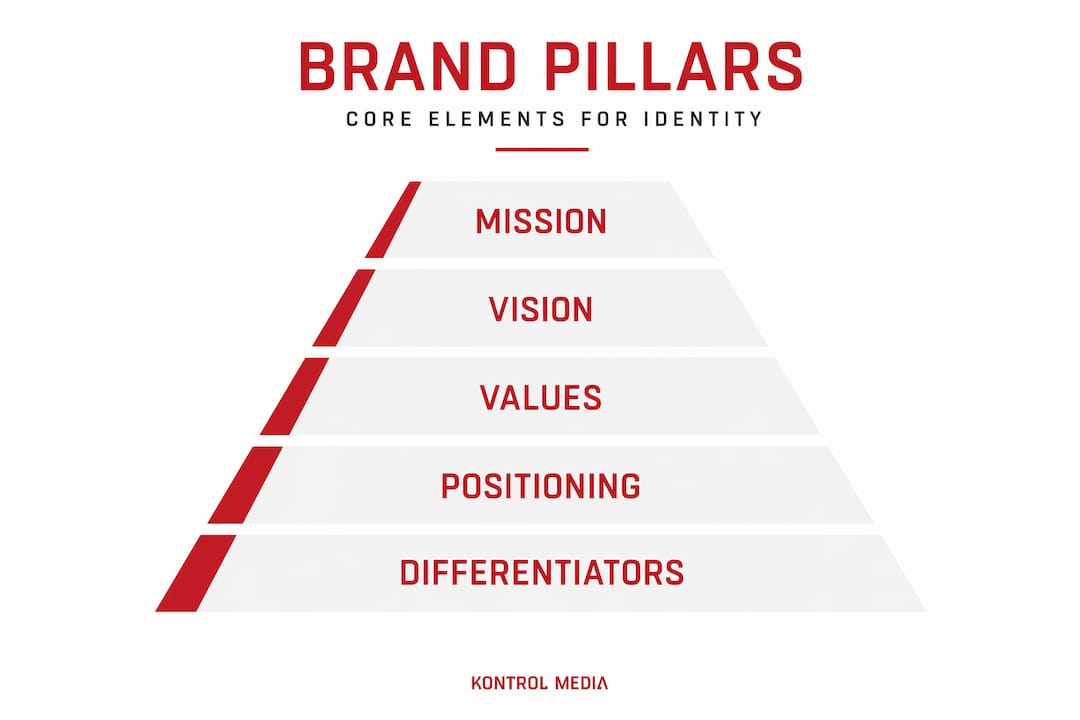
Brand identity development, when done correctly, produces a set of core brand pillars. These typically include your mission, vision, values, positioning statement, and key differentiators. Those pillars then feed directly into your messaging architecture, giving every piece of communication a shared foundation regardless of format or channel.
The components of effective brand messaging
Effective brand messaging is built from six core components: mission, vision, values, positioning statement, differentiators, and a consistent value proposition. Each one serves a specific function in the messaging architecture, and skipping any of them leaves a gap that audiences will feel even if they can’t name it.
Your positioning statement does the heavy lifting. It defines who you serve, what you offer, and why you’re the right choice. It is not a tagline. It’s an internal compass that keeps every external message oriented in the same direction. Your differentiators are what make that positioning credible. Your value proposition translates both into plain language that speaks directly to what your audience actually cares about.
Message structure matters just as much as content. Concise, value-driven messaging consistently outperforms longer creative copy by increasing click-through rates and reducing drop-offs. Each message should carry one clear idea and one primary call to action. When longer formats are necessary, optimize for scanning with clear hierarchy and visual anchors so readers can find the point without working for it.

One of the most underused tools in messaging is word choice at the linguistic level. Research on reversible words in messaging shows that using language with a clear opposite (“intense” vs. “mild”) reduces confidence in skeptics and increases certainty in supporters, which means your message actually moves people rather than leaving them neutral. Simple negations like “not prominent” don’t produce the same effect. This is a small, precise adjustment that measurably improves persuasiveness.
Pro Tip: Before finalizing any campaign message, run it through this test: Can someone identify your brand, your promise, and your audience from the copy alone, with no logo visible? If the answer is no, the message isn’t doing enough.
Incorporating your audience’s own language is another lever most teams underutilize. Message design that prioritizes the audience clarifies purpose and core idea before a single word is written. Most communication fails not because the message was poorly crafted but because it was never designed with the audience’s actual frame of reference in mind.
Integrating brand strategy with marketing execution
Getting branding and messaging to work together inside a live marketing operation requires a specific sequence. Here’s how the integration should flow:
Establish your brand strategy first. Lock in your positioning, pillars, and core narrative before anything touches a channel. This isn’t a one-time exercise. Revisit it annually or when the business changes significantly.
Build a messaging framework. A messaging framework system aligns your core brand pillars, proof points, tone guidelines, and delivery channels into one document your entire marketing team can reference. This framework is what prevents fragmentation.
Map messages to the customer journey. Different audience segments and different stages of the buyer journey need different message depths. Awareness content should orient. Consideration content should differentiate. Decision content should validate. When you assign messaging by stage and segment, campaigns become coherent rather than random.
Brief your channels from the framework, not from scratch. Whether you’re running paid social, email, or content marketing, every channel brief should pull from the same messaging architecture. This is how you maintain the importance of brand consistency across wildly different formats and contexts.
Audit and align quarterly. Markets shift. Audiences evolve. A quarterly review of your messaging against actual campaign performance keeps your brand strategy connected to reality, not just aspiration.
The practical benefit of this sequence is that it reduces the creative friction that kills consistency. When a copywriter, a media buyer, and a product marketer all work from the same framework, you get coherence without micromanagement. That coherence compounds over time into brand recognition and audience trust, both of which directly support business growth.
Common pitfalls in branding and messaging
The failures in branding and messaging tend to cluster around a handful of predictable mistakes. Knowing them in advance is half the defense.
Mistaking visual identity for brand strategy is the most pervasive. Teams invest in a rebrand, get a new logo and a fresh color palette, and announce they’ve repositioned. They haven’t. Brand equity is built through consistent experiences across all interactions, not through visual assets alone. The design is an output of strategy, not a substitute for it.
Skipping message design is a close second. Most teams jump directly into copy without first answering who the message is for, what behavior or belief they want to change, and what single idea needs to land. That shortcut produces copy that sounds fine but doesn’t convert.
Inconsistent messaging across channels is often a structural problem, not a creative one. When there’s no central framework, different teams build their own interpretations of the brand. Sales uses one set of language. Marketing uses another. The website says something slightly different. Audiences notice even when they can’t articulate why they don’t trust the brand.
Failing to measure messaging effectiveness is also common, and it’s fixable. If you can’t tell which messages drive engagement and which ones fall flat, you’re managing by instinct rather than evidence. Build measurement into your messaging rollout from day one.
Pro Tip: Treat your messaging framework as a living document. Schedule a review every quarter, assign an owner, and track which proof points are generating the most traction across channels. What you measure, you can improve.
A sustainable brand messaging system requires governance. Someone needs to own it, update it, and ensure it’s actually being used. Without that ownership, even a well-built framework becomes shelf-ware.
A practical framework for improving your messaging
Improving your branding and messaging doesn’t require a full rebrand. It requires discipline and sequence. Here’s a framework you can apply now:
Audit your current state. Pull your last six months of marketing assets across every channel and read them together. Ask whether a consistent identity and promise emerges. The gaps you find are your starting priorities.
Define your core brand pillars. If you don’t have them documented, interview your leadership team, your top customers, and your best salespeople. The themes that emerge consistently become your pillars.
Write your positioning statement. One sentence. Who you serve, what you provide, and why you’re different. Test it with someone outside your organization. If they can’t repeat it back accurately, simplify it.
Build your messaging architecture. Layer in proof points, tone guidelines, and audience-specific variations. Effective messaging frameworks typically use three to five core brand pillars for structural focus. Don’t exceed that or the architecture collapses under its own weight.
Deploy and measure. Implement the framework across all touchpoints. Set clear performance benchmarks before launch. Track click-through rates, conversion rates, and qualitative audience feedback in parallel.
| Messaging element | Primary function | Key question to answer |
|---|---|---|
| Positioning statement | Sets direction for all messaging | Who do we serve, and why us? |
| Core brand pillars | Provide structural consistency | What themes anchor our identity? |
| Proof points | Build credibility | What evidence supports our claims? |
| Tone guidelines | Maintain voice consistency | How do we sound across formats? |
| Value proposition | Connects brand to audience need | Why should the audience care? |
Understanding how to enhance brand messaging isn’t a one-time project. It’s an ongoing practice that gets sharper every cycle.
My take on what actually moves the needle
I’ve seen companies invest six figures in brand design before they could answer the question of who their brand is actually for. The result is almost always the same: beautiful assets that don’t connect, campaigns that generate impressions without conviction, and a team that quietly goes back to winging it because nothing feels grounded.
What I’ve learned across years of working in this space is that brand strategy isn’t the slow, philosophical exercise people assume it is. When it’s done right, it accelerates everything downstream. Your designers make better decisions faster. Your sales team stops inventing their own pitches. Your marketing campaigns carry a consistency that audiences recognize and respond to.
The brands that get this right treat their messaging framework the way a good engineer treats a system architecture. They design it with precision, stress-test it against real audience scenarios, and update it when the inputs change. They don’t treat it as a document they file after a workshop. They treat it as the operating system their entire go-to-market runs on.
The uncomfortable truth is that most messaging problems are actually strategy problems wearing a creative costume. If your campaigns feel scattered, the fix probably isn’t better copy. It’s a clearer foundation. Invest the time there, and the creative output takes care of itself.
— Mark Kapczynski
How Kontrol Media can sharpen your brand strategy
At Kontrol Media, we work directly in the space where brand strategy meets real-world marketing execution. We’ve helped organizations from mid-market companies to large enterprises close the gap between what their brand stands for and what their marketing actually communicates.
If your messaging feels inconsistent, your campaigns aren’t converting the way they should, or you’re about to enter a new market and need a sharper positioning, we build and execute the frameworks that fix those problems. Our work spans marketing strategy and execution through to measuring campaign ROI so you can see exactly what’s working and where to push harder. Reach out to Kontrol Media and let’s figure out what your brand is actually saying, and make sure it’s saying the right thing.
FAQ
What is the difference between branding and messaging?
Branding defines who your company is at the identity level, including values, positioning, and personality. Messaging is the verbal expression of that identity, translated into the specific words and narratives used across marketing channels.
How many core pillars should a brand messaging framework have?
Research shows that effective messaging frameworks typically use three to five core brand pillars. Fewer than three risks oversimplification, while more than five tends to dilute focus and make consistent application harder.
Why does brand consistency matter for marketing performance?
Brand equity builds through consistency across every touchpoint, not just through visual assets. Inconsistent messaging creates audience confusion and erodes the trust that drives long-term customer acquisition.
What makes brand messaging more persuasive?
Word choice plays a measurable role. Using reversible language with clear opposites (like “intense” rather than “not mild”) increases conviction among supporters and softens resistance among skeptics more effectively than simple negations.
When should a company update its brand messaging framework?
Review your framework at least quarterly and revisit the underlying brand strategy whenever the business changes significantly, such as entering a new market, launching a new product line, or shifting your core audience segment.